
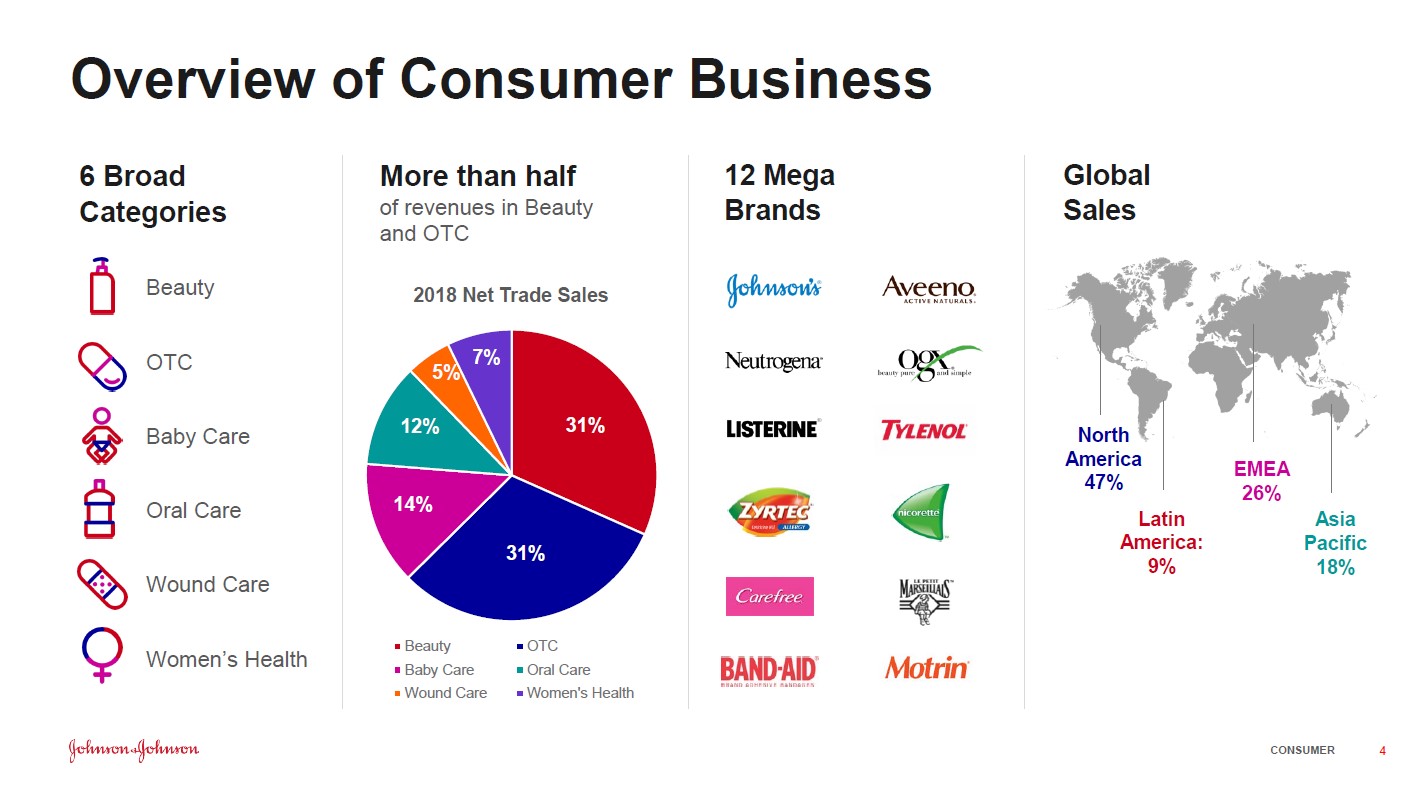
Image Source: Johnson & Johnson – February 2019 CAGNY IR Presentation
By Callum Turcan
A holding in both our Dividend Growth Newsletter and Best Ideas Newsletter portfolios, shares of Johnson & Johnson (JNJ) have been on a wild ride of late over dueling narratives regarding the firm’s potential legal liabilities. In particular, liabilities concerning its talc-based Johnson Baby Powder product. On October 18, Johnson & Johnson announced it was voluntarily recalling “a single lot” of its Johnson Baby Powder product (equal to around 33,000 bottles) after the US FDA found sub-traces of chrysotile asbestos in a single bottle (less than 0.00002%). At the time, Johnson & Johnson vigorously defended its baby care brand and said that its Johnson Baby Powder product line was completely safe. Shares of JNJ yield 2.9% as of this writing.
Fighting Back
On October 29, Johnson & Johnson came out swinging noting that after numerous tests were conducted at two third-party laboratories, those third-party tests did not detect any asbestos in the bottle flagged by the FDA. Furthermore, tests done on other bottles in the voluntarily recalled lot did not detect any asbestos. Shares of JNJ are up well over 3% after-hours on October 29 on the news, but we caution trading activity will continue to be volatile going forward. Here’s what the company had to say in its press release:
“Johnson & Johnson Consumer Inc. (the Company) today announced that 15 new tests from the same bottle of Johnson’s Baby Powder previously tested by the U.S. Food and Drug Administration (FDA) found no asbestos. An additional 48 new laboratory tests of samples from the single lot of Johnson’s Baby Powder that the Company voluntarily recalled on October 18 (Lot #22318RB) also confirm that the product does not contain asbestos. These tests were conducted by two third-party laboratories as part of the Company’s ongoing testing and investigation.”
Additionally:
“The Company has a rigorous testing standard in place to ensure its cosmetic talc is safe. Thousands of tests over the past 40 years, including FDA’s own testing as recently as last month, repeatedly confirm that Johnson’s Baby Powder does not contain asbestos. Our talc comes from ore sources confirmed to meet our stringent specifications that exceed industry standards. The Company and its suppliers routinely test to ensure our talc does not contain asbestos. Our talc has also been tested and confirmed to be asbestos-free by a range of independent laboratories, universities and global health authorities.”
Concluding Thoughts
Major retailers including Wal-Mart Inc (WMT), Rite Aid Corporation (RAD), and CVS Health Corporation (CVS) pulled Johnson Baby Powder products from their shelves after the announcement by the FDA. Johnson & Johnson is hoping that by fighting back it can preserve its brand power, revenues, and position on retailer’s shelves once it’s all said and done. We will continue to monitor this situation going forward and would like to note that Johnson & Johnson, potential legal liabilities aside, raised its full-year guidance for 2019 multiple times this year highlighting the underlying demand for its vast array of healthcare-related offerings (more on that here). That supports a nice free cash flow growth trajectory.
We assign shares of J&J a fair value estimate of $151 and continue to like the firm as a holding in both our Dividend Growth Newsletter and Best Ideas Newsletter portfolios. For more information on this unfolding issue and why we think Johnson & Johnson can push through the controversies, check out this article here—–>>>>>
Household Products Industry – CHD, CL, CLX, ENR, HELE, JNJ, KMB, PG
Related: TEVA, MNK, ENDP, CAH, MCK, ABC, WMT, RAD, CVS
—–
Valuentum members have access to our 16-page stock reports, Valuentum Buying Index ratings, Dividend Cushion ratios, fair value estimates and ranges, dividend reports and more. Not a member? Subscribe today. The first 14 days are free.
Callum Turcan does not own shares in any of the securities mentioned above. Johnson & Johnson (JNJ) is included in Valuentum’s simulated Dividend Growth Newsletter and Best Ideas Newsletter portfolios. Some of the other companies written about in this article may be included in Valuentum’s simulated newsletter portfolios. Contact Valuentum for more information about its editorial policies.