
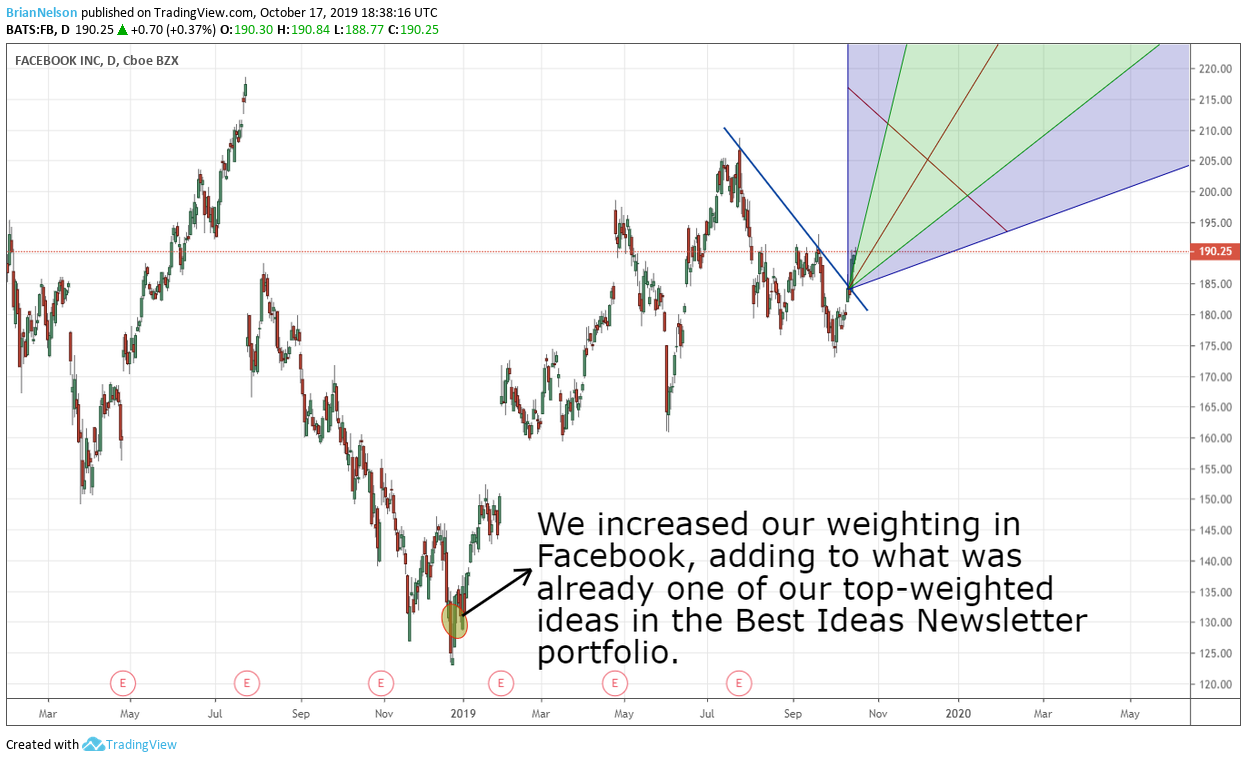
Image Shown: Facebook has room to run higher, with or without Libra.
While several large financial technology and payment processing firms have recently made it clear they no longer want to be a part of the nascent Libra Association, that didn’t stop roughly two dozen members from signing the group’s charter in Geneva, Switzerland, on October 15. We really must stress that our discounted free cash flow models for Facebook don’t take in account the upside its proposed asset-back cryptocurrency Libra might generate. This opportunity represents pure upside to our forecasts, and we continue to like Facebook as a top holding in our Best Ideas Newsletter portfolio.
By Callum Turcan
Regulatory and political fears have apparently scared off several companies that initially expressed interest in joining the nascent cryptocurrency venture known as the Libra Association, founded by Facebook Inc (FB). So far, Visa Inc (V), Mastercard Inc (MA), PayPal Holdings Inc (PYPL), eBay Inc (EBAY) and a few others have decided not to become members of the Libra Association according to the Wall Street Journal (at least at this time). However, that didn’t stop roughly two dozen companies from signing on and becoming charter members of the Libra Association on October 15 in Geneva, Switzerland, a group that now includes Facebook, various venture capital firms, Vodaphone Group Plc (VOD), Lyft Inc (LYFT), Uber Technologies Inc (UBER), Shopify Inc (SHOP), and more.
Libra
The idea behind Libra is that Facebook and its partners could create an asset-backed cryptocurrency, with each member of the Libra Association chipping in a relatively “modest” amount ($10 million or so has been reported as the potential contribution) to provide asset backing from Day 1 of the cryptocurrency’s targeted launch in 2020. Having a cryptocurrency supported by a basket of major currencies would ensure that Libra, utilizing permissioned blockchain technology (allows for the cryptocurrency to become widely used without needing to build up the network effect first), maintains tangible value in terms of commonly used global currencies. Known as the Libra Reserve, the interest earned on this reserve will be used to help cover the costs of the venture.
Facebook’s Libra Association aims to do several things. That includes substantially lowering transaction costs, particularly in emerging and developing markets (where money transfers, cross-border transactions, even accessing ATMs can be relatively expensive), in order to increase the world’s access to banking infrastructure. The unbanked portion of the global populace is estimated at 1.7 billion, according to the Libra Association, but a large portion of this group has mobile phones and access to the internet. By making financial transactions (sending money, receiving money, sending money across borders which would be made easier by the group radically simplifying the foreign exchange side of things) cheaper, that should in theory help bring in the unbanked populace. Additionally, the Libra Association aims to reduce transaction times, which can be especially useful when lines of credit aren’t readily available. More broadly, there’s a lot of opportunity for the unbanked and those with limited access to global financial infrastructure to get access to cheaper loans and other forms of credit.
So far, Facebook has met stiff resistance against its proposed asset-backed cryptocurrency from Capitol Hill to the Palais Bourbon. Both American and European regulators, legislators, and other political actors have come out swinging against Facebook’s proposed Libra offering. Whether the asset-backed cryptocurrency will be able to win over global regulators remains a concern, but that’s to be expected in the heavily regulated world of finance and banking. In the post-Great Financial Crisis era, new entrants (especially ones as large as Facebook) in the realm of payment processing are likely to receive extra scrutiny. Additionally, it’s likely the blowback Facebook is facing is at least in part influenced by anything from animosity over the social media giant’s rules governing political ads in the US to frustrations over the tax regime the firm operates in (particularly in Europe), things that go far beyond Libra.
Concluding Thoughts
We want to stress that our models don’t include any upside relating to Facebook’s Libra project. Furthermore, the costs associated with this venture are negligible for a company of Facebook’s size. We like Facebook as one of the top holdings in our Best Ideas Newsletter portfolio with or without Libra, and we continue to see shares of FB as trading at a nice discount to their intrinsic value. Our fair value estimate for Facebook stands at $234 per share, while FB is trading near $190 per share as of this writing.
Internet Content & Services Industry – GOOG GOOGL BIDU FB JD TECHY TWTR
Related: BKNG
—–
Valuentum members have access to our 16-page stock reports, Valuentum Buying Index ratings, Dividend Cushion ratios, fair value estimates and ranges, dividend reports and more. Not a member? Subscribe today. The first 14 days are free.
Callum Turcan owns shares of Visa Inc (V) and Facebook Inc (FB). Shares of Alphabet Inc (GOOG) (GOOGL) Class C, Facebook Inc, and PayPal Holdings Inc (PYPL) are all included in Valuentum’s simulated Best Ideas Newsletter portfolio. Some of the other companies written about in this article may be included in Valuentum’s simulated newsletter portfolios. Contact Valuentum for more information about its editorial policies.