
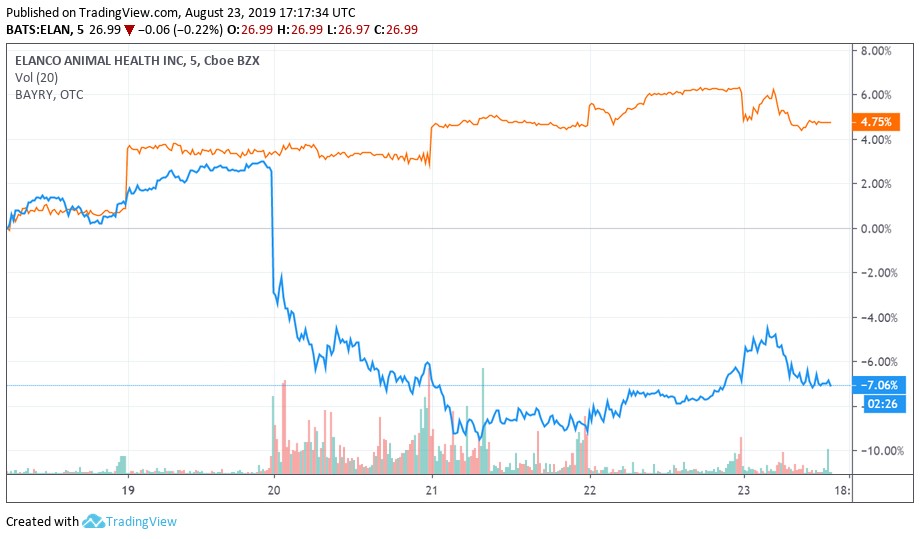
Image Shown: Shares of Elanco Animal Health Inc (ELAN) sold off after the company announced on August 20 it was acquiring Bayer AG’s (BAYRY) animal health unit through a cash and deal stock deal worth $7.6 billion at the time the deal was announced.
By Callum Turcan
On August 20, Elanco Animal Health Inc (ELAN) agreed to acquire Bayer AG’s (BAYRY) animal health unit for $7.6 billion (at the time the deal was announced) through a cash and stock deal. That includes $5.3 billion in cash and $2.3 billion in stock, keeping in mind shares of ELAN initially shifted lower after the news. Bayer plans to exit its stake in Elanco over time as management seeks to rebuild the company’s business around its pharmaceutical, crop science, and consumer health segments. This is also likely a defensive maneuver by Bayer to raise cash in the face of mounting lawsuits over Roundup, liabilities the firm took on after acquiring Monsanto through a ~$63 billion deal a few years ago. For Elanco, the company is seeking economies of scale in an industry that requires it. Please note Elanco’s market cap stands at $10.1 billion as of this writing, making this deal quite transformative. Closing is expected by mid-2020.
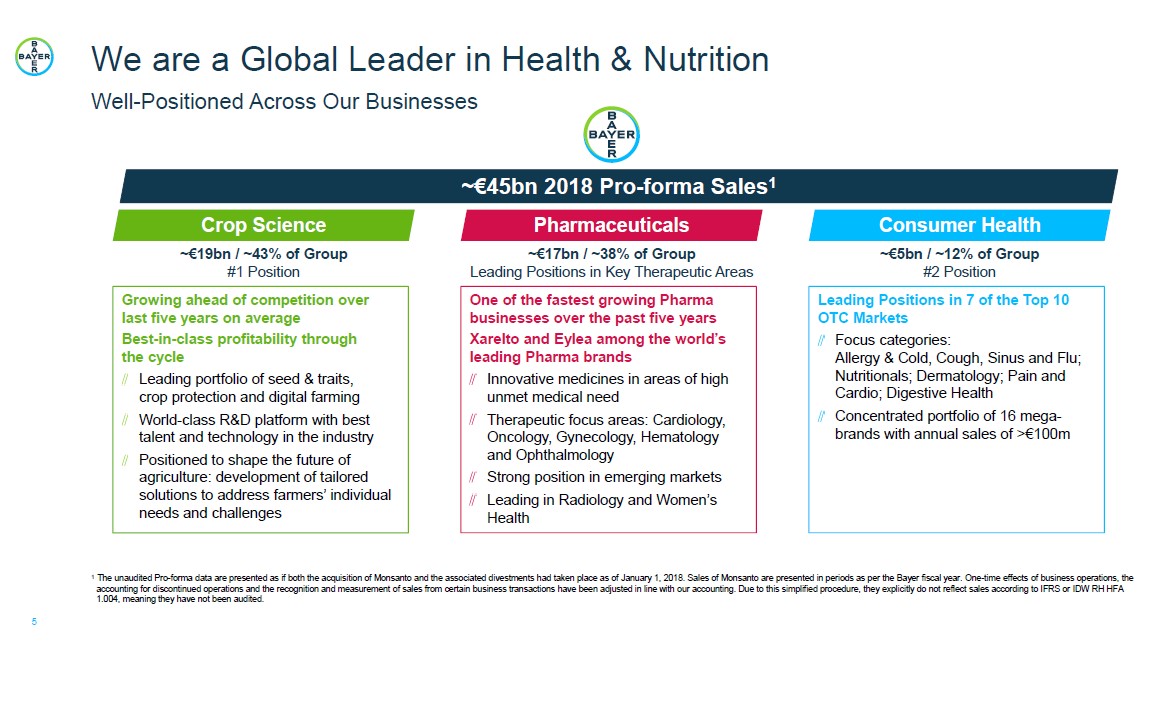
Image Shown: The three segments Bayer plans to build its business around going forward once the sale of its animal health unit is completed. Image Source: Bayer – IR Presentation
Eli Lilly and Company (LLY) launched a strategic review of its animal health unit back in 2017, which resulted in Elanco going public in September 2018. By March 2019, Eli Lilly had completely separated from Elanco. As a standalone entity, it’s much easier for Elanco to pursue bold acquisitions such as its deal with Bayer, the kind Eli Lilly would likely have balked at (given how such a deal would drain resources from its other segments). Down below is a look at why Elanco pursued its purchase from Bayer. Please note that Elanco’s companion animals business will grow significantly assuming the deal closes as envisioned.
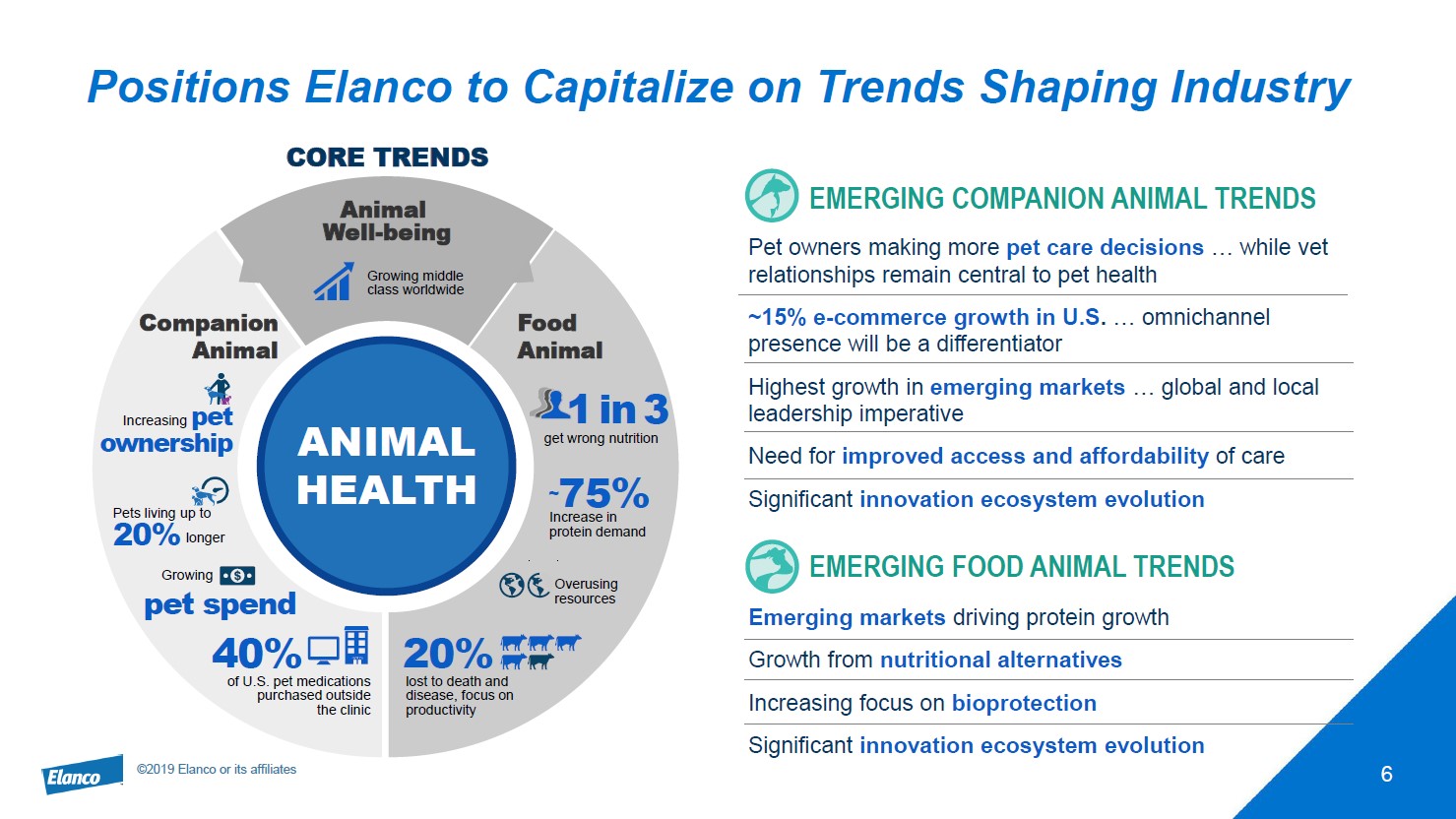
Image Shown: Elanco’s companion animal business will become significantly larger once its deal with Bayer closes. Image Source: Elanco – IR Presentation
Follow the Leader
This isn’t the first time a pharmaceutical company has exited the animal health business to pivot their focus elsewhere while also better enabling that unit to flourish simply by allowing it to operate on its own. Back in 2013, Pfizer Inc (PFE) spun-off animal health company Zoetis Inc (ZTS) through an IPO. Pfizer completely separated from Zoetis several months later, and Zoetis has grown considerably since then. Shares of ZTS have risen four-fold (as of this writing) since going public roughly six and a half years ago.
Zoetis has an acquisitive streak that’s worth keeping in mind. The company acquired Scandinavian Micro Biodevices for less than $0.1 billion in 2016 to enhance its veterinary diagnostic offering. To keep the momentum going, Zoetis acquired Abaxis Inc in 2018 for ~$2.0 billion in cash to further strengthen its veterinary diagnostics offerings. On August 14, Zoetis completed another acquisition (financial terms weren’t disclosed), buying animal nutrition company Platinum Performance. That deal isn’t expected to have a material impact on Zoetis’ financial performance this fiscal year, indicating it’s probably a relatively small acquisition.
Success Through Scale and the Humanization of Pets Trend
We think Elanco, in its own way, wants to replicate the success of Zoetis. Through scale, Elanco will be able to bulk up its R&D workforce and investment capabilities to levels that can compete with the big dogs. Beyond Zoetis (the company has a $59.8 billion market cap as of this writing), that includes pharmaceutical giant Merck & Co Ltd. (MRK), which recently spent EUR$2.1 billion acquiring the equity of privately held Antelliq Group, along with assuming EUR$1.15 billion of that firm’s debt. Merck noted that Antelliq is “a leader in digital animal identification, traceability and monitoring solutions” and that this space is “the fastest growing part of the animal health industry.” Merck closed the deal in April 2019. To keep up, Elanco had to either make a transformative deal of its own or wait until it got swallowed up by a different company.
The animal health segment is an interesting one due to the need to meet ever growing demand for protein around the world and the ongoing “humanization of pets” trend, specifically in America (represented by sharp increases in consumer spending on companion animals). Elanco’s purchase of Bayer’s animal health unit will make it one of the largest animal health companies out there. More importantly, Elanco will derive about half of its pro forma business from its “Companion Animal’ segment and will gain a stronger foothold in the e-commerce and retail arena. From Bayer’s press release (emphasis added):
“The combination is highly complementary and creates the number two animal health company, with top three positions across a broad range of species and geographies. It also enhances Elanco’s portfolio of leading global brands and bolsters its innovation capabilities and R&D pipeline.”
Additionally, from Elanco’s press release (emphasis added):
“Adding Bayer Animal Health’s business accelerates Elanco’s portfolio transformation by elevating Companion Animal to nearly half of the overall business. The combination creates access to new segments of the parasiticides market with topical treatments and collars, and propels Elanco into expanding pet e-commerce and retail spaces. This complements Elanco’s already strong veterinary presence, enabling the company to reach more pet owners. In the Food Animal business, the acquisition will add a number of anchor cattle brands, create a bio-protection portfolio and expand Elanco’s aqua presence into warm water fish. The enhanced global presence will allow Elanco to better serve veterinarians, farmers and pet owners.”
Bio-protection will be another key focus for Elanco going forward in its bid to enhance global protein production. Elanco is targeting between $275-$300 million in potential synergies which should meaningful enhance its future net operating cash flows.
Management has plans for major deleveraging efforts once the deal closes, and we caution Elanco is taking on a lot of leverage to fund this transaction. Elanco sees its gross debt to adjusted EBITDA ratio standing around ~5x at the time of closing, which will be cut down below 3x by the end of 2022 through deleveraging activities made possible through Elanco’s strong expected cash flow profile.
Concluding Thoughts
This is a transformative deal for Elanco and one that will create a real competitor to Zoetis’ and Merck’s animal health units. For Bayer, the company can now pivot to segments where it has stronger competitive advantages while also raising cash to cover potential Roundup-related legal liabilities (which could be enormous). We will be monitoring the space going forward but are staying firmly on the sidelines for now.
Pharmaceuticals (Biotech/Generic) Industry – ALXN AGN BHC BIIB BMRN GILD MYL REGN TEVA VRTX ZTS
Pharmaceuticals (Big Players) Industry – ABT ABBV AMGN AZN BMY LLY GSK MRK NVS NVO PFE SNY
Related: CHWY
—–
Valuentum members have access to our 16-page stock reports, Valuentum Buying Index ratings, Dividend Cushion ratios, fair value estimates and ranges, dividend reports and more. Not a member? Subscribe today. The first 14 days are free.
Callum Turcan does not own shares in any of the securities mentioned above. Some of the companies written about in this article may be included in Valuentum’s simulated newsletter portfolios. Contact Valuentum for more information about its editorial policies.