

By Callum Turcan
On July 24, Tesla Inc (TSLA) posted second quarter 2019 earnings that did not go over well with investors. For starters, the electric vehicle maker’s company-wide GAAP gross margin tanked by ~100 basis points while Tesla’s ‘Automotive’ segment’s gross margin came in at 18.9% during the quarter, down ~170 basis points from 20.6% in the same period last year. This is entirely a result of Tesla ramping up production and deliveries of the less profitable Model 3 to meet demand while production and deliveries of its higher margin Model S/X move lower. Shares of TSLA are under considerable pressure as the market adjusted its long-term view of Tesla’s gross margins and ultimately future free cash flows.
Here we would like to highlight why companies with a lot of operational leverage, like Tesla or Amazon Inc (AMZN), can see large movements in their share prices after earnings. With no investor having a crystal ball that allows them to see into the future, the daily volatility in the price of a given equity comes from investors knowing that the future is uncertain. As new information comes to light expectations change, influencing daily trading activity and ultimately driving the equity price generally towards the new market consensus of an the equity’s estimated intrinsic value over the long-term (when or whether the price of the equity actually converges with consensus intrinsic value expectations is a different matter). Therefore, we provide a range to our fair value outcomes to capture this volatility. This is explained in detail in Valuentum’s recent book Value Trap.
Down below is a look at Tesla’s projected EBITDA, from its 16-page stock report that can be viewed here. As you can see, depending on what one’s expectation is for Tesla’s margins (with gross margins filtering down through the rest of the income statement), how much EBITDA the car company is expected to generate in the future changes dramatically. Revenue growth estimates are also key of course, but the biggest question Tesla now faces is how to preserve its lofty gross margins considering the company is moving down-market, transitioning from a luxury auto manufacturer to one that caters to a broader audience. Model 3s may not be cheap, per se, but they are vastly more affordable than the Model S/X and mark the beginning of Tesla’s plan to eventually become a major auto manufacturer.
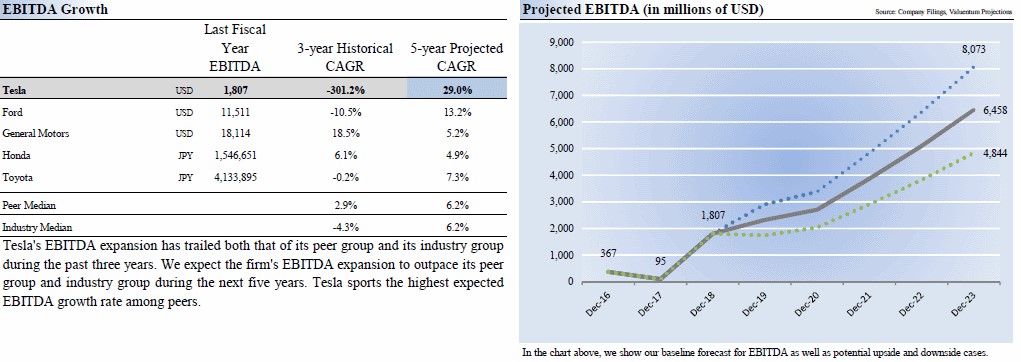
Image Shown: Due to Tesla’s high levels of operating leverage, small changes in future margin expectations have an outsized influence on its financial trajectory.
We see Tesla’s revenue growth story continuing going forward, even under our most pessimistic assumptions, as production continues to ramp up and due to its entrance into the “mass-market” auto space. Tesla mentioned it was on track to start producing Model 3s at its new factory in China by the end of this year, which further exemplifies the company’s growth story. As you can see below, there is an enormous amount of volatility in the trajectory of its future sales growth. How successful Tesla is at converting drivers familiar with internal combustion engine (“ICE”) technology over to its electric vehicle offerings and battery technology will depend on how effectively the company can ramp up production while continuing to maintain brand power and reliability.
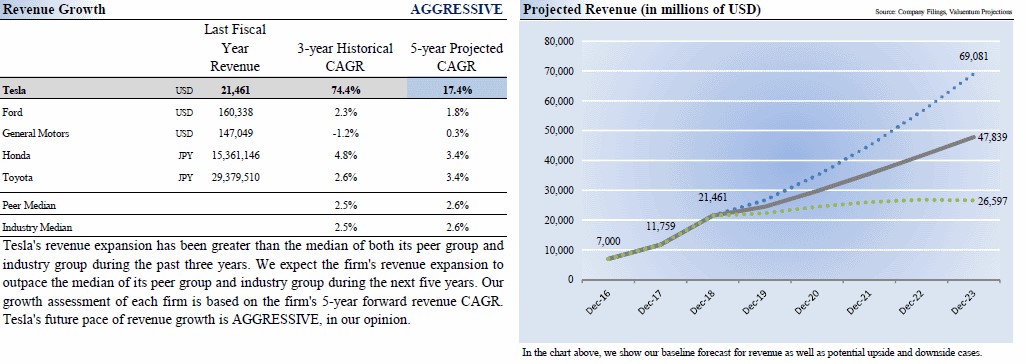
Image Shown: We expect Tesla to post meaningful revenue growth over the coming years, but where that trajectory ends up depends on many moving pieces.
Management sees demand for Tesla’s products holding up well, with CFO Zachary Kirkhorn stating this during the quarterly conference call (emphasis added):
“Three years ago, we unveiled the Model 3. Two years ago, we brought the product to market. One year ago, we demonstrated our ability to build the Model 3 at high rate. So far this year, we’ve demonstrated our ability to manage global deliveries and logistics at a higher rate, but the most important thing is that we’ve demonstrated our ability to generate significant organic demand as nearly all orders generated in Q2 were non-reservation holders. And thus far in Q3, our order pacing is ahead of where we were at this point in Q2. And as we noted in our Q2 production and delivery release, our order backlog increased over the course of Q2.
Ultimately, the Model 3 is accomplishing what our business needs it to do. It expanded our sales and customer base, enabling us to generate cash we need to reinvest. In the process, we’ve appropriately managed our operating expenses and have reduced the cost of running the business. This is critically important because I feel as though we’ve broken through a baseline fixed cost barrier, enabled by the success of the Model 3 business. With continued focus on execution and cost management, the next 12 to 18 months should be the most exciting yet. During this time, we believe that Gigafactory, Shanghai will be producing at scale. Model Y will be in production, addressing the most popular vehicle segment.”
The market is worried, however, that demand for Model S/X is falling off a cliff. Model S/X deliveries fell by 21% year-over-year while production dropped by 41% during the second quarter. Some see demand for Model S/X vehicles being cannibalized by the cheaper Model 3, which isn’t the worst problem to have in the world but isn’t the greatest either. When investors became aware that Apple Inc (AAPL) was likely cannibalizing sales of its iPods in favor of its then-new iPhone offering, that wasn’t a bad problem at all as consumers were migrating to a higher margin product Apple sells, thus bolstering its financial trajectory. This is the opposite of what Tesla is experiencing right now.
While the late Steve Jobs had found a way to win over customers to Apple’s vast ecosystem, where the company wins no matter what when winning new business (in the sense that whether the consumer buys a iPod or an iPhone, Apple wins, and it wins again when that customer starts using its high margin services), Elon Musk still needs to prove that pivoting to a mass-market electric vehicle option will lead to profitability and eventually free cash flow. As expected, Tesla was not profitable last quarter, posting a net loss of $0.4 billion, bringing its total loss for the year up to $1.1 billion. Tesla generated $0.2 billion in net operating cash flow during the first six months of 2019 while spending $0.5 billion on capital expenditures, resulting in negative free cash flows.
As you can see down below, we don’t expect Tesla to become free cash flow positive until sometime in the early-to-mid-2020s at the earliest.
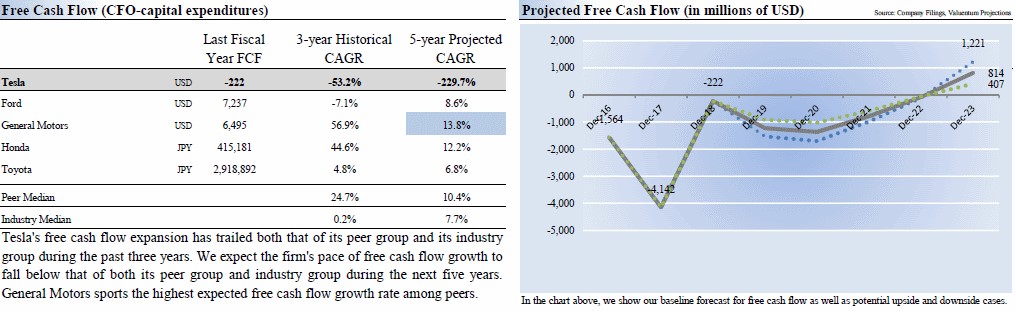
Image Shown: Tesla will become free cash flow positive, eventually, but not for a few more years.
That’s why most of the value of Tesla’s equity comes from the mid-cycle period, when the company should be free cash flow positive, assuming things progress as expected. Free cash flows are (or at least should be) the ultimate goal of every company, as that’s what drives the value of equities. Price-to-sales (P/S) or P/E ratios are ambiguous ratios with no predictive properties as it relates to future stock prices.
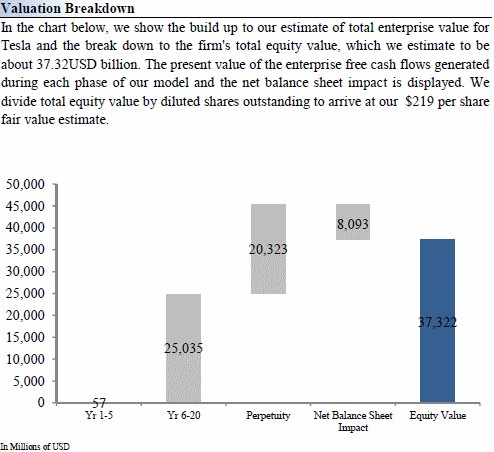
Image Shown: Most of the value of Tesla’s equity comes from the mid-cycle period and its perpetuity, offset by its net debt load.
Concluding Thoughts
Tesla shares are under considerable pressure, and we can understand why. Investors are concerned positive free cash flows may be farther away than previously anticipated as Tesla’s margins come under pressure from its transition into the mass-market via the Model 3 offering. We value shares of TSLA at $219 per share at the midpoint of our fair value estimate range and are staying away from the electric automaker as it doesn’t appear the company is firing on all cylinders just yet. Our fair value estimate remains unchanged.
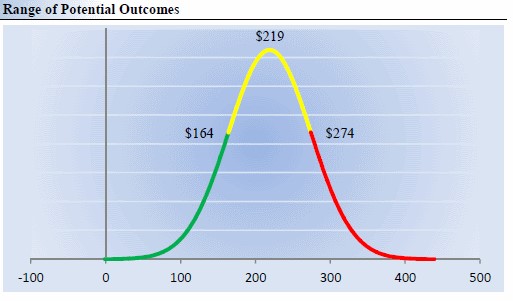
Image Shown: We value shares of TSLA between $164/share – $274/share, with a Fair Value Estimate of $219/share which is below where Tesla is trading at as of midday July 25.
Auto Making Industry – F GM HMC HOG TM TSLA
—–
Valuentum members have access to our 16-page stock reports, Valuentum Buying Index ratings, Dividend Cushion ratios, fair value estimates and ranges, dividend reports and more. Not a member? Subscribe today. The first 14 days are free.
Callum Turcan does not own shares in any of the securities mentioned above. Apple Inc (AAPL) is included in both Valuentum’s simulated Best Ideas Newsletter and Dividend Growth Newsletter portfolios. Some of the companies written about in this article may be included in Valuentum’s simulated newsletter portfolios. Contact Valuentum for more information about its editorial policies.