
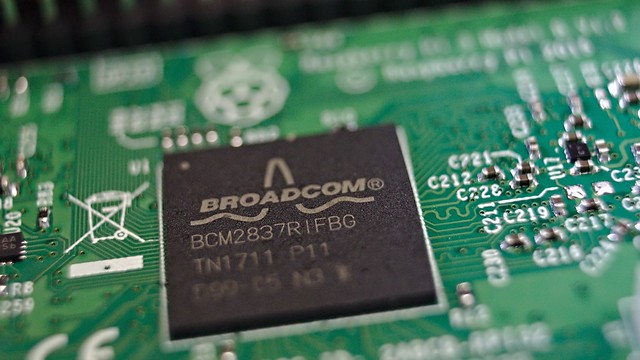
Image Source: Florian Knodt
Broadcom resets investor expectations, sending shares of the company and peers lower. Broadcom sports a juicy yield.
By Callum Turcan
Global semiconductor and infrastructure software giant Broadcom (AVGO) spooked the market during its fiscal second quarter report, released June 13, by sharply revising its revenue forecast for FY2019 lower (its FY2019 ends November 3, 2019). Shares of the company finished lower ~6% on the trading session June 14. As of this writing, Broadcom’s shares yield a juicy 4.0%
Guidance Moves Lower
Earlier this year, Broadcom set some lofty expectations. In its fiscal first quarter FY2019 (ended February 3, 2019) earnings release, released March 14, management issued guidance for the full fiscal year that called for $24.5 billion in GAAP revenue and an adjusted non-GAAP operating margin of 51.0%. That indicated modest top-line growth on an adjusted basis along with some non-GAAP operating margin expansion.
Fast forward to the fiscal second quarter FY2019 (ended May 5, 2019), however, and things start to look a lot less rosy. Before getting into the guidance cut for FY2019, note that Broadcom generated $20.8 billion in GAAP revenue in FY2018 with an adjusted non-GAAP operating margin of 50.0%. After its latest earnings report, management now sees Broadcom’s FY2019 sales coming in at $22.5 billion, down $2.0 billion from its previous forecast.
However, note that the firm’s $18.9 billion all-cash purchase of CA Technologies closed during the first day of FY2019. At the time of closing, management stated in the press release:
The transaction is expected to drive Broadcom’s long-term Adjusted EBITDA margins above 55% and be immediately accretive to Broadcom’s non-GAAP EPS. On a combined basis, Broadcom expects to have last twelve months non-GAAP revenues of approximately $23.9 billion and last twelve months non-GAAP Adjusted EBITDA of approximately $11.6 billion.
Using that as a baseline for FY2018, Broadcom’s adjusted revenue is actually expected to decline in FY2019. Going from expected top-line growth to contraction is why we think shares sold off aggressively on June 14, and why we caution readers that Broadcom’s growing troubles are material. This is not a trivial cut and indicates that global demand for semiconductors is beginning to show serious signs of stress (infrastructure software sales are holding up better). A key excerpt from Broadcom’s latest quarterly conference call, as CEO Hock Tan attempted to calm investors by explaining the forecast cut:
“Now, let me address the current business environment and our outlook for the remainder of the year. We have, as I indicated, performed very much to plan in the first half of fiscal 2019. And in the second half, we had expected a recovery. However, while enterprise and mainframe software demand remained stable, particularly in North America and Europe, with respect to semiconductors, it is clear that the U.S./China trade conflict, including the Huawei export ban, is creating economic and political uncertainty and reducing visibility for our global OEM customers.
As a result, demand volatility has increased and our customers are actively reducing inventory levels to manage risks. This leads us to believe the second half of 2019 will be more in line with the first half as opposed to the previously expected recovery. We now anticipate fiscal 2019 semiconductor solutions segment revenue of $17.5 billion, which translates into a year-over-year decline in the high single-digits.”
Previously, semiconductor solutions revenue was estimated at $19.5 billion for FY2019. On the flip side, the company is now expecting its non-GAAP operating margin to climb up to 52.5% this fiscal year, up 150 basis points from previous guidance. That appears largely due to Broadcom’s CA Technologies acquisition holding up nicer than expected. CEO Hock Tan noted during the conference call that:
“CA software continues to perform above our original expectations while SAN switching is slowing down after a very strong first half. As a result, we are maintaining our fiscal 2019 infrastructure software outlook at $5 billion.”
While there wasn’t much readily-available commentary regarding the adjusted non-GAAP operating margin increase, stronger software sales appear to be the main culprit (another factor could be weaker sales of potentially lower margin products/offerings). Looking farther out, Broadcom’s goal was to push its adjusted non-GAAP operating margin closer to 55.0% by FY2020 on the back of the CA Technologies purchase. That strategy may get derailed if its growth story slows down elsewhere when contending with macro headwinds, depending on how steep the slowdown gets going forward.
How We View Broadcom
Broadcom is still very much a free cash flow cow due to its capex-light business model, generating $2.5 billion in free cash flow during its latest quarter. That underpins management’s goal to return $8.0 billion to shareholders this fiscal year through dividends and share buybacks. Here’s how we view Broadcom’s main strengths as it relates to its dividend coverage (from our two-page Dividend Report):
The new Broadcom is levered to growth trends in the areas of LTE transition, datacenter spending, IP traffic, and the Internet of Things, all of which are expected to grow at strong double-digit CAGRs over the next 3-4 years. We’re expecting robust free cash flow generation from the newly combined company, but notable execution and integration risk remains. In addition to its larger purchase of CA Tech, the company is working to integrate Brocade but has abandoned its unsolicited takeover attempt for Qualcomm (QCOM), which may have been a blessing in disguise, especially for its balance sheet. Management plans to pay out 50% of prior fiscal year’s free cash flow as dividends in any given year.
As always, downside risks need to be kept in mind when analyzing equities. Broadcom’s Dividend Cushion ratio stands at 1.0x due to the debt the company took on to fund its acquisitions while also generously rewarding shareholders (via buybacks and dividends). Here is how we view Broadcom’s potential weaknesses as it concerns its dividend coverage (from our two-page Dividend Report):
Broadcom’s Dividend Cushion ratio has suffered as a result of it adding a substantial amount of debt to fund recent acquisitions. Our current estimation of its financial leverage is based on guidance that came prior to the CA Tech deal closing. While we think the firm is well-positioned to take advantage of a number of secular growth trends, we must highlight the integration risk associated with any merger of this size; synergy targets are not guaranteed. At the moment, we have confidence that management will be able to deliver on its expectations, but we think it may want to consider prioritizing deleveraging in the near term. Management expects to use the balance of free cash flow after dividends for share repurchases or M&A.
Concluding Thoughts
Broadcom exited the second quarter FY2019 with $32.2 billion in net debt, and while the company is very free cash flow positive, the semiconductor and infrastructure software industries are very competitive. We would prefer management to consider deleveraging efforts, particularly as it cites the US-China trade war becoming a major headwind going forward. This would help shore up its dividend coverage. At a time when supply chains are undergoing fundamental shifts from exogenous events beyond any one company’s control, it’s best to batten down the hatches. Shares of Broadcom are now roughly in-line with our fair value estimate following the decline on the trading session June 14.
Related: QCOM, INTC, XLNX, STM, MU
Related: SMH, QQQ
—–
Valuentum members have access to our 16-page stock reports, Valuentum Buying Index ratings, Dividend Cushion ratios, fair value estimates and ranges, dividend reports and more. Not a member? Subscribe today. The first 14 days are free.
Callum Turcan does not own shares in any of the securities mentioned above. Some of the companies written about in this article may be included in Valuentum’s simulated newsletter portfolios. Contact Valuentum for more information about its editorial policies.