
Image Source: NextEra Energy Inc – IR Presentation
By Callum Turcan
NextEra Energy (NEE) is one of the largest electric utility companies in North America. Management’s long-term strategy involves building out renewable energy power generation facilities all across America and Canada, namely wind farms and solar plants, while also making the necessarily investments in baseload generating facilities like nuclear power plants, natural gas-fired power plants and gas pipeline networks. Battery storage is increasingly becoming a key focus as well, as that’s what should enable renewable energy facilities to shift from intermittent to baseload power generators over time.
We like NextEra’s strong growth trajectory and commitment to dividend growth, but like all utilities, a key part of its business model relies on maintaining ample access to cost-effective sources of capital. The company yields 2.5% as of this writing, partially due to its stellar stock performance over the past few years. We caution that with NextEra Energy trading at $204 per share as of May 24, NEE shares are richly priced and trading well above the top end of our fair value range ($176 per share).
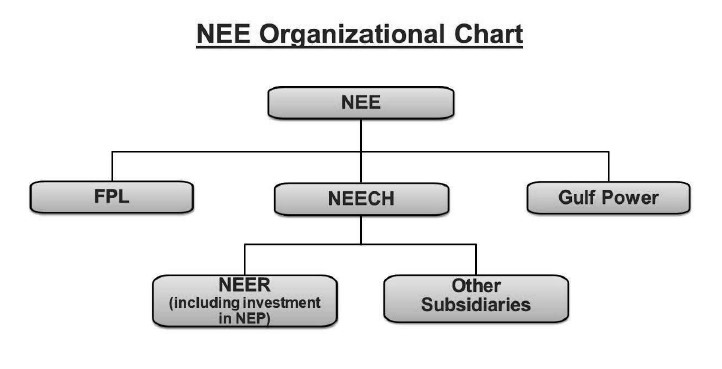
Image Shown: The corporate organization chart of NextEra Energy. Image Source: NextEra Energy 2018 10-K
Business Overview
Though its ownership of NEER, NextEra Energy Resources, NextEra Energy has a very sizable interest in NextEra Energy Partners LP (NEP). The goal of the limited partnership is to acquire, develop, and operate renewable energy developments with a focus on growth. Note that back in 2018 due to an organization change, NextEra Energy no longer consolidates its financial results with NextEra Energy Partners. Here is an explanation of this relationship from NextEra Energy’s 2018 10-K filing:
“NEP – NEP was formed in 2014 to acquire, manage and own contracted clean energy projects with stable long-term cash flows through a limited partner interest in NEP OpCo. NEP’s projects include energy projects contributed by NEER to NEP OpCo in connection with NEP’s initial public offering in July 2014 as well as additional energy projects acquired thereafter. Through an indirect wholly owned subsidiary, NEE owns 101,440,000 common units of NEP OpCo representing a noncontrolling interest in NEP’s operating projects of approximately 64.4% at December 31, 2018.
NEP was deconsolidated from NEE for financial reporting purposes in January 2018 as a result of changes made to NEP’s governance structure during 2017 that, among other things, enhanced NEP common unitholder governance rights. The new governance structure established a NEP board of directors, which elected board members commenced service in January 2018. Subsequent to deconsolidation, NEE began reflecting its ownership interest in NEP as an equity method investment with its earnings from NEP as equity in earnings of equity method investees and accounting for NEER’s asset sales to NEP as third-party sales in its consolidated financial statements.”
NextEra Energy’s core operations include FPL (Florida Power & Light Company), Gulf Power, and its expansive NEER segment. FPL is the largest electric utility provider in Florida and the subsidiary also owns a retail gas business after acquiring one in the middle of last year. As a rate-regulated utility, FPL’s cash flows are very consistent. The electric utility supplies power to over ten million people through five million customer accounts in Florida, operations that are supported by 24,500 MW of net power generating capacity and over 75,000 miles of transmission and distribution lines.
Through a deal announced last year, NextEra Energy purchased Gulf Power from Southern Company (SO) along with Florida City Gas and Southern Company’s ownership stakes in two natural gas-fired power plants in a transaction valued at $6.5 billion when including the assumption of $1.4 billion in Gulf power debt. NextEra Energy paid Southern Company in cash and all three deals had closed by the beginning of 2019, further cementing NextEra Energy’s dominance in Florida’s utility space. At the end of 2018, Gulf Power served 460,000 customers in northwest Florida as a regulated electric utility supported by 2,300 MW of electricity generating capacity. Those operations will now be supported by NextEra Energy’s stakes in the Plant Oleander and the Stanton Energy Center gas-fired power plants, both located in Florida. NextEra Energy expects these transactions will be $0.15 and $0.20 accretive to its adjusted EPS in 2020 and 2021, respectively.
Pivoting to NEER, that unit had 21,000 MW of net electricity generating capacity at the end of last year with 20,400 MW located in America, 500 MW located in Canada, and 100 MW located in Spain. The unit also invests in battery storage technology to support its power plants, as the majority of its generation capacity is weighted towards wind and solar facilities. Wind accounted for almost two-thirds of NEER’s electricity generation capacity at the end of 2018, followed by nuclear (13%) and solar (11%). By fuel type, wind (59%) and nuclear (33%) represented the bulk of its net power generation last year. NEER also owns a gas distribution business which is currently expanding as new pipeline projects, like the Mountain Valley Pipeline, come online.
Good Credit Rating
NextEra Energy has an investment grade credit rating of A- from S&P with a stable outlook, a rating that was reaffirmed after its purchase of Gulf Power was completed in early-January 2019. Moody’s Corporation (MCO) gives NextEra Energy an investment grade credit rating of Baa1 with a stable outlook and also reaffirmed its rating after the Gulf Power deal. Fitch gives NextEra Energy an investment grade credit rating of A- with a stable outlook as well, but that rating is current as of May 2018. We appreciate NextEra Energy’s strong credit rating and ability to manage its debt profile well. As mentioned previously, utilities must retain reasonable access to capital markets to fund expansion efforts and maintain dividend payments as part of their business model (specifically for growing utilities). Having a credit rating that is comfortably in investment grade territory even after a major purchase is a positive sign.
Solid Track-Record of Growth
Below is a look at NextEra Energy’s historical growth trajectory in terms of adjusted EPS and dividend payments. Since 2005, NextEra’s adjusted EPS growth rate of 8.6% CAGR and its dividend per share growth rate of 9.2% CAGR through 2018 has been quite impressive. While past results aren’t indicative of future performance, having a strong track-record of growth is also nice plus.
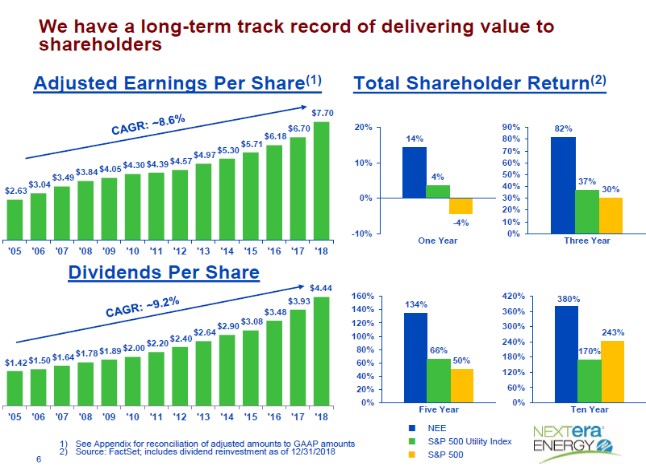
Image Shown: A look at NextEra Energy’s historical financial performance from 2005 to 2018 and its total shareholder return over the past ten years. Image Source: NextEra Energy – IR Presentation
Looking Ahead
Going forward, NextEra Energy’s renewable growth strategy is what will drive future earnings and ultimately dividend growth. At the end of the first quarter of 2019, NextEra Energy’s NEER unit had a backlog of roughly 9,800 projects. Most of those projects involve constructing wind farms and solar plants but note that there is a growing demand for energy storage developments as well. That is an area with a lot of potential growth as intermittent sources of electricity need storage options in order to meet consumer demand 24/7. The sun isn’t always shinning, the wind isn’t always blowing, but North Americans always need electricity. We would expect to see NEER’s backlog of energy storage projects grow materially over time.
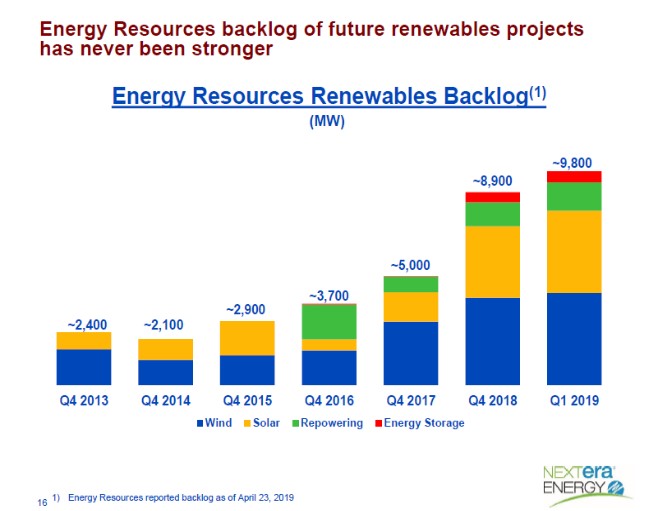
Image Shown: Most of NextEra Energy’s NEER growth, as indicating by its current project backlog, will come from developing solar plants and wind farms. A growing chunk of its backlog is now coming from energy storage projects and that trajectory looks quite promising. Image Source: NextEra Energy – IR Presentation
Management expects to grow NextEra Energy’s dividend per share by 12% to 14% per year through the end of 2020 versus 2017 levels. That will be made possible through the utility’s growing adjusted EPS as its asset base continues to expand. NextEra Energy increased its latest quarterly dividend to $1.25 per share from $1.11 previously, good for 12.6% payout growth, indicating management is potentially targeting a dividend growth rate at the lower end of its given range and there’s a reason for that.
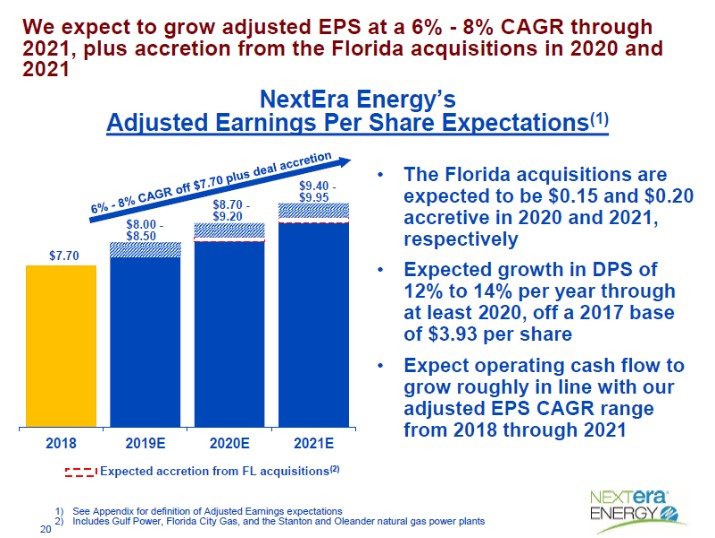
Image Shown: NextEra Energy expects its adjusted EPS to grow by 6% to 8% over the next few years as its rate base grows. Image Source: NextEra Energy – IR Presentation
A large part of the reason why NextEra Energy is likely targeting a lower dividend growth rate (within guidance) is due to the downside risks relating to NextEra Energy’s dealings with embattled PG&E Corporation (PCG). During NextEra Energy’s latest quarterly conference call, management had this to say on the issue:
“At the end of the first quarter, approximately $38 million of cash distributions for PG&E related projects including Desert Sunlight 250, which is contracted with Southern California Edison were restricted as a result of events of defaults under the financing that arose due to PG&E bankruptcy filing. PG&E continues to make payments under all of our contracts for post-petition energy deliveries and we continue to pursue all options to protect our interests, including vigorously defending our contracts, and working with key stakeholders of each financing.”
PG&E is undergoing immense financial distress from lawsuits relating to various California wildfires and it isn’t clear what impact its bankruptcy filing will have on PG&E’s partners. NextEra Energy Partners forecasts that $95 – 105 of its 2019E expected cash available for distribution won’t be available to investors due to problems relating to PG&E, which will negatively impact NextEra Energy as well. That’s equal to a little under a fifth of NextEra Energy Partners’ expected cash available for distribution for 2019E. We will be monitoring this situation going forward.
Concluding Thoughts
As the world slowly shifts towards a greener future, one powered by wind farms and solar plants that are supported by enormous battery facilities to ensure customers can receive power without interruption, NextEra Energy is well-positioned to capitalize on the future of electric power. Supported by an expanding asset base, strong forecasted adjusted EPS growth, and a quality investment grade credit rating, NextEra Energy’s dividend growth story is still well underway. That being said, we aren’t interested in the company as NextEra Energy trades well above the top end of our fair value range. With problems at NextEra Energy Partners compelling NextEra Energy to raise its 2019 payout at the lower end of its long-term CAGR guidance, it’s hard to justify such a premium, even for a company with a great story.
Utilities: AEE, ALE, APU, BIP, CMS, CNP, DTE, ES, LNT, MGEE, NI, NFG, PEG, PNW, SJI, SR, SRE, WEC
Related ETFs: XLU
—–
Valuentum members have access to our 16-page stock reports, Valuentum Buying Index ratings, Dividend Cushion ratios, fair value estimates and ranges, dividend reports and more. Not a member? Subscribe today. The first 14 days are free.
Callum Turcan does not own shares in any of the securities mentioned above. Some of the companies written about in this article may be included in Valuentum’s simulated newsletter portfolios. Contact Valuentum for more information about its editorial policies.