
Entertainment giant Disney has been milking the Star Wars franchise for all its worth since acquiring Lucasfilms back in 2012. Now fans are starting to shun the franchise’s blockbuster movie releases and that has management considering how to properly leverage this top tier asset going forward.
By Callum Turcan
Walt Disney (DIS) has long been a giant in the entertainment industry, a position further cemented by its $71.3 billion purchase of 21st Century Fox which only just closed in March. As of this writing, Disney yields 1.3% and has a great track record when it comes to dividend growth. Even better, we are very optimistic on Disney’s ability to keep growing its quarterly payout over the coming years as the firm is a quality free cash flow generator. The company has been generating headlines as of late due to updates regarding its Star Wars ambitions and how management plans to proceed with one of Disney’s most valuable intellectual properties.
Milking Versus Managing Top Tier Properties
Back in 2012, Disney acquired Lucasfilm for approximately $4.1 billion, gaining access to the lucrative Star Wars franchise. This transaction led to the launch of a sequel trilogy (Star Wars: Episode VII, VIII, and IX) that within the story arc of the film franchise chronologically follows the events of the original trilogy (Stars Wars: Episode IV, V, and VI), with the middle trilogy (Star Wars: Episode I, II, and III) representing the film franchise’s prequel trilogy. Why that is the case is irrelevant at this point because it’s clear the deal was a big win for Disney, drawing comparisons to the company’s purchase of Marvel Entertainment for $4.0 billion back in 2009, which was a smashing success by almost all measures.
Disney, however, is becoming aware of something along the lines of “Star Wars fatigue” and in order to preserve the brand, management is putting new Stars Wars movies on a ‘hiatus’ after the final installment in the latest trilogy is released this upcoming December. This decision indicates Disney is now focusing on longevity and is an admission that the company needs to better manage its top tier properties, particularly as it relates to movie launches.
Star Wars: Episode VII – The Force Awakens was released in 2015, ten years after Episode III – Revenge of the Sith was launched at theaters around the world. Historically, each Star Wars trilogy saw a new movie released every three years, as was the case with the first trilogy (1977 – 1983) and the second trilogy (1999 – 2005). That changed with the latest trilogy, with each movie being released every two years (2015 – 2019). Note that a spin-off, Solo: A Star Wars Story, was released in 2018 which really means Disney has been aggressively milking this property for all its worth.
Box Office Mojo reports that Star Wars: Episode VII (2015) generated almost $2.1 billion worldwide at the box office, including over $0.9 billion in domestic ticket sales where Disney’s cut is much higher. Star Wars: Episode VIII (2017) generated just $1.3 billion in ticket sales globally, including $0.6 billion in domestic sales. By the time Solo: A Star Wars Story (2018) was released, fatigue had clearly set in as that movie generated just $0.4 billion in ticket sales worldwide, including $0.2 billion in domestic sales. That wasn’t the only problem, as Star Wars toy sales dropped in both 2017 and 2018 according to NPD, after originally seeing a great revival when the series was rebooted. Keep in mind that each of these movies cost hundreds of millions of dollars to make, and even more to market. Anything less than a blockbuster hit at the box office is underperformance in the eyes of the market.
Significance for Disney’s Growth Trajectory
Disney isn’t just betting on toy sales and movie tickets to grow, the company is launching the Star Wars-themed Galaxy’s Edge addition at its California theme park this month, which will be followed up by the launch of a similar attraction under the same name at its Florida theme park. This is a multi-billion investment in one of Disney’s most profitable business segments that has posted tremendous growth over the years. If the company is inundating the world with too much big ticket Star Wars content (there are major differences between blockbuster movie launches and ongoing TV series as it relates to brand management) and thus weakening the perceived quality of that intellectual property, investments like Galaxy’s Edge could yield weak returns in the event fans get fed up with the Star Wars franchise.
From 2016 to 2018, Disney’s ‘Parks and Resorts’ division has seen its annual revenue jump up 20% to $20.3 billion while its operating income rose by 36% over that period to $4.5 billion. For perspective, Disney generates a third of its revenue and over a quarter of its operating income from its ‘Parks and Resorts’ division. This is a business where Disney has consistently realized growth and that has been offsetting significantly weaker performance at its ‘Media Networks’ and ‘Consumer Products & Interactive Media’ divisions and volatile performance at its ‘Studio Entertainment’ division.
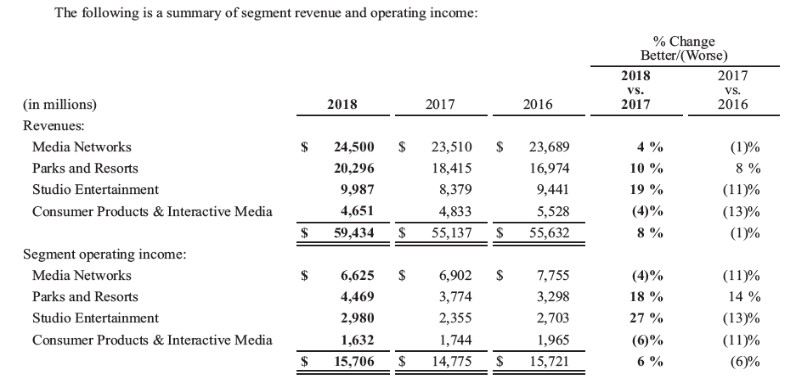
Image Shown: Disney’s growth engine is its ‘Parks and Resorts’ division, which has been offsetting weaker performance elsewhere to better enable year-over-year revenue and operating income growth. Image Source: Disney’s 2018 10-K.
Management is recognizing the need for change, and we are supportive of that. Disney plans to focus more so on television shows relating to Star Wars going forward, including The Mandalorian, which will be the first original content on Disney’s new streaming service Disney+. The entire entertainment industry has been grappling with the rise of streaming services and the cancellation of one ubiquitous channel content packages, and Disney thinks it has finally found a solution.
Streaming Ambitions
Starting this November, Disney will be launching a $6.99 per month (or $69.99 per year) streaming service, undercutting the likes of Netflix Inc (NFLX) ($12.99 per month) and Amazon Inc (AMZN) ($12.99 per month for Prime), as Disney+ is priced to gain a real foothold in the streaming market. Disney plans on investing billions of dollars on original content that will be created specifically for Disney+ in order to differentiate this offering from the offerings of Disney’s very competitive peers.
That price point also makes Disney+ competitive against Hulu, a streaming service that Disney owns roughly two thirds of (on a pro forma basis) along with Comcast Corporation (CMCSA) now that AT&T Inc (T) sold its 9.5% stake in the joint-venture back to Hulu on April 15 in a transaction that valued the streaming service at $15.0 billion.
Regardless of how the cards fall in the global streaming wars, Disney intends on being the victor with several ways to play this growth market. Note that according to Disney’s 2018 10-K:
“At the end of fiscal 2015, the Company had a 33% interest in Hulu, a joint venture owned one-third each by the Company, 21CF and Comcast Corporation. Warner Media LLC (WM) acquired a 10% interest from Hulu for $0.6 billion in August 2016, which diluted the Company’s ownership interest to 30%. In addition, WM has made $0.2 billion in subsequent capital contributions. For not more than 36 months from August 2016, WM has the right to sell its shares to Hulu and Hulu has the right to purchase the shares from WM under certain limited circumstances arising from regulatory review.
The Company and 21CF have agreed to make a capital contribution for up to approximately $0.4 billion each if Hulu is required to repurchase WM’s shares. The August 2016 transaction resulted in a deemed sale by the Company of a portion of its interest in Hulu at a gain of approximately $175 million. The Company expects to recognize the gain if and when the put and call options expire. Following completion of the 21CF acquisition the Company will consolidate Hulu’s financial results and assume 21CF’s capital contribution obligations.”
It appears that Disney will likely contribute $0.8 billion to the joint-venture in order to enable Hulu to repurchase AT&T’s stake (held by Warner Media) in the consortium. As of this writing, Disney hadn’t issued a press release covering the Hulu news, so it isn’t clear if this will be the case or if it has already occurred. In early-May, Disney will report second quarter results for its 2019 fiscal year which should give the market greater clarity on this subject.
Our Thoughts on Disney
Below on our thoughts on Disney as it relates to the company’s core strengths (from Valuentum’s two-page dividend report);
“Disney owns some incredible brands, and it continues to reinvent how it provides its customers with the high-quality entertainment it is synonymous with. Shareholders have been pleased, and income investors even more so; dividend growth has accelerated, with the executive team more than tripling the payout in just the past few years. Star Wars has been a windfall for the company, and we think Disney has the unique ability to evolve with each new generation to make the franchise as relevant to future generations as those that first discovered “The Force.” Annual free cash flow generation of ~$9 billion during the past three years (2016-2018) is more than triple the annual run-rate of Disney’s cash dividend obligations.”
When viewing an investment, any investment, it’s always best to also take key weaknesses into consideration as well;
“Disney has made some fantastic acquisitions during the past few years, including Pixar, Marvel, and Lucasfilm (Star Wars), but income investors should be aware of integration and execution risk associated with its purchase of 21st Century Fox. The media market continues to change rapidly, and while Disney boasts some impressive brands — ABC, Disney and ESPN — consumer behavior is notoriously difficult to predict. Nevertheless, it is working to expand its direct-to-consumer offerings. Disney is betting on its new Shanghai Disney Resort in mainland China, and it offers a huge step to introducing the company to the Chinese people. The acquisition of 21st Century Fox will impact its balance sheet, but free cash flow generation is solid.”
Furthermore (from Valuentum’s 16-page stock report);
“Disney acquired 21st Century Fox for $71.3 billion in cash and stock at an overall 50/50 mix of cash and stock after 21st Century was spun off from Fox. Disney now owns Fox’s film and TV studio, along with FX and National Geographic networks. $2 billion in cost synergies are expected by 2021, and $13.8 billion in 21st Century Fox’s debt was assumed.”
Operational synergies, especially when presented emphatically by management teams backed up by optimistic slides on an IR presentation, can seem a lot more straightforward at first than they really are. While we recognize that Disney has made some truly stellar acquisitions in the past that paid off tremendously, that doesn’t mean that going forward, Disney will always be able to realize that same level of success. We will be monitoring how well Disney integrates 21st Century Fox’s operations into its own, and what cost savings are ultimately realized.
Concluding Thoughts
Disney is trading right near the midpoint of our range of potential fair value outcomes as of this writing and sports tremendous dividend coverage, with a Dividend Cushion ratio of 3, offering management plenty of room to push forward with further payout increases. We will be keeping an eye on Disney going forward, but as things stand today, we think shares are fairly valued.
Related: FOX, FOXA
—–
Valuentum members have access to our 16-page stock reports, Valuentum Buying Index ratings, Dividend Cushion ratios, fair value estimates and ranges, dividend reports and more. Not a member? Subscribe today. The first 14 days are free.
Callum Turcan does not own shares in any of the securities mentioned above. Some of the companies written about in this article may be included in Valuentum’s simulated newsletter portfolios. Contact Valuentum for more information about its editorial policies.