
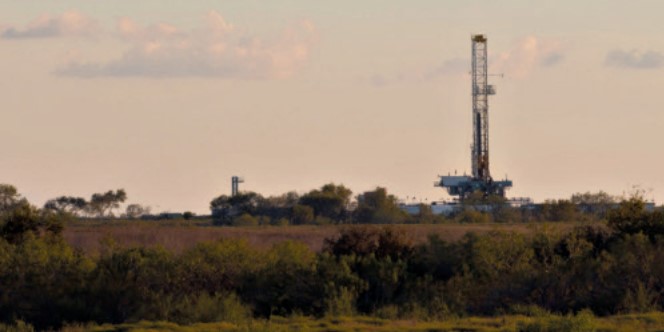
Image Source: Halliburton 2016 Annual Report
Halliburton’s 2018 performance was boosted by higher oil prices driving upstream capital spending, but tough times may very well lay ahead for the oilfield services provider.
By Callum Turcan
While Halliburton’s (HAL) financial performance improved materially last year as upstream capital expenditures perked up on the back of higher global oil prices, tough times lay ahead for this oilfield services provider given the current near-term outlook for oil prices. A large part of Halliburton’s business caters to unconventional upstream operators in North America, which are quick to react to any changes in oil prices when it comes to setting capital expenditure budgets. 60% of Halliburton’s revenue last year was generated in North America. Pricing pressures, particularly for well completion services, will likely continue to put significant downward pressure on its margins, and management is responding by curtailing Halliburton’s capital expenditures.
2018 Recovery
Last year, many oilfield service providers breathed a sigh of relief as West Texas Intermediate and Brent rallied during the first half of the year due to OPEC+ production cuts and ongoing global demand growth. Non-OPEC output had to fill the gap, which meant significant increases in North American drilling and completion activity. As more rigs hit the shale patch and additional frac crews were mobilized to bring those wells online, things were looking up for Halliburton for a spell. Barclays’ (BCS) published a survey in August 2018 that highlighted how North American upstream capital expenditures were expected to rise by 15% in 2018 on a year-over-year basis.
Increased upstream investments drove Halliburton’s revenue up 16% year-over-year to $24.0 billion in 2018. Sales growth and an absence of major impairment charges led to margin expansion, with Halliburton’s operating income rising 80% to $2.5 billion, and its operating margin climbed by 364 basis points from the year-ago period to 10.3%. Part of this significant operating income improvement is due to Halliburton’s revenue growth, but it is also important to note that the firm recorded $0.6 billion in impairment and other charges in 2017, which fell by $0.4 billion in 2018. These are expenses that management has determined to be one-off items, but as always, one needs to view special items outside the purview of GAAP with a grain of salt.
Halliburton’s ‘Completion and Production’ division generated $16.0 billion in sales last year, up 22% from 2017 levels. ‘Completion and Production’ revenue represents two-thirds of Halliburton’s company-wide revenue, with its ‘Drilling and Evaluation’ division representing the remainder, and the division’s revenue was up 6% on a year-over-year basis as sales grew to $8.0 billion last year.
Pain Ahead
The fourth quarter of 2018 brought a precipitous drop in oil prices, which led to a significant weakening in Halliburton’s financial performance and highlights just how sensitive the company is to swings in raw energy resource markets. Management had this to say during the firm’s fourth quarter of 2018 conference call:
“We finished the quarter with total company revenue of $5.9 billion and operating income of $608 million, representing a sequential decrease of 4% and 15% respectively. Our Completion and Production division revenue declined 8% sequentially and operating income was down 19%, driven by lower activity in pricing for stimulation services in North America. Our Drilling and Evaluation division delivered a strong quarter, growing revenue 5% and operating income 2% sequentially.
While our business in North America declined this quarter as the completions market softened, internationally, we delivered 7% revenue growth, which underscores the versatility and global reach of our business portfolio. The trajectory of this cycle has been far from smooth. The end of last year saw a large swing in commodity prices with both Brent and WTI retrenching over 40%, the levels not seen since June of 2017.”
Management is expecting this pain to continue into the first quarter of 2019, and it forecasts sales from both its ‘Completion and Production’ and ‘Drilling and Evaluation’ divisions will fall by “mid-to-high single-digits” sequentially. That includes an expected 300 to 400 basis point drop in its ‘Completion and Production’ operating margin and a 100 to 150 basis point drop in its ‘Drilling and Evaluation’ operating margin.
Whether or not this picture improves as we get deeper into 2019 will largely be a function of global oil prices. Management is optimistic that new oil pipelines catering to the roaring Permian Basin will result in a major pickup in unconventional well completion activity during the second half of 2019 when those systems are operational, which would also alleviate some of the pricing pressures facing Halliburton. America is sitting on a recovery amount of drilled but uncompleted wells, almost 8,600 as of December 2018, offering Halliburton an enormous growth runway if oil prices rise to levels that encourage a drawdown in that inventory, which is another catalyst management referenced.
Dividend Analysis
Valuentum members know the emphasis we place on the visibility of free cash flow generation as it relates to a company’s ability to make good on its existing dividend commitments and its potential to grow that yield over time. Halliburton’s Dividend Cushion ratio stands at just 0.4, giving it a VERY POOR Dividend Safety rating, and shares yield ~2.3% as of this writing. A prolonged downturn in the upstream space could mean significant trouble for the company’s payout.
In 2018, Halliburton generated $3.2 billion in operating cash flow which was enough to cover $2.0 billion in capital expenditures, $0.6 billion on its dividend payouts, and $0.4 billion in share repurchases. Halliburton spent $0.4 billion retiring debt last year, which is largely why the firm’s cash balance moved lower by $0.3 billion over the course of 2018. When viewing 2018 results in a vacuum, it appears Halliburton could easily make good on its dividend payments over the years to come, but that doesn’t take into account the volatile nature of the firm’s financial performance on an ongoing basis.
Management is slashing Halliburton’s 2019 capital expenditure budget by 20% versus 2018 levels to $1.6 billion, which will include investments in its new direction drilling platform (catering to the needs of the upstream unconventional space as well laterals get longer and longer) and an expansion of its Production business. We assign Halliburton an ATTRACTIVE Economic Castle rating as management has demonstrated the ability to consistently invest in projects that earn a return on invested capital that is reasonably above its weighted-average cost of capital.
A key area the company seeks to capitalize on is mature fields, which involves leveraging its investments in technology and utilizing those investments to enhance its existing prowess regarding enhanced oil recovery operations (EOR). Keep in mind that EOR operations, at least for now, have only been utilized on a widespread scale at conventional fields (specifically older oil fields). Unconventional EOR operations have only been tested at the pilot project level with mixed levels of success.
Taking Care of Old Fields
Primary recovery operations simply involve drilling production wells and pumping oil, natural gas, and natural gas liquids straight from the reservoir without the need for injection wells. In most circumstances, artificial lift is utilized during the primary recovery period to maintain consistent well productivity as artificial lift services enables hydrocarbons to reach the surface when reservoir pressure isn’t enough by itself. Only 10% of any given field’s oil originally in place is produced during the primary recovery phase.
Secondary recovery operations involve drilling water and gas injection wells to maintain reservoir pressure and boost the total recovery rate at the field. If the oilfield produces associated gas, often that natural gas is reinjected back into the field unless there is already extensive natural gas handling infrastructure in the producing region. The secondary recovery phase can recover 20%-40% of the oil originally in place.
The goal for both the upstream and oilfield services industries is to increase the total recovery rate of these older fields north of 50%. Norway’s storied oil industry is targeting as much as a 70% recovery rate, up from just below 50% as things stand today, which is extremely bold but probably a tad too optimistic. That being said, CO2 injection operations in America are thought to potentially yield recovery rates close to 60%.
For Halliburton, the goal is to utilize 21st century solutions to fix 20th century problems and make a nice profit in the process. In light of most old oilfields producing less than half of the oil originally in place, there is a huge opportunity for any oilfield service provider than can increase recovery rates beyond what is achievable through secondary recovery operations. The oil industry is slowly undergoing a major digital transformation, but much more work needs to be done on this front. Halliburton received almost 900 patents last year and has made investments in digital technology a top priority.
Over the long term, the idea is that optimization improvements (less downtime due to digital infrastructure identifying faulty equipment before it breaks down, better producing and injection well placement due to enhanced geological modelling technology, greater understanding of how EOR operations influences reservoir pressure and how to prevent further losses in reservoir pressure over time) combined with engineering gains will increase recovery rates at oilfields all over the world. During Halliburton’s fourth quarter conference call management commented:
“It is critical to understand how we prioritize technology investment. We spent money on developing or acquiring technologies that help our customers solve their asset challenges, drive better productivity and reliability, minimize downtime and improve asset velocity. This helps create meaningful differentiation and deliver returns on our technology investment.”
Conclusion
In the event the oilfield services market turns around during the second half of 2019 as Halliburton hopes, free cash flow (after covering its dividend payment) may be allocated to additional share buybacks. At the end of 2018, the firm’s existing share repurchasing program had $5.3 billion in remaining buyback capacity, equal to 19% of Halliburton’s market capitalization. Dividend increases are possible but may not be likely, and management’s lack of reference to a potential increase during Halliburton’s latest update and its volatile financial performance support this notion. We assign Halliburton a VERY POOR Dividend Growth rating, and its quarterly payout has been stagnant at $0.18 since mid-2014.
We aren’t interested in Halliburton at this point in time due to the macro headwinds that will likely stymie its 2019 financial and operational performance. Halliburton isn’t an upstream operator, but it is at the mercy of oil prices just like most of the industry. Our fair value estimate for the company currently sits at $35 per share.
Energy Equipment & Services (Large): BHGE, FTI, HAL, NBR, NOV, SLB, TS, WFT
—–
Valuentum members have access to our 16-page stock reports, Valuentum Buying Index ratings, Dividend Cushion ratios, fair value estimates and ranges, dividend reports and more. Not a member? Subscribe today. The first 14 days are free.
Callum Turcan does not own shares in any of the securities mentioned above. Some of the companies written about in this article may be included in Valuentum’s simulated newsletter portfolios. Contact Valuentum for more information about its editorial policies.