
Image Source: TradingView.com
This article was sent to members via email December 21. You can access that email at the link that follows this article.
By Brian Nelson, CFA
Good morning folks,
Boy is it good to be back in the full swing of things.
Writing Value Trap: Theory of Universal Valuation took almost everything out of me the past few months, but it was absolutely necessary. This book challenges the greatest thinkers in finance, and its 350 pages are chock-full of footnotes and examples, complete with a Preface, Notes, Bibliography and 18-page index. I think you’re going to love it, and what’s more, if you have questions about it, you can reach out to me for further explanation!
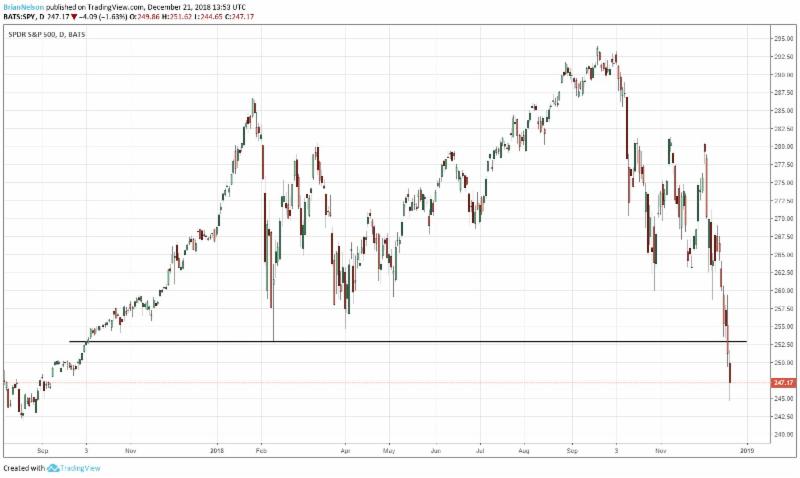
Yesterday was another tough day in the markets. I think we’re going to start seeing more and more of these, both big down days and big up days. Many continue to point to the Fed as the biggest source of uncertainty, but the Fed is almost always the biggest source of uncertainty. The trajectory of growth of China and the US’ relationship with the country have always been an issue. We’re seeing something structurally change in the marketplace, and I think that’s the biggest issue: price-agnostic trading.
I don’t think the levels of volatility we’ve experienced this year are anything to worry about, of course. The most important time period for consideration will always be the future. When in doubt, always remember: All of what is known is in the past, and all of what has value is in the future. The value of research is not to tell you what has happened, but rather to inform you of what is more likely than not to happen.
Surely, we don’t believe last year’s book-to-market (price-to-book) ratio, or which most of quantitative finance is based upon, had anything to do with stock returns this year, which have changed considerably in only the past couple months. What has changed, my friends, is future expectations. If all you’re focused on is the past, you’re going to miss what drives stock returns, and that’s not going to help you or your clients.
It’s not anyone’s fault. We have an entire field in finance that is looking nowhere but backwards. The basic construct of any valuation framework, however, rests on the present value of future expected enterprise free cash flows, not on ambiguous valuation metrics from yesteryear or even ones for next year. Look – data is easy. Data is there. Everyone has data. But you have to think why, why, why is the data important? If you’re not focused on the difference between price and estimated value, you may just be speculating.
I have no expectations for market activity today or for the rest of this year, but I do believe in coming years, we may see levels of volatility not witnessed in a very, very long time. If most of quant is looking at past data that is not causal to stock returns, and most indexers are buying anything at any price, most of the structure of today’s stock market is made up of speculators, plain and simple. I think we’ll be in for a wild ride soon. Fasten your seat belts.
Link to original article: http://campaign.r20.constantcontact.com/render?m=1110817109903&ca=c518858e-57f1-48a8-a44a-7e1021da2fad
—–
Valuentum members have access to our 16-page stock reports, Valuentum Buying Index ratings, Dividend Cushion ratios, fair value estimates and ranges, dividend reports and more. Not a member? Subscribe today. The first 14 days are free.
Brian Nelson does not own shares in any of the securities mentioned above. Some of the companies written about in this article may be included in Valuentum’s simulated newsletter portfolios. Contact Valuentum for more information about its editorial policies.