
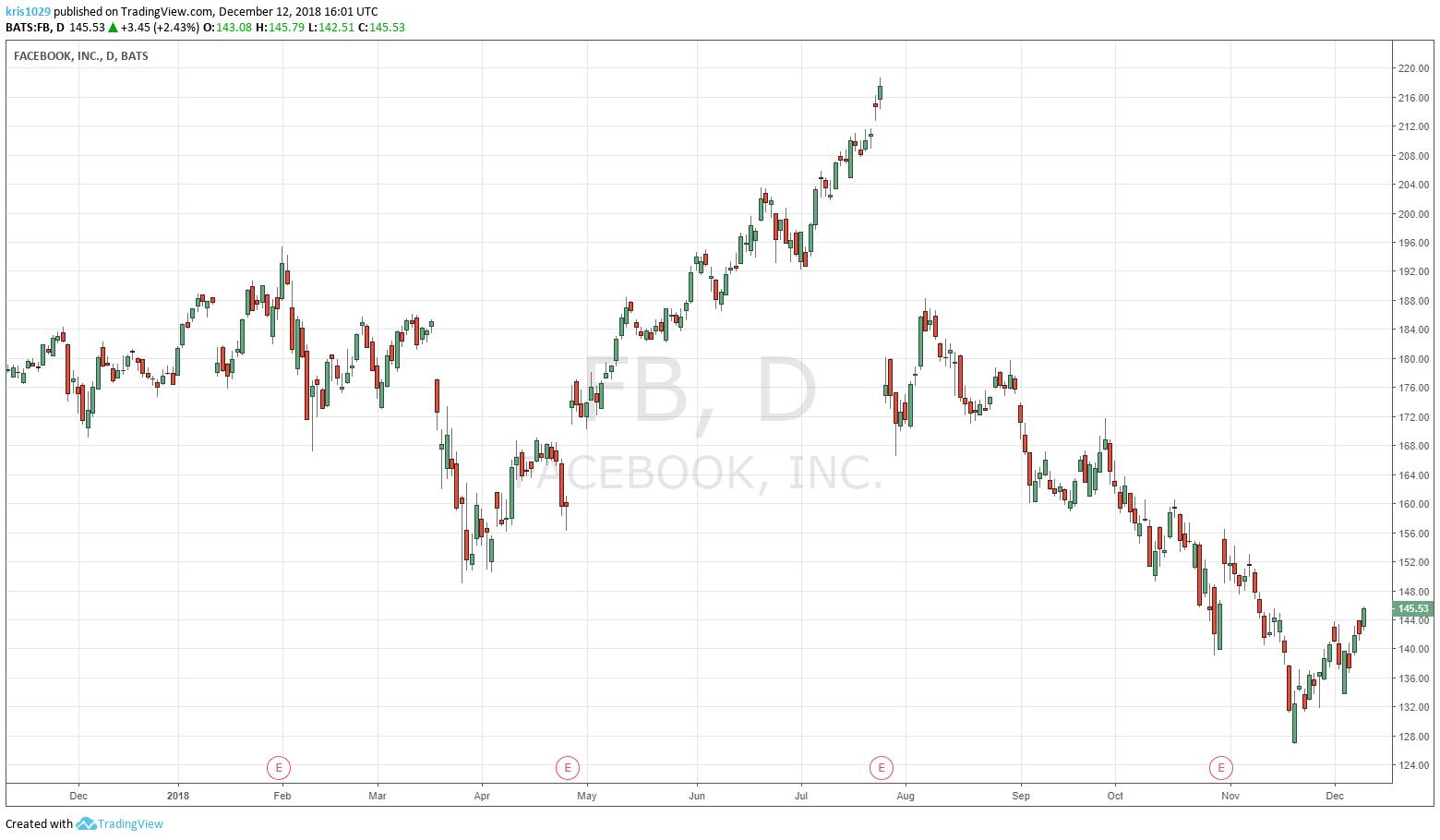
Image Shown: Facebook’s share price performance since late 2017. Shares may be poised to breakout of a recent downtrend. Source: TradingView.com
Facebook has faced significant pressure from a number of sources in recent months, but we continue to like the stock, which may be poised for a technical breakout and appears undervalued.
By Kris Rosemann
It’s no secret that simulated Best Ideas Newsletter portfolio idea Facebook (FB) has been working to right the ship while under an intense level of scrutiny from a variety of sources. The company has been caught in perhaps an unprecedented culmination of social and political pressures, but these are unprecedented times.
We continue to like shares of Facebook due to the robust free cash flow the company generates, its fortress-like balance sheet, and its current position in an online advertising duopoly along with fellow simulated Best Ideas Newsletter portfolio idea Alphabet (GOOG, GOOGL). Estimates for the 2018 calendar year suggest that Facebook controls ~19.5% of the nearly $280 billion digital ad market, second to only Alphabet’s Google, which holds an estimated 31.5% share.
Facebook is now looking to expand the avenues through which it sells advertising, though its most recent endeavor is not exactly new as it explored a similar service around the time of its IPO in 2012. The company is reportedly testing the implementation of ads in its search results and Marketplace, a similar feature to Google’s AdWords, and it plans to test the feature by letting a select group of advertisers display ads on search results pages in mobile in the US and Canada, with the potential for the feature to be expanded to other regions. Critics of Facebook may point to the new advertising feature as another potential exploitation of user data by corporations looking to sell more targeted ads, and this has been a key sticking point for the social pressure heaped on the company recently.
The move comes as Facebook and other social media entities, such as Snap (SNAP), continue to work with advertisers on monetizing the increasingly popular “stories” feature that has been a smash hit with users around the globe. Slowing revenue growth has also been a key feature of negative news surrounding Facebook of late, but we’re less concerned with ongoing double-digit top-line increases at the social media giant than we are with significantly increased spending that appears to be at least in part influenced by outside pressures.
E-commerce giant Amazon (AMZN) is also making a significant push into the online advertising market as well and currently holds the number three position in the US behind Google and Facebook. The dominant player in online shopping has a treasure trove of user data and a massively popular platform, both of which bode well in its quest for a growing share of digital advertising. Perhaps the most interesting angle of Amazon’s move is its proximity to points of consumer decision making. If users find an ad that strikes the buying bone properly, it may be possible that conversion rates of interested consumers on a platform such as Amazon’s could eclipse that of the current players that require additional effort.
Amazon is still a long way from gaining material share, but its presence should not be written off entirely. The trade-off for advertisers to consider, at least for the time being, may be for a lesser reach compared to the potential exposure of Facebook or Google but with a more acute target that could bring potentially higher conversion rates. In any case, the days of Facebook and Google operating in a digital advertising may come to an end if Amazon is successful in its disruptive endeavors. It certainly would not be the first time the company has altered the landscape of an industry, albeit not one quite like this.
Regardless of the success of the young search ads test and despite recent scrutiny, we continue to like shares of Facebook, which are currently trading at a notable discount to our fair value estimate of $229 per share, an estimate that incorporates assumptions such as notable revenue growth deceleration and significant operating margin contraction. What’s more is that shares may be poised to break out technically after months of selling pressure. We’re going to keep highlighting this idea in the simulated Best Ideas Newsletter portfolio due in part to these two current attributes, the first of which is supported by a debt-free and cash-rich balance sheet and robust free cash flow generation.
—–
Valuentum members have access to our 16-page stock reports, Valuentum Buying Index ratings, Dividend Cushion ratios, fair value estimates and ranges, dividend reports and more. Not a member? Subscribe today. The first 14 days are free.
Kris Rosemann does not own shares in any of the securities mentioned above. Some of the companies written about in this article may be included in Valuentum’s simulated newsletter portfolios. Contact Valuentum for more information about its editorial policies.