
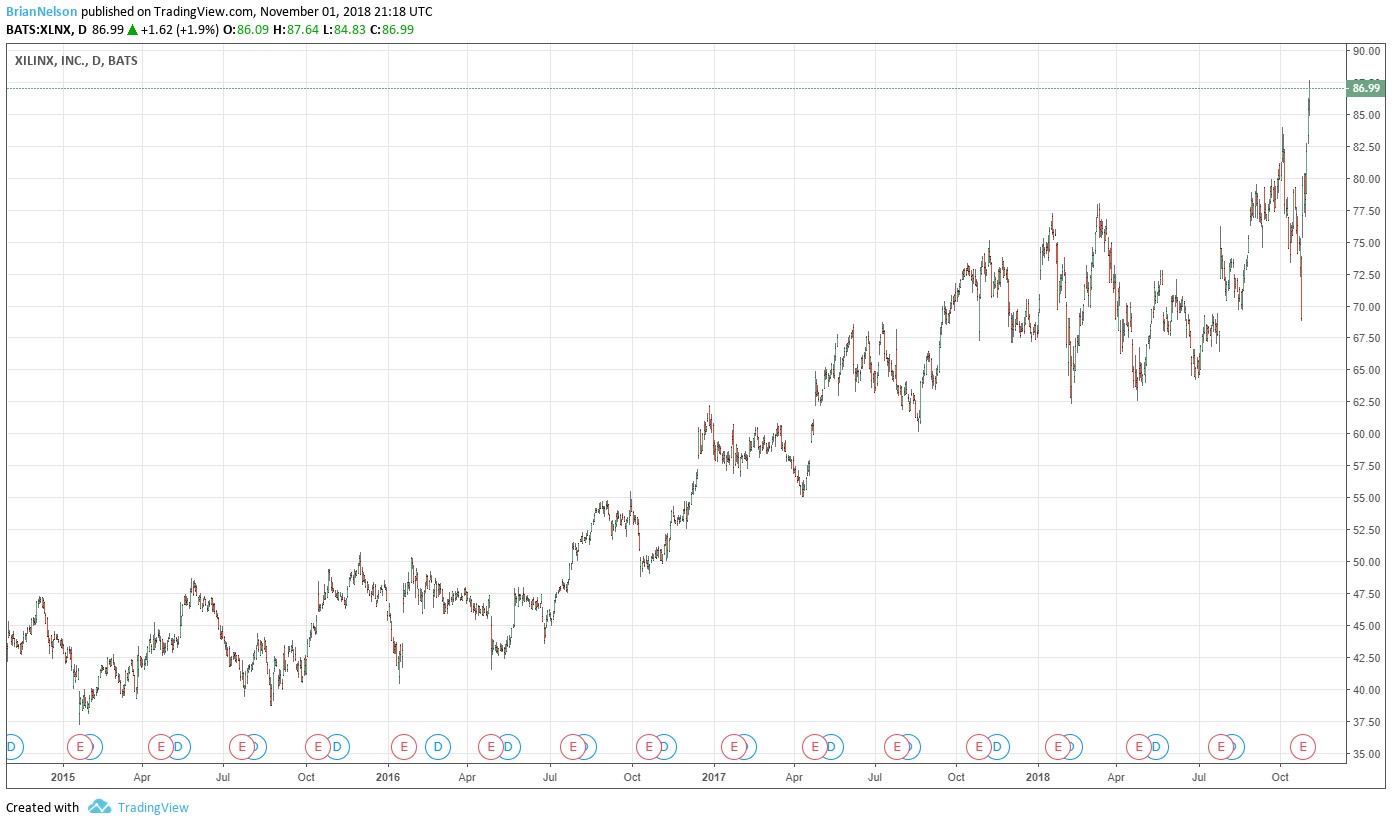
We’re adding Xilinx to the simulated Dividend Growth Newsletter portfolio. The company generates a hefty Dividend Cushion ratio of 3.3!
By Brian Nelson, CFA
Xilinx (XLNX) rewrites the book when it comes to free cash flow efficiency!
The company makes programmable logic devices (PLDs), including programable System on Chips (SoCs) and three-dimensional integrated circuits (3D ICs), and its intellectual property is a key component of its value proposition. During the three fiscal years ending 2018, for example, Xilinx’s operating cash flow averaged over $830 million, while its entire cash bill for capital spending, including growth and maintenance, averaged just over $50 million, meaning all capital spending represented, on average, approximately 6% of operating cash flow. This is simply incredible.
During the three fiscal years ending 2018, Xilinx generated substantial free cash flow, averaging roughly $780 million per year. Xilinx is about as capital light of an entity as one can imagine, and we love these types of companies in the simulated Dividend Growth Newsletter portfolio because it means more of their free cash flow can go to future dividend growth. Though shares are not necessarily cheap, we expect an upward revision to our fair value estimate upon the next update.
The company’s share-price breakout has us excited, too, and its recent deal with Microsoft (MSFT), ousting Intel’s (INTC) Altera unit is very encouraging on the competitive front. Shares yield ~1.8% at the time of this writing, but we’re expecting some big growth in coming years. Its impressive dividend growth potential is further bolstered by a net cash position on the balance sheet.
Here’s what we say about the company in its Dividend Report:
Key Strengths
Xilinx is expecting expansion in the markets it serves thanks to ‘multi-market high growth megatrends’ including cloud computing, embedded vision, industrial Internet of Things, and 5G wireless. These dynamics add to the dividend growth potential embedded in the firm’s capital-light business model, which drives solid free cash flow and helps maintain a healthy balance sheet. As of the end of fiscal 2018, the company had a net cash position of ~$1.7 billion, inclusive of current debt. Free cash flow generation averaged ~$781 million over the past three fiscal years (2016-2018), more than enough to cover annual run rate cash dividend obligations of just over $353 million.
Potential Weaknesses
Xilinx appears to have very little dragging on its dividend growth potential. Management has been very shareholder friendly as of late, having returned more than 100% of operating cash flow to shareholders via dividends and share repurchases in the past ten years. Competing capital allocation options in the form of share repurchases (averaged nearly $480 million from fiscal 2016-2018) have the potential to impact the pace of dividend expansion moving forward. Nevertheless, we expect the supporting macro trends to continue to fuel demand for Xilinx, and its solid free cash flow generation and impressive balance sheet health should drive ongoing dividend growth.
Readers should expect a material increase in our fair value estimate of Xilinx, in part because of its new deal with Microsoft, but mostly due to a lower cost of capital assumption to better reflect its fundamental financial risk.
—–
Valuentum members have access to our 16-page stock reports, Valuentum Buying Index ratings, Dividend Cushion ratios, fair value estimates and ranges, dividend reports and more. Not a member? Subscribe today. The first 14 days are free.
Brian Nelson does not own shares in any of the securities mentioned above. Some of the companies written about in this article may be included in Valuentum’s simulated newsletter portfolios. Contact Valuentum for more information about its editorial policies.