
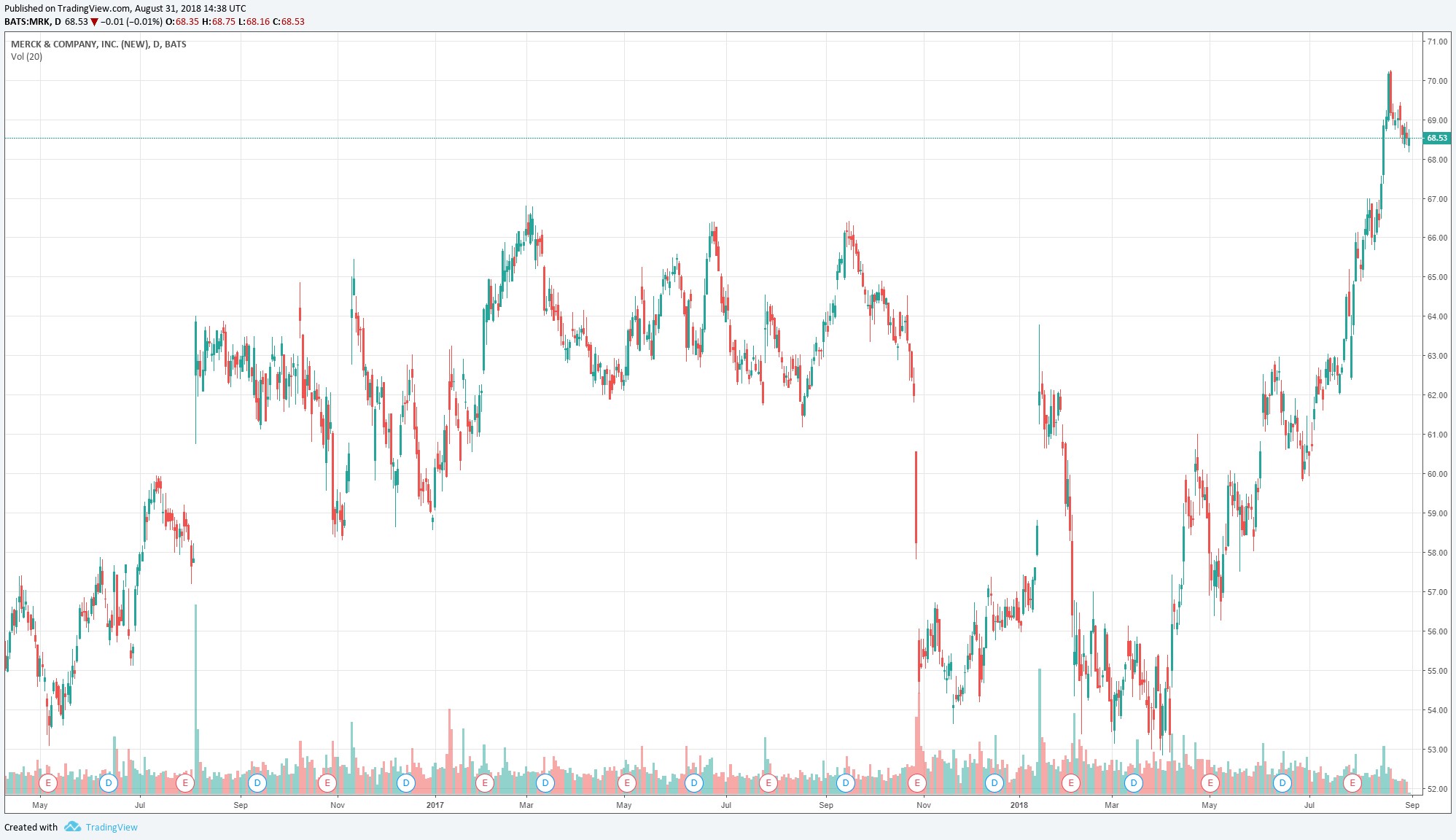
Shares of pharmaceutical giant Merck continue to accelerate thanks in large part to the growth of its key oncology asset Keytruda. Even though Merck is a well-established entity, future growth is highly correlated to the continued expansion of Keytruda as it continues to gain market share thanks in large part to superior clinical data and label expansion.
By Alexander J. Poulos
Key Takeaways
Keytruda remains a star performer powering Merck’s quarterly performance.
We remain big fans of Keytruda’s potential as the recent clinical data underscores the best in class potential of the molecule.
The performance of Keytruda is critical for Merck as sales deceleration in former growth properties begin to weigh on overall sales of the company.
Why are we profiling Merck in the High Yield Dividend Newsletter? For one, we’re expecting big growth in the company’s dividend in coming years, and the entity almost yields 3%. When it comes to pharma/biotech exposure in the High Yield Dividend Newsletter, we’re pretty light.
Merck is a strong consideration, even if the magnitude of its dividend yield may be still one in the making. The high end of our fair value range for Merck is $74 per share. The company is trading at ~$68 per share at the time of this writing.
Merck’s Keytruda
We would classify Merck (MRK) as an oncology growth story as future expansion is highly correlated with the performance of Keytruda. We are comfortable with the large degree of exposure tied directly to Keytruda as it is not uncommon for one or two compounds to fuel growth as witnessed throughout the pharma landscape. The large degree of concentration, however, carries an elevated degree of risk if a new entity disrupts market share, usually via an unexpected post-marketing side effect or through superior clinical data.
A recent example of this phenomena is the relatively poor performance of Bristol-Myers Squibb (BMY) since it topped out in the mid-$70s in July 2016, fueled in large part by the superior data that Keytruda continues to generate. Despite the broader stock market reaching new highs yet again, Bristol-Myers’ share price has yet to recover from the steep sell off due in large part to its key compound Opdivo failure in a critical clinical trial in August of 2016. Shares of Bristol are trading at ~$60 per share at the time of this writing.
Merck’s Keytruda continues to cement its dominance as the go-to immune-oncolytic agent as evidenced with an impressive string of data releases, culminating with simply stellar numbers following the recent ASCO conference in June of 2018. The data presented at ASCO, in our view, has cemented Merck’s leadership position in Immuno-Oncology, thus paving the way for future revenue growth for Keytruda. The pace of expansion is evident in Merck’s second-quarter numbers, released July 27, as the company reported Keytruda sales of $1.667 billion for the second quarter 2018 versus $881 million in the second quarter of 2017, an 89% year-over-year increase.
As impressive as Keytruda’s second-quarter performance was, Merck may still be in the early stages of realizing the full commercial potential of Keytruda. Firstly, the data release in June of 2018 came at the tail end of the second quarter, meaning the sales force has not even begun the marketing push for Keytruda based on new data. In addition to the expected strong push from the sales force, the FDA has yet to grant first-line status to Keytruda in certain indications, thus an additional regulatory hurdle is impeding wider uptake.
On August 20, however, the FDA approved Keytruda for first-line metastatic Non-Small Cell Lung Cancer (NSCLC), but there are still opportunities. We were especially impressed with comments made by Merck during the July 27 conference call that the company is capturing roughly two thirds of all new patient starts for first line Non-Small Cell Lung Cancer (NSCLC), one of the largest areas of need. We view Merck’s commentary as further validation of our thesis that Merck is now in the pole position with the key immuno-oncolytic agent.
The Oncology division remains the linchpin of Merck’s growth as the division generated sales of $3,6 billion for the first six months of 2018. To add further context to the sales figures, Merck’s pharmaceutical sales generated $18.2 billion for the comparable period. Oncology remains an area of notable growth, as Merck needs continued expansion in oncology to offset the loss of revenue from other divisions.
Diabetes Franchise
The Diabetes division spearheaded by Januvia and Janumet continue to feel the pressure form new entrants, along with a less-than-optimal reimbursement environment, which continues to weigh on margins.
Januvia posted sales of $949 million during the second quarter of 2018 versus sales of $947 million in the second quarter of 2017. The “flattish” nature of sales of Januvia, in our view, underscores the competitive nature of the diabetes market. Janumet fared somewhat better with sales of $585 million versus sales of $563 over the comparable year-over-year second-quarter periods.
We do not view Diabetes as an area of focus for Merck going forward as the company has one asset in phase 2 trials, which is currently under clinical hold. Typically, when a product is placed on a clinical hold, it is due to some underlying issue, either with the efficacy of the product or the side-effect profile. Instead, we believe Merck will look to maximize the profitability of the unit, which may include a lower sales level as funding for reps may be diverted into other more promising areas.
Vaccines
The vaccine market remains an area of growth for Merck, in spite of recent disruption via a new product introduction by GlaxoSmithKline (GSK). Merck’s Zostavax vaccine for shingles has been disrupted by Shingrix, GSK’s two-shot regiment for the prevention of shingles in adults.
Zostavax six-month sales in 2018 totaled $108 million versus the $308 million over the first half of 2017, despite the severe manufacturing constraints as GSK woefully underestimated demand for Shingrix. Going forward, we expect Zostavax sales to tail off further, however. Thankfully for Merck shareholders, the continued growth of Gardasil and Proquad continue to power growth higher.
Sales for Merck’s entire Vaccine division totaled $2.9 billion in the first half of 2018 versus $2,744 in the comparable period of 2017. The Vaccine division remains an area of continued investment for Merck, as with three assets in phase III trials (though one is under clinical hold), along with one under review by the FDA. We view the Vaccine division as a steady growth engine for Merck, and though it lacks the explosive growth of a “Keytruda-like-drug,” the business dynamics remain compelling, in our view, as Merck looks to continue to build on its leadership position in vaccines.
Animal Health
The pricing dynamics of Animal Health remain favorable, thus underscoring Merck’s continued enthusiasm for the division. Unlike its smaller rival Eli Lilly (LLY), which plans to spin off to shareholders its Animal Health Division (Elanco), Merck continues to view Animal Health as an area ripe for additional business development deals. Sales for the first six months of 2018 totaled $2.16 billion versus $1.89 billion in the comparable period of 2017 for an overall year-over-year growth rate of 14%.
In our view, we favor Lilly’s move to spin off Elanco as the impressive growth prospects of the division will no longer be masked by the much larger revenue stream of the parent. Let’s keep in mind–the end users tend to be brand loyal with the relative absence of a robust generic market for branded animal feeds. Thus, the overall dynamics of Animal Health remain very favorable in our view.
Wrapping Things Up
Overall, for the second quarter, Merck reported sales of $10.5 billion versus $9.93 billion in the second quarter of 2017, an increase of 5%. The increase in sales allowed Merck to post earnings of $1.06 per share on a non-GAAP basis, well ahead of the consensus projection. The better-than-expected performance prompted management to raise its annual earnings guidance to $4.22-$4.30 versus the prior range of $4.16-$4.28 per share.
We remain bullish on the prospects of Keytruda, as we feel at this juncture the molecule remains best-in-class in the ultra-competitive field of Oncology. Our issue with Merck remains the deceleration in sales of other key franchises, however, which may hamper some of the upside revenue potential for Merck. We’ll be monitoring this risk closely.
Our fair value estimate range for Merck is $50-$74 per share with the recent share price rally pushing Merck towards the higher end of our fair value range. We rank Merck’s dividend as Good with a Dividend Cushion ratio of 2, underscoring the ability of Merck to raise its dividend over time. We like Merck’s long-term prospects, and we’re hoping that we may have a chance in the future to add the idea to either the simulated Dividend Growth Newsletter portfolio or the simulated High Yield Dividend Newsletter.
—–
Valuentum members have access to our 16-page stock reports, Valuentum Buying Index ratings, Dividend Cushion ratios, fair value estimates and ranges, dividend reports and more. Not a member? Subscribe today. The first 14 days are free.
Independent healthcare and biotech contributor Alexander J. Poulos does not own shares in any of the securities mentioned above. Some of the companies written about in this article may be included in Valuentum’s simulated newsletter portfolios. Contact Valuentum for more information about its editorial policies.