
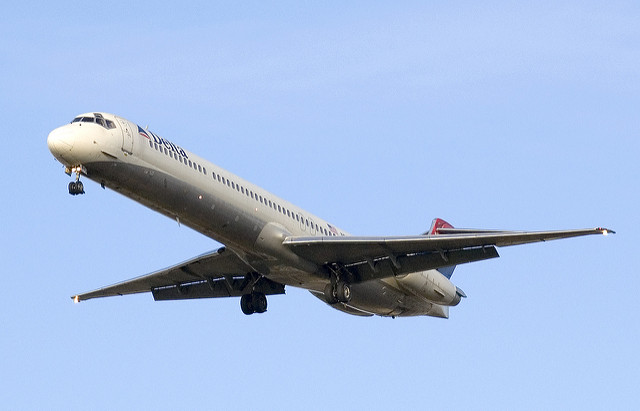
Image Source: BriYYZ
Warren Buffett has famously said that airline stocks are horrible long-term investments, but his vast portfolio now owns a number of airlines. What’s the bull case for owning these capital-intensive, cyclical and often boom-and-bust stocks?
By Brian Nelson, CFA
Last year, the Oracle of Omaha Warren Buffett shocked the investment world when his company Berkshire Hathaway (BRK.A, BRK.B) disclosed that it held stakes in American Airlines (AAL), United Continental (UAL), Delta (DAL) and Southwest (LUV). For a die-hard, economic-moat investor, thinking about taking a stake in an airline seems crazy. After all, Buffett himself used to joke that he had an 1-800 number that he could call anytime he had the urge to buy an airline stock – “’My name is Warren and I’m an air-aholic,’ and then they talk me down” – is what he reportedly once quipped.
There may be a couple reasons why Buffett & Co. added airlines to his portfolio, in our view. The stated reason by Buffett and his partner Charlie Munger could be that the industry has rationalized (given consolidation over the years), but given the low barriers to entry, excess capacity will always be a threat, especially during downturns. For one, the airline business is a “sexy” one, and there will always be entrepreneurs wanting to break into it. Boeing (BA) has a webpage to help them get started, and just recently, Iceland-based low-cost carrier WOW Air just launched service in the Midwest United States. We’re skeptical that the structural dynamics of the airline business have favorably transformed, and the view that just because the business has had a bad first century that the current one is certain to be better seems a bit of a logical stretch.
That said, holding airline stocks in a diversified portfolio can make sense under certain conditions. We think, for example, that a hedging benefit is probably the more reasonable explanation as to why Berkshire jumped into the airline space. For example, even if airline industry capacity (the number of seats) cannot by definition be permanently rationalized (the industry was deregulated in the 1970s), airline business models may offer a very unique hedge for energy-heavy portfolios against falling energy resource pricing. With Berkshire owning a number of energy giants, one way for the firm to hedge against spot-rate declines is to scoop up equities that benefit in the event energy resource prices fall. Airlines are probably an industry most impacted by the cost of fuel; railroads are another, and it’s probably no surprise Berkshire owns railroad Burlington Northern, too.
We’ve written extensively about the reasons why airline stocks are not long-term investments, “Warren Buffett Is Back Into Airlines, Should You?,” and we maintain that view, but for investors that do have portfolios heavily-weighted toward energy, the allure of airline equities can be great, especially if investors don’t want to dabble in energy commodities specifically. The newsletter portfolios don’t have too much exposure to energy stocks, so we can’t see a reasonable path toward adding capital-intensive, cyclical airlines to them, but if we did ever decide to “take on” the risk of airline equities, it would have to be a diversified idea, namely the US Global Jets ETF (JETS) — see more here. We won’t be making any moves anytime soon, however.
Airlines – Major: AAL, ALK, DAL, HA, JBLU, LUV, SAVE, UAL
Related: RYAAY, GOL, SKYW