
“Be sure to continue to study the difference between price and value—just because a stock’s price has advanced doesn’t make it more expensive if the value of its enterprise has increased at a faster rate. If you understand this concept, you may be smarter than 99.9% of the investing population.” – Brian Nelson, CFA
By Brian Nelson, CFA
The first quarter of 2017 came and went.
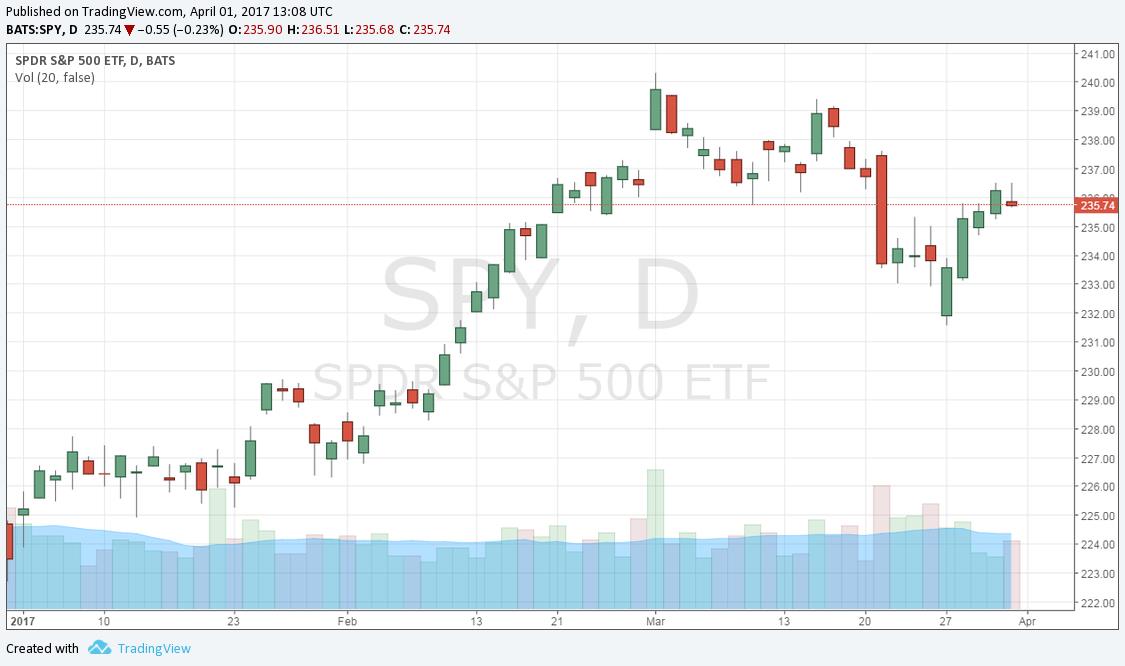
Including dividends, the S&P 500 (SPY) roared nearly 6% higher during the period thanks to solid gains from the land of technology, an area that we have liked for the longest time. The Technology Select Sector SPDR (XLK) advanced more than 10% during the period, and key technology holdings in the Dividend Growth Newsletter portfolio include Apple (AAPL), Cisco (CSCO), Intel (INTC), and Microsoft (MSFT). Apple has surged to nearly $145 per share from ~$115 at the start of the year. Cisco is now approaching $34 per share from just north of $30 at the start of 2017. Intel has held the line at $36, despite a nice dividend increase to $1.09 per share on an annual basis (~3% annual dividend yield), while Microsoft is now ~$66 per share, up a few dollars from the beginning of January. The Dividend Growth Newsletter portfolio has been well-rewarded as a result, and we trust that those that are following along are very, very happy. Some of our members are even doing better, and we love that!
I’d like to take a quick second to help readers better understand the annualized return measurement that we use to assess performance of the Dividend Growth Newsletter portfolio. The return measurement is not an absolute measure as that of the Best Ideas Newsletter portfolio, where if the portfolio value increases, the return increases. In the case of annualized returns, if performance does not advance faster than the negative impact of the passing of time, the annualized return may actually decline for any given period even if the portfolio itself advances. In this light, it’s easy to see how targeting a high-single-digit annualized return for a Dividend Growth Newsletter portfolio is no easy task, as in some cases, both the market and time can act as significant headwinds. That said, however, we think the annualized measure is appropriate when it comes to dividend growth investing, as most income investors are looking at their monthly or annualized income, and the annualized return speaks to that consideration. This may not be the easiest mathematical concept to understand, so please let me know if I can elaborate further.
The largest-weighted holding in the Dividend Growth Newsletter, Johnson & Johnson (JNJ) hit a new high of ~$129 per share during the month, and we must say we’re pretty pleased with the company’s performance. We’re huge fans of J&J’s opportunities in oncology, “Johnson & Johnson’s Oncology Division A Force to Be Reckoned With (February 2017):”
J&J continues to pivot into the field of oncology as reimbursement levels remain robust.
The company owns a 50% stake in Imbruvica, the pace setter for the treatment of Leukemia, and sales of Imbruvica continue to ramp higher as partner AbbVie (ABBV) pushes for a more rigorous label. The expansion of Imbruvica’s treatment label is crucial for the product to reach its lofty peak annual sales estimates of $6 billion, and J&J’s portion of Imbruvica sales came in north of $1.2 billion in 2016, a significant jump over 2015’s tally. We remain excited about Imbruvica’s potential and view the product as an attractive cornerstone of J&J’s oncology division.
Still, new compounds are necessary to expand J&J’s reach in the field, and the recently approved Darzalex for the treatment of multiple myeloma may help to fill this role. The product achieved approval as fourth line monotherapy, but its true potential remains in combination with the established treatments in the field. For example, J&J is looking to pair Darzalex with Velcade in addition to dexamethasone in an effort to set up a new standard of care for the treatment of multiple myeloma, which remains an area of intense competition with multiple recent entrants into the field.
We are impressed with Darzalex thus far and feel J&J has a winning compound that should help offset potential sales erosion from the loss of patent exclusivity for Remicade. With Imbruvica and Darzalex in the fold, J&J’s ‘Oncology’ division is a force to be reckoned with.
Hasbro (HAS), another top holding in the Dividend Growth Newsletter portfolio, continues to defy gravity, hitting a new high during March, following a nice dividend hike of nearly 12% in early February. I’m just so thankful for those that see the many good things that we do, and highlighting Hasbro repeatedly has been one of them, “EVERYTHING DIVIDENDS.” The toy giant was added at a mere ~$30 per share at the inception of the Dividend Growth Newsletter portfolio, and now shares have rocketed to nearly $100 each. Of course, we’ve had better performers along the way, but I’m just really happy that things continue to work out for members. Any time that investors can triple their money on a solid dividend payer, it’s a good thing. Hasbro management had a lot of good things to say in its latest quarterly release:
Hasbro’s global team delivered a tremendous 2016. We reached the $5 billion revenue mark for the first time in company history, we improved profitability and we invested to grow Hasbro over the long-term while increasing our dividend and share repurchase levels. Hasbro’s foresight to build brands led by storytelling, consumer insights and innovation, combined with the relentless execution of our Brand Blueprint including investments in entertainment and digital gaming, is driving our business and creating long-term strategic differentiators for Hasbro. We are well positioned for a successful 2017 and the continued advancement of Hasbro’s brand-building capabilities for years to come. – CEO Brian Goldner
Our strong top line performance continued in the fourth quarter and we profitably grew Hasbro throughout the year. Looking ahead, we are very well positioned to support our business. We continue investing in our industry-leading brands, our differentiated capabilities around the Brand Blueprint and in our systems to support long-term, cost efficient business growth. We ended the year with $1.28 billion in cash, inventories in line with last year, and we paid out $400 million to shareholders through dividends and share repurchases.” – CFO Deborah Thomas
We’re still being patient with some of the new additions to the Dividend Growth Newsletter portfolio. Boeing (BA) is sitting comfortably above our add price, and we continue to believe that the aerospace (plane-building) market remains one with the greatest visibility within the industrials sector (XLI), if not of any sector, including utilities (XLU). The backlogs of the airframe makers remain robust, and while order growth may slow in coming periods, we think it is more a function of not being able to receive planes fast enough than anything else – near-term slots are full so no need to rush an order in. Boeing’s total company backlog at the end of 2016 was $473 billion, which includes more than 5,700 airplane orders, or nearly a decade worth of deliveries at the current annual run rate. Its 3%+ dividend yield should provide support to the equity, and free cash flow of $7.9 billion covered cash dividends paid of $2.8 billion by nearly 3 times during 2016.
There’s not much to say about Hanesbrands (HBI), despite our continued acknowledgement of its disappointing performance out of the gate, but this has happened many a time before. We may be off on the timing by a few months or so, and then the stock comes roaring back in a big way, only to find that many that may have liked it initially have moved on to another idea. It takes patience to be successful in the market, and many investors have a difficult time waiting a month or so let alone a couple years. The Alerian MLP ETF (AMLP) has essentially held the line since it was added to the newsletter portfolio, and many have pointed to its tax implications, so be cognizant of those (we cannot provide any tax advice). Crude oil prices (USO) have bounced considerably from the mid-$20s doldrums, and as we’ve pounded the table on the concept of the linkage between midstream equities and energy prices, midstream MLPs have come rallying back, as expected. Let this finally be put to rest: the fundamentals and prices of midstream equities are tied to energy resource pricing.
We include the Energy Select Sector SPDR (XLE) in the Dividend Growth Newsletter portfolio, too:
The key benefit to energy sector ETFs rests heavily on diversified exposure to a potential rebound in the price of crude oil, which will be a relief not only for exploration and production entities but also for oil and gas equipment and servicing firms, which are tied heavily to capital spending at the majors. In our view, most energy sector ETFs will experience a ‘rising tide lifts all boats’ phenomenon if crude oil prices rise, offering reasonable risk-adjusted ideas for investors to consider following the collapse.
In light of the potential for further price declines in crude oil and the firm-specific risk of a dividend cut by any one operator, however, it’s difficult to argue that energy sector ETFs are not the best risk-adjusted way to play a rebound in crude oil prices. Sector ETFs are also not beholden to any one operator’s capital budget decisions, and as a result, a probable dividend cut by a constituent or two should not be tragic to an ETF’s yield. This should help investors sleep at night. — source
Just a reminder, we think our best ideas for consideration are included in the newsletter portfolios at any given time. Certainly, many ideas have advanced considerably since inception, but our process is always forward-looking. What is sometimes lost amid talk of strong performance is the very notion that if we were to create a new dividend growth portfolio today, it would be the Dividend Growth Newsletter portfolio. Each day our team evaluates whether we want to continue to include existing ideas in the newsletter portfolio—if we don’t, we’ll seek to remove them or develop an exit plan. The newsletter portfolios have done well, including the Best Ideas Newsletter portfolio, but that has little bearing on our efforts to continue to do well in the future. Be sure to continue to study the difference between price and value—just because a stock’s price has advanced doesn’t make it more expensive if the value of its enterprise has increased at a faster rate. If you understand this concept, you’re smarter than 99.9% of the investing population.
I hope you enjoy this April edition of the Dividend Growth Newsletter!
(The April edition of the Dividend Growth Newsletter was released to members April 1.)
Related: VDE, OIH, XES, MAT, EADSY, DIA
Aerospace Suppliers: AIR, AIRI, AL, ATRO, COL, HEI, HXL, ISSC, SPR, TATT, TDY, TXT