
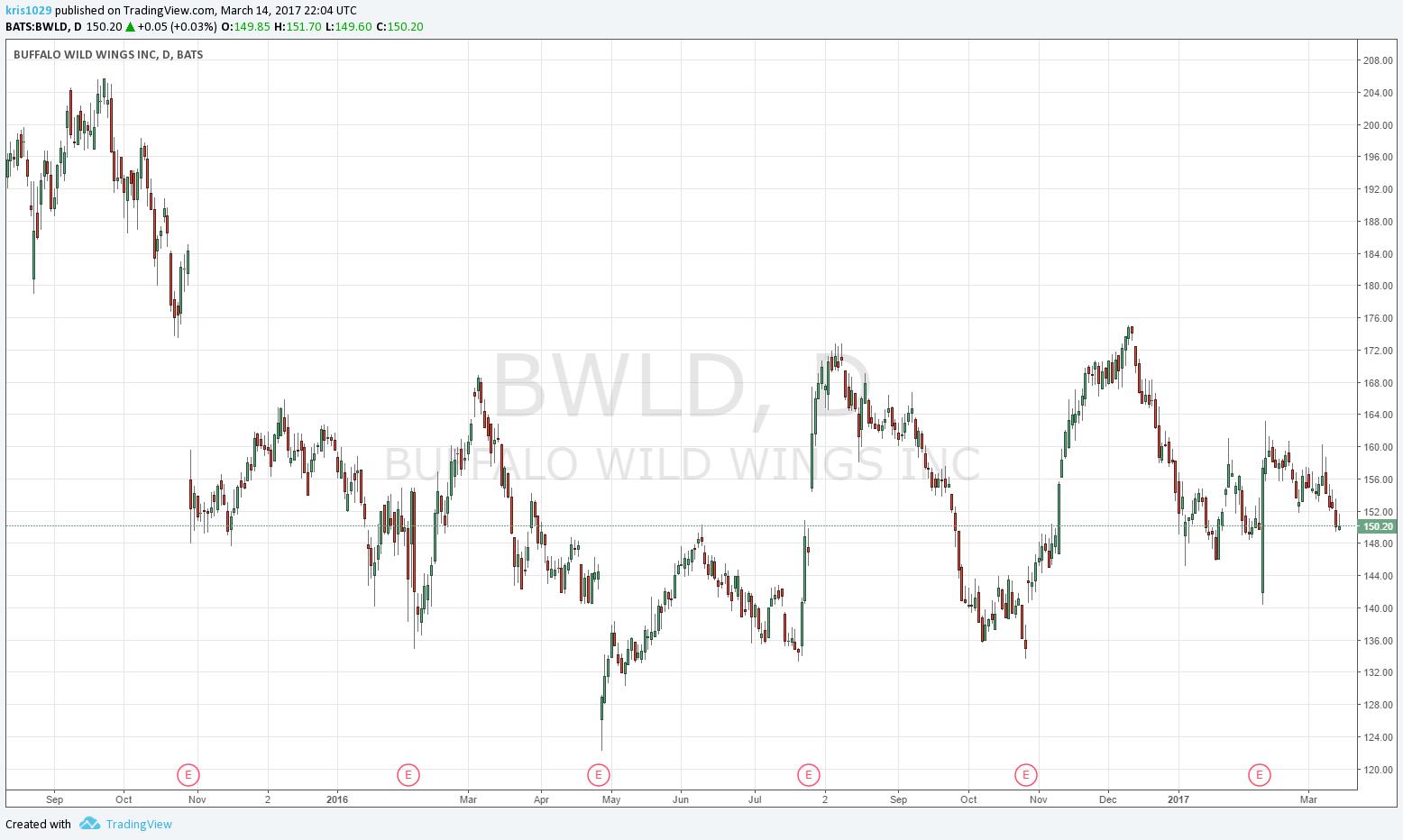
Best Ideas Newsletter portfolio holding Buffalo Wild Wings is battling a challenging operating environment. Management is searching for ways to shore up performance, but some shareholders are getting antsy. Is a BWLD-WING deal in the cards?
By Kris Rosemann
It’s no secret that the restaurant industry has struggled of late, “Restaurant Traffic – What’s Going On?” “Examining Same-Store Sales in the Restaurant Industry.” Best Ideas Newsletter holding Buffalo Wild Wings (BWLD) was not spared the pain in 2016, as same-store sales fell more than 2% at both company-owned and franchised restaurants from 2015 levels, though management is optimistic for 2017 after a positive read on the measure through the first several weeks of the year, “Best Ideas Roundup: Visa, Facebook, Buffalo Wild Wings.” We continue to have confidence in the long-term potential of its distinct “Wings. Beer. Sports.” concept, but let’s dig into some recent developments at the firm along with some of our concerns.
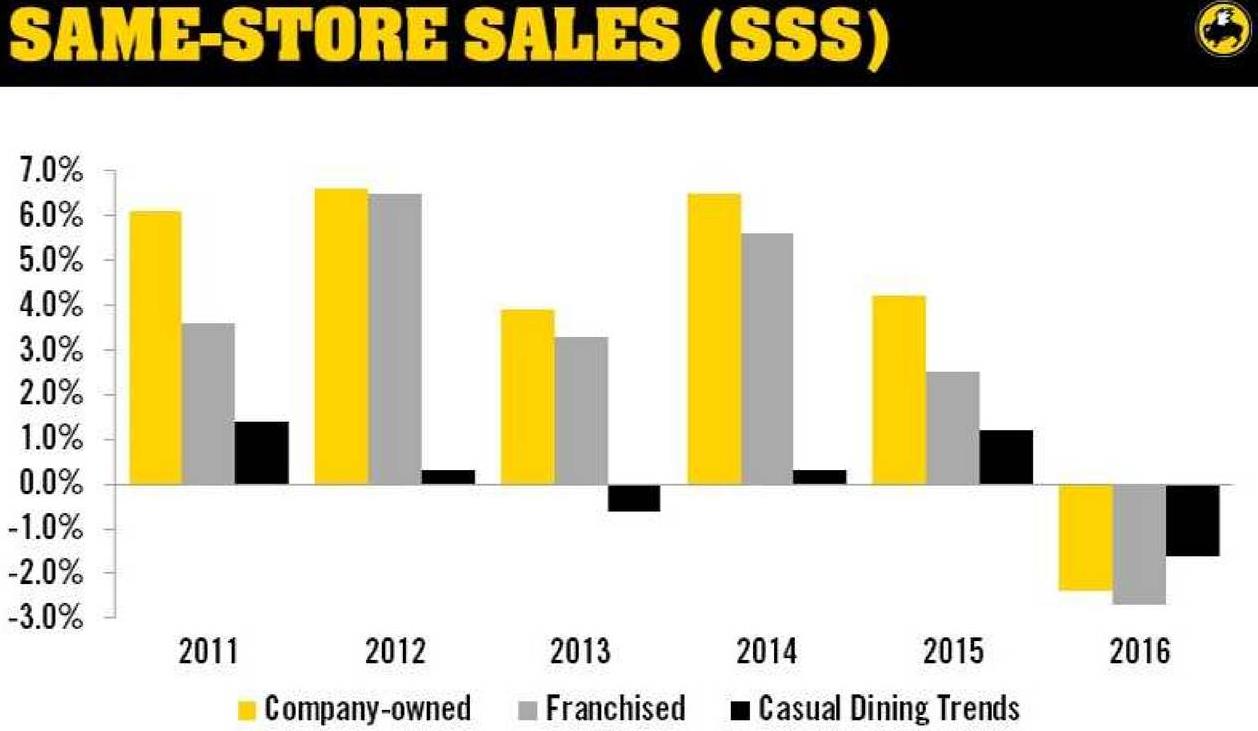
Image source: Buffalo Wild Wings
Activist investment firm Marcato Capital, which owns a 5.6% stake in Buffalo Wild Wings, released a scathing assessment of the management team February 22, demanding company leaders be held accountable for failing to achieve stated objectives on a number of initiatives. The hedge fund cites under-delivering on international growth efforts and poor visibility into financial targets as examples of the lack of credibility Buffalo Wild Wings management has on Wall Street, in addition to pointing to selling of the vast majority of management’s ownership stakes since the IPO in 2003. The full presentation can be seen here (http://www.winningatwildwings.com/content/uploads/2017/02/BWLD_Missed-Targets-Feb-2017.pdf), and though we aren’t going to dig in point-by-point, some issues ring true in highlighting areas for improvement.
Buffalo Wild Wings has since released new initiatives that could potentially help it achieve its target of a 20% restaurant-level margin across its system in 2018. However, the measure fell to 17.7% in 2016 from 18.6% in 2015, and management’s 2017 guidance, released February 7 along with fourth quarter results, shows it is expecting only 10-30 basis points of margin improvement in the year. This suggests the company has identified significant margin expanding initiatives for 2018, or has it?
Portfolio optimization is one of the new initiatives being explored by B-Dubs management; specifically it is exploring the sale of ~10% of its worst-performing company-owned restaurants. Instead of working to improve operations at all of its company-owned restaurants, management has decided to simply franchise some of the lower-margin units. This may result in a step-change in the restaurant-level margin, but the expansion of margins via franchising is not a sustainable profit growth driver. Converting poorly performing company-owned restaurants into poorly performing franchised restaurants–company owned restaurants typically outperform their franchised peers–is not a viable strategy for operating efficiency improvements over the long run, in our opinion.
The other portion of Buffalo Wild Wings’ potential portfolio optimization is alternative format pilots, including takeout and delivery hubs and small format restaurants in metropolitan areas. We like the idea of takeout and delivery hubs in the context of operating a more capital light restaurant model with significantly reduced overhead costs—perhaps similar to that of Wingstop (WING). Such a concept may very well be the future of restaurants, similar to how e-commerce has disrupted traditional retail, but the very idea seemingly runs counter to the Buffalo Wild Wings brand, which was built on the combination of chicken wings, drinking beer and watching sports with fellow sports fans. In fact, Buffalo Wild Wings has identified the experience of dining in its restaurants as one of the key long-term drivers of same-store sales, but it also expects to be able to generate value by removing the entirety of the guest experience from its restaurants. Having diversified restaurant concepts is certainly a reasonable strategy, but contradicting long-term demand drivers is not a reassuring sign.
Management has also tagged its “Blazin’ Rewards” loyalty program as a driver of long-term same-store sales growth, and the team stated it plans to roll out the program systemwide in the second quarter of 2017. The company seems to expect similar results to the “Up to +2% lift in test stores,” but no specific metric or comparison was offered for the 2% lift it is expecting. What’s more concerning about the loyalty program is the fact that management is still hyping it at all. In the company’s 2014 Analyst Day, a stated goal was the launch of a system-wide loyalty program in 2015. The progress of the roll-out has been a complete disappointment, from where we stand, and such developments are the basis for the undressing of management from Marcato Capital.
All things considered, we still have confidence in Buffalo Wild Wings’ potential as a long-term value creator for shareholders. The company does have multiple levers that it can pull to improve operating efficiency, but it is time for management to begin delivering on its promises in a meaningful way. International expansion is a meaningful opportunity for growth, and management may finally be ready to lever up and achieve its international goals–it recently upped its debt capacity to $700 million.
Hedge fund Marcato Capital may be partially overreacting to what has turned out thus far to be a poorly-timed investment–the hedge fund first disclosed its position in late July 2016–but B-Dubs management has acknowledged the validity of some of its concerns. Importantly, however, the context of the struggling restaurant sector when considering the recent struggles of Buffalo Wild Wings should not be overlooked, and if broad traffic trends turn around, a lot of B-Dubs problems may solve themselves. We still like the long-term picture at Buffalo Wild Wings, and we think the company has a lot of options left to create shareholder value—even a buyout of Wingstop (~$750 million market capitalization) isn’t be out of the question. Shares might very well soar on that deal announcement if it happens.