
Consumer staples giants Kimberly-Clark and Colgate-Palmolive are expecting product pricing growth to be less of a contributor in 2017.
We think investors are wising up to the risks of consumer staples stocks, and increasing risk-free rates seem to already be complicating the investment decision-making process for many investors.
Consumer staples equities in the S&P 500 are currently trading at ~19.4 times forward 12-month earnings, well above their sub-17 times 10-year trailing average. We believe investors will continue to swap out of these steady-eddy, but overpriced, gems in the near term, in favor of higher-beta commodity and energy-oriented companies as the market sets up to surge in 2017.
We have been warning about the tipping point in Treasury yields and implications on dividend-paying consumer staples equities for some time.
— Brian Nelson, CFA, “5 Shocking Stock Market Predictions for 2017”
By Kris Rosemann
Valuentum President of Investment Research Brian Nelson’s prediction for the prices of many consumer staples (XLP) stocks to underperform in 2017 continues to be based on valuation considerations and potentially shifting capital allocation preferences of investors, but we’re adding a less-than-optimal product pricing environment to the list of factors that could potentially weigh on the sector in the year. Many consumer staples entities have become used to being able to raise product prices at will, regardless of the economic environment, but recent results have called into question whether consumers are still willing to pay more year after year for the same everyday products.
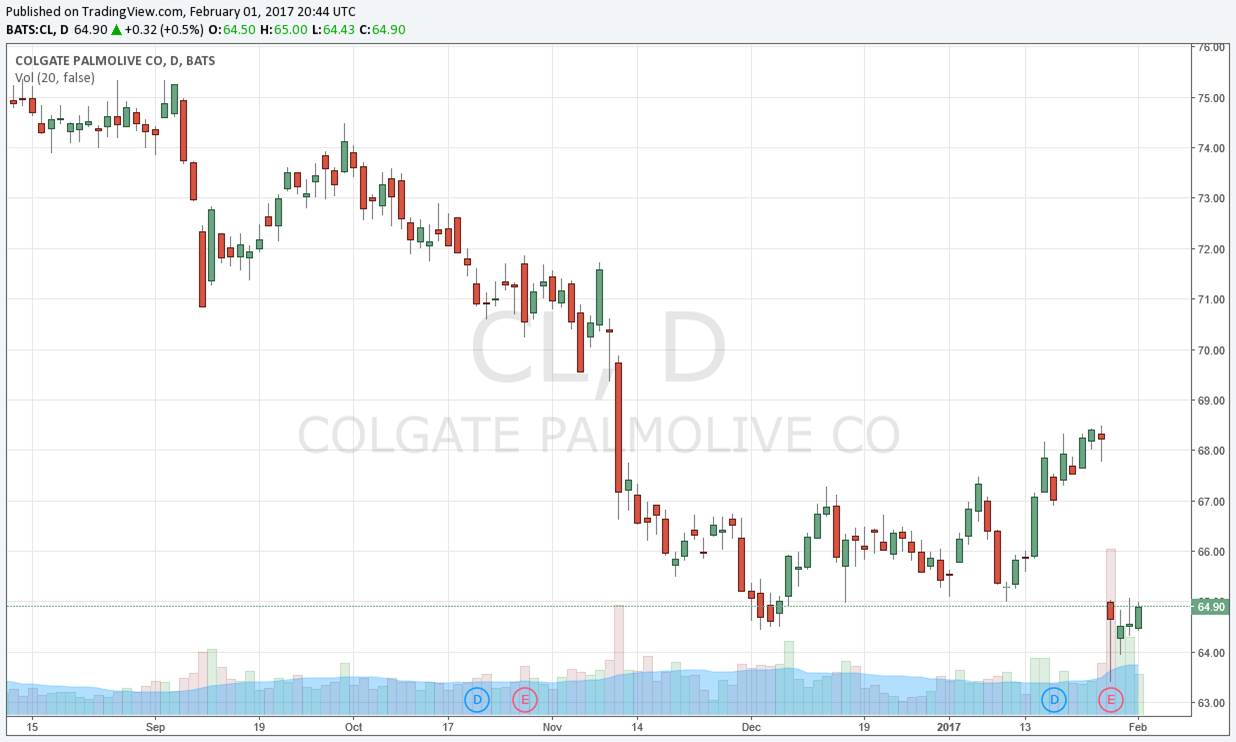
On January 27, Colgate-Palmolive (CL) reported a 4.5% drop in reported revenue in the fourth quarter of 2016 as global unit volumes fell 5.5% and foreign exchange headwinds of 1.5% overwhelmed product pricing gains of 2.5% in the period. Cost savings initiatives helped boost gross and operating margins in the quarter, but an increased emphasis on profitable volume growth rather than direct product pricing initiatives should now be expected to drive organic sales growth through the remainder of 2017–a statement that has caught our attention, even if lower commodity costs, a rather benign condition, is mostly to blame for the tactical change in pricing strategy.