
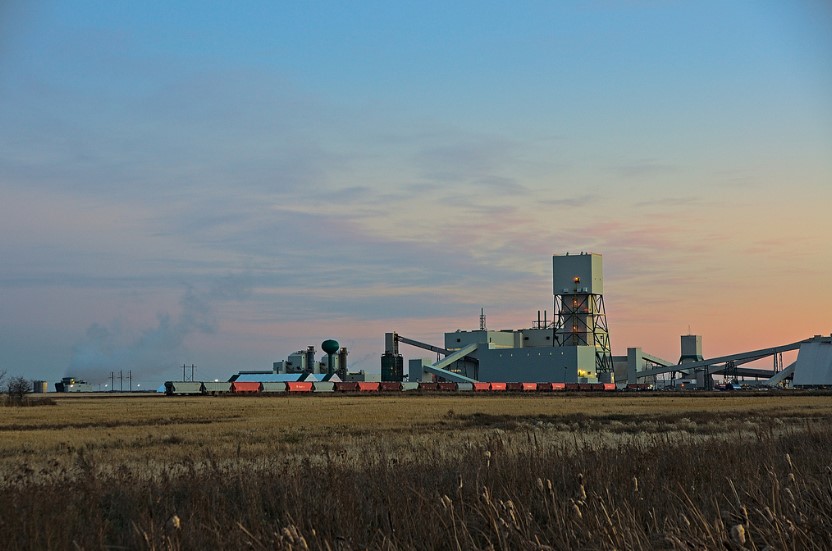
Image Source: Bruce Guenter
By Kris Rosemann
Suppressed crop prices and a supply glut have negatively impacted the financial performance of crop nutrient companies around the world and have helped spur a string of attempted mergers in the agriculture space. Seed giant Bayer’s (BAYRY) pursuit of rival Monsanto (MON) and ChemChina’s purchase of Syngenta (SYT) for $43 billion are two recent examples of consolidation attempts among major agricultural firms, the latter of which is expected to create the world’s largest supplier of pesticides and agrochemicals.
Canadian firms Potash Corp (POT) and Agrium (AGU) had previously announced they were in preliminary merger talks and have now announced an agreement to combine forces in a merger of equals that will create a North American fertilizer and farm retail giant. The new company, which has yet to be named, will combine Potash Corp’s low-cost potash and high-quality nitrogen and phosphate production capacity with Agrium’s impressive agricultural retail network to create an integrated platform better suited to serve its customers worldwide.
Potash Corp shareholders will receive 0.4 common shares of the new company for each common share of Potash owned, while Agrium shareholders will receive 2.23 common shares for each common share of Agrium owned. At the close of the transaction, current Potash shareholders will own ~52% of the new firm on a fully diluted basis.
On a 2015 pro forma basis, the combined company’s net revenue would have been roughly $20.6 billion, while its EBITDA would have come in at approximately $4.7 billion before expected synergies. This would make the firm the largest crop nutrient company in the world, and the third largest natural resource company in Canada. Annual operating synergies are anticipated to be up to $500 million, which are expected to come primarily from distribution and retail combination benefits and production and SG&A optimization. If the expected synergies are successfully extracted, the deal implies value creation for the combined companies of up to $5 billion, a 20% increase to the companies’ combined market capitalizations on August 29, 2016, the day before the firms announced they were in preliminary merger discussions.
The combination is also expected to improve the cash flow generating abilities of the companies as well. On a 2015 pro forma basis, the new firm would have had operating cash flow of more than $4 billion, inclusive of expected synergies. Major capacity expansion projects have been nearly completed at each firm, suggesting capital spending of the companies would have seen a reduction whether or not the merger is completed. Nevertheless, the increased cash flow generation potential will benefit the dividend prospects of the combined company, which is expected to target a dividend payment equal to the current Agrium dividend level. The firm’s shares currently yield ~3.7%.
The improved cash flow generation will be a welcome sign for both companies as neither of them have a healthy balance sheet, in our opinion. As of the end of the second quarter of calendar 2016, the companies had a combined net debt position of nearly $9.8 billion. As a result, we are not fond of the safety of either Potash’s or Agrium’s dividend. Potash has cut its payout twice in the past year, largely due to structural changes in the potash industry, and both it and Agrium receive VERY POOR dividend safety ratings based on their respective Dividend Cushion ratios, which are both well below 1.
We think the Agrium-Potash tie-up makes sense for the companies and for investors already holding shares of the firms as a result of the expected value creation via the extraction of expected synergies, but the deal does not create an attractive opportunity for those currently on the outside, in our opinion. The agreement will face material regulatory pressure, particularly in the US and Canada. The combined company would dominate the crop nutrient market in North America, as it would own nearly two-thirds of potash production capacity, ~30% of phosphate capacity, and ~29% of nitrogen capacity.
Regulators in the US and around the world have not been shy about their increased scrutiny of major mergers as of late. In the agricultural realm, the US Department of Justice very recently sued to keep Deere (DE) from acquiring Monsanto’s Precision Planting farm equipment business. Farmers across North America will inevitably turn to regulatory bodies to help them keep current levels of negotiating power and are likely to find an ally given the recent regulatory environment. The farmers may very well have a compelling case, as fertilizer can account for up to one-third of input costs for US corn farmers.
In that light, the merger’s proceedings are worth watching as it relates to another data point in the evolving regulatory and overall global economic environment in which we find ourselves. Companies are going to continue to look for top-line growth and value creation via mergers and acquisitions amid concerns of macroeconomic weakness and uncertainty. How regulatory bodies worldwide react to such consolidation attempts is anyone’s guess at this point in time, but we are counting on a significant level of inspection and investigation into the competitive implications of the Potash-Agrium tie-up.
Chemicals – Agricultural: AGU, CF, CMP, IPI, MON, MOS, POT, SMG, TNH