
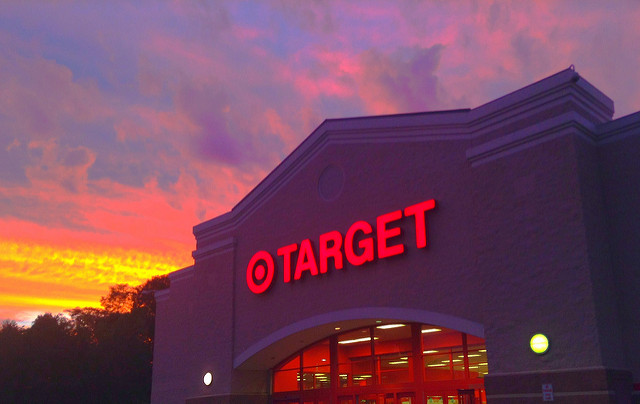
Image Source: Mike Mozart
By Brian Nelson, CFA
Warren Buffett’s Berkshire Hathaway (BRK.A, BRK.B) isn’t the only firm that has become less bullish on Walmart (WMT). The company that the Oracle of Omaha built recently reduced its stake in Walmart to 40.2 million shares from 55.2 million shares, but Valuentum is equally worried about the big box giant’s long-term picture. Target (TGT) is not faring much better, if it is faring better at all.
The structural headwinds impacting both companies aren’t going away anytime soon, and while you wouldn’t know it by the market’s positive reaction to Walmart’s second-quarter report, total operating income, adjusted for the gain from the sale of Yihaodian, fell more than 7% in the period. A bump in Walmart’s full-year earnings per share guidance was welcome news, but the acquisition of Jet.com does little to change the near- and long-term picture, at least from our perspective. Expected operating losses and one-time transaction costs related to the Jet.com deal will weigh on performance in the near term, and online behemoths Amazon (AMZN) and eBay (EBAY) are far ahead of Walmart these days, making any long-term gains particularly difficult.
In Walmart’s second quarter, total revenue increased just 0.5%, while consolidated operating income declined more than 7% as social pressures weighed heavily on profitability. We’ve outlined the extraordinary circumstances the ‘Fight for 15’ movement and efforts to push minimum wages higher across the US are having on its business, and the second quarter was no exception. “Investments in people and technology” hurt operating earnings considerably, and while we’re in favor of workers getting what they deserve, we doubt that Walmart is going to make up for such investments with respect to productivity. The company has been in business for decades, and absent layoffs that may obliterate morale, operating profits will remain under pressure for some time, in our view – and this statement comes during the “best of times,” more than seven years into the economic recovery.
Certainly, Walmart is still a fantastic company with considerable competitive advantages, but its business model is eroding – not only from aggressive online competition that want their staples delivered on their doorstop periodically but on the cost side, too. Walmart employs roughly 2.3 million associates worldwide, and the continued push higher to better pay and benefits will hurt the company’s profits considerably. We don’t think its business model is as conducive to the comparatively lofty pay packages of employees of Costco (COST), particularly in light of the falloff in second-quarter operating earnings. More importantly for investors, however: what earnings multiple is Walmart garnering on modest revenue growth and falling operating earnings? Try nearly 17 times the high end of its fiscal 2017 earnings per share guidance range of $4.35. That’s a hefty multiple for a business whose profits are under pressure.
We’re probably most concerned about the intermediate picture at Target, however. The company’s pull-out of Canada and its selling of its pharmacy operations mean that it has limited its focus to US retail, which will only become more competitive and increasingly more difficult in coming years. Rivals aren’t sitting on their hands if Walmart’s efforts are any evidence, and online competition is only becoming more aggressive. We think management made a long-term blunder and perhaps has over-simplified its business operations by shedding assets that it may wish it didn’t in 5 or 10 years. It won’t be long before Target realizes that it should have kept investing in Canada to turn the profit corner or that consumer health is one of the most profitable trends in America as a result of aging demographics.
Target’s second quarter was at best a mess, too. Total revenue and segment profit declined more than 7% and 8%, respectively, mostly because of the removal of its pharmacy and clinic business, but comparable store sales fell 1.1%, worse than the performance at Walmart. Remember – Target has gone all-in on US retail, so falling behind Walmart is a big no-no. That management called this poor performance “in line with guidance” is also telling of an executive team that may not be working hard enough to drive performance. CEO Brian Cornell called the quarter “above its expectations” as it relates to profitability, but then proceeded to lower comparable store sales expectations during the back half of calendar 2016, now expected to be down 2% to flat. The executive team also cut 2016 GAAP earnings per share guidance from continuing operations to the range of $4.36-$4.76 from $4.76-$4.96 previously, implying a current-year earnings multiple of ~15 times on a business in decline.
Of course Walmart and Target are fantastic companies, but we wouldn’t be surprised to see more profit disappointments down the road. That said, shares of both companies receive market support from their dividend yields and consecutive annual dividend growth track records, and ongoing dividend expansion in coming years may keep returns respectable (1), or at least “less bad.” Fundamentally speaking, however, the best days at Walmart and Target may very well be behind them. Online competition will pressure comparable store sales while rising wages will squeeze operating income. The situation is far from ideal, and there’s no easy way out of it.
(1) Barron’s published an article, “The Best Websites for Dividend Stock Ideas,” July 9 that included Valuentum’s work. In that article, Barron’s said “(Valuentum) thinks Wal-Mart is unlikely to boost its payout.” This was incorrect. We believe Walmart will continue to raise its dividend for the foreseeable future. A Dividend Cushion ratio of 1, while Poor, reveals the company can cover its future dividend payments and our expected growth in them, but it doesn’t have much wiggle room beyond that. View page 2 of Walmart’s dividend report .