
Key Takeaways:
After being negative throughout much of the collapse in energy resource prices during 2014-2015, Valuentum has been market-neutral on the energy sector since October of last year, and the newsletter portfolios have participated in the bounce in energy shares from January 2016 via the Energy Select Sector SPDR (XLE).
The Dividend Cushion ratio, which is a forward-looking cash-flow based metric of dividend health, flagged the risk of every dividend cut, without fail, in the Independent Oil & Gas industry in advance of the event: Anadarko (APC), Cenovus (CVE), Cimarex (XEC), Devon Energy (DVN), Noble Energy (NBL), and Range Resources (RRC).
We’ll walk through the degree of capital cuts across the Independent Oil & Gas industry, the group’s efforts at extending debt maturities, and the performance of our fair value estimates across the Independent Oil & Gas industry.
Though we generally prefer the resilient business models of the largest integrated majors, including Exxon Mobil (XOM) and Chevron (CVX), via diversified exposure in the form of the Energy Select Sector SPDR and corporate exposure in Kinder Morgan (KMI) within a midstream space littered with master limited partnership models (AMLP), we offer a handful ideas within the Independent Oil & Gas space, for the value, dividend growth, income, aggressive growth, and risk-seeking investor, respectively.
Though we include such ideas in the article that follows, we note that the “easy” money in energy has likely been made from the January bounce and that a normalization of crude oil prices in the $50 range would not be inconsistent with the lower bound of our forecast range during the next 5 years. Please contact us for our commodity-price deck.
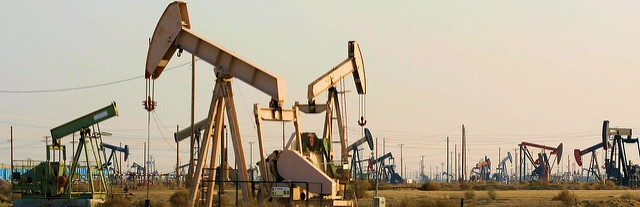
Image Source: Richard Masoner
By The Valuentum Team
Valuentum announced May 26 that it has updated its 16-page valuation reports and dividend reports on the Independent Oil & Gas space and the Large Energy Equipment industry.
Quite possibly, the biggest takeaway from the recent update has been the carnage that has been thrust upon the income investor. Since the last update, Anadarko (APC), Cenovus (CVE), Cimarex (XEC), Devon Energy (DVN), Noble Energy (NBL), and Range Resources (RRC) have slashed their payouts — these cuts only since the last update, a period that doesn’t consider the prior dividend cuts at Chesapeake (CHK) and Pioneer Natural (PXD), the latter in 2009. In light of bellwether ConocoPhillips’ (COP) dividend cut earlier this year, it should no longer be any surprise to readers that cyclical, commodity-producers aren’t generally dependable dividend payers.
Importantly, in every instance mentioned, the Dividend Cushion ratio flagged the risk of each dividend-cut offender in the form of a substantially negative measure in advance, “White Paper: The Dividend Cushion Beats the Aristocrats,” “Adjusted Vs. Unadjusted Cushion.”
Fair Value Changes
Let’s address some of the reasons behind the most recent fair value changes in the Independent Oil & Gas space, which includes more than 20 equities under coverage and excludes the largest majors, their group of which can be found here.
For starters, what is a fair value estimate? We define a fair value estimate as our quantified measure of a company’s intrinsic worth on the basis of its net balance sheet position and its discounted future free cash flows. Where the former is rather easy to ascertain via regulatory filings, the latter is quite difficult to measure with precision in light of volatile energy resource pricing, which has also impacted production profiles and capital spending decisions.
Since the last update, crude oil (USO) has bounced from the doldrums of the $20-$30 range to near-$50 in late May, a move that has raised the bar when it comes to our near-term earnings forecasts in 2017 and 2018, though we note such near-term earnings revisions should not be viewed as firm in light of the ongoing commodity-price volatility. Capital spending cuts, which bolster near-term free cash flow within the valuation context, have also served to aid in upward fair value estimate revisions, almost across the board. Since they are based in part on future forecasts, fair value estimates can and should change, “What Causes Fair Value Estimates to Change?”
When it comes to how our fair value estimates have performed since the last update, they have fared pretty well. Continental Resources has largely converged to our previous fair value estimate, though we’ve ratcheted our estimate higher upon this latest update. QEP Resources (QEP) has largely converged to our previous fair value estimate, though it, too, has been revised modestly higher. Occidental Petroleum’s equity has also performed well and shares a similar fair-value story to the aforementioned.
Capital Spending — Cuts, Cuts, and More Cuts
Let’s cover some of the vast capital cuts that we’re seeing in the Independent Oil & Gas space. Occidental Petroleum (OXY), for one, plans to spend as much as $3 billion in capital during 2016, down from $5.6 billion in 2015 and $8.7 billion in 2014. Oxy still plans to grow production in the year, however, upping the pace of expected growth to the range of 4%-6% from 2%-4% to shore up cash. Anadarko is targeting capital spending in the range of $2.6-$2.8 billion in 2016, down ~50% from the $5.4 billion mark in 2015, but such cutbacks weren’t enough to save its dividend at previous levels.
EOG Resources remains on track to achieve a 47% year-over-year capital-expenditure decrease in 2016, while Apache’s (APA) capital program reflects more than a 60% year-over-year reduction in 2016, to the range of $1.4-$1.8 billion. Capital expenditures at Continental Resources (CLR) are targeted at $920 million during 2016, down from $3-$4 billion+ in each of the past three years. Noble Energy plans to cut organic capital expenditures to less than $1.5 billion in 2016, down from nearly $3 billion and $5 billion in 2015 and 2014, respectively, while Cabot (COG) will follow a 56% reduction in capital spending in 2015 with more drastic cuts in 2016, even as it anticipates nominal production growth during the year.
Hitting the Long End of the Curve
Most constituents in the Independent Oil & Gas industry have been extending debt maturities. Recent new issuances by Occidental, for example, have extended the dollar-weighted average maturity of its debt by over 5 years, helping to support the firm’s A-rating at the credit agencies (it recently issued debt maturing in 2046). Anadarko refinanced billions of debt coming due in 2016 and 2017 and now sports a weighted average maturity of 16+ years. A large portion of its debt load to the tune of ~$9 billion doesn’t mature before 2030. Anadarko receives junk ratings from Moody’s, but both S&P and Fitch give it investment-grade marks.
Pioneer Natural issued funded payments of its 2016 and 2017 bond maturities with 3.45% and 4.45% senior notes maturing in 2021 and 2026, respectively. Apache cut its net debt position by 36% on a year-over-year basis at the end of the first quarter of 2016, while it only has $700 million of debt maturing through 2020. Noble’s Energy debt-to-capital remains well below covenant levels and doesn’t have a maturity coming due until 2019 (most of its debt is due after 2022), but while Continental has listed debt reduction as a key priority for 2016, it has some work to do. Net debt/EBITDAX stands at nearly 4x and late 2018 marks its next debt maturity ($500 million).
Oh Canada
The higher-cost, energy-intensive Canadian tar-sands producers haven’t been spared the pain either. Interestingly, we bore witness to a very rare three-notch credit rating downgrade at Cenovus Energy (CVE) by Moody’s earlier this year. Perhaps it was the scare when the price per barrel of tar-like oil sands fell to uneconomical levels earlier this year, but we were still surprised to see such a large credit-rating revision (even two notch revisions are rare). On the basis of the company’s cash balance of near C$4 billion and its pace of its annual free-cash-flow burn of C$240 million (2015), Cenovus has years and years of financial flexibility to wait out the crisis. The company is actively working on reducing its unit costs, targeting significant oil sands operating-expense reductions on a per-barrel basis, and has slashed its dividend materially to shore up cash. Cenovus doesn’t have any debt maturities until the fourth quarter of 2019, buying it even more time.
Canadian Natural (CNQ) continues to work through capital-spending reductions and annual operating-cost reductions, the latter totaling north of $1.1 billion from the beginning of 2014 on a unit cost basis. As with Cenovus, the company is burning through cash to the tune of C$380+ million (negative free cash flow) during the first quarter of 2016, even as capital spending was cut more than 25% in the period. The largest producer in Canada, Suncor Energy (SU) is also feeling the squeeze, with free cash flow dipping into negative territory in each of the past two quarters after a consistent streak of strong positive free cash flow generation. Operating earnings dropped to a -C$500 million during the first quarter of 2016, a large swing from profits in the year-ago period. The difficult commodity-price environment won’t slow the company’s plans to grow production at a ~6% compound annual growth rate through 2019, however. Nearly $10 billion in liquidity and strong investment-grade marks offer considerable financial flexibility. Per-unit operating cost reductions will also be ongoing as the industry works through the recent disruptive wild fires.
An Idea For the Pure Value Investor
Devon Energy retains the most attractive price-to-fair value ratio in the Independent Oil & Gas industry, even as it has rallied from under $20 in February to over $30 today. We value shares of the company at nearly $50 each and point to it as a rare “value” idea within the space addressed in this article. Devon has an investment-grade balance sheet, no significantly near-term debt maturities, $4.6 billion in liquidity, and plans to prudently scaled back exploration and production spending by ~75% in 2016, to the range of $900 million – $1.1 billion. An overreaction to the company’s dividend cut may spell ongoing opportunity for value investors, and its position in the Oklahoma Anardarko Basin speaks to an emerging development opportunity.
For the Very Long-term Dividend Growth Investor
Though EOG Resources’ dividend yield is paltry at less than 1%, investors may still be drawn to the company’s consistency and its commitment to the dividend payout. Since 1999, for example, EOG Resources’ dividend has expanded to $0.67 per share from a very modest $0.03, reflecting a compound annual growth rate of 20% over a time period in which many of its peers have either slashed or eliminated theirs. The company has raised its dividend in 16 of the past 17 years, the only pause during the dot-com bust of 2001-2002. Not only does it have a lucrative position in the Bakken (Three Forks), EOG Resources’ position in the Eagle Ford is also the most attractive among peers, in our view.
Doubling Up For Income Investors
Though we exclude a discussion of the integrated majors in this analysis, and while we point to Occidental as offering some nice security for the size of its yield, we’re going to Canada to highlight two brand new ideas for the income investor. Suncor’s five-year dividend growth rate has been phenomenal, offering a compound annual growth rate of north of 20%, and 2016 will round out its 15th consecutive year of a dividend increase. A dividend yield that is north of 3% and one the strongest balance sheets around make it worthy of consideration for the income-oriented investor, in our view. Free cash flow trends should be watched closely, however.
Imperial Oil (IMO) is yet another Canadian gem that even tops Suncor when it comes to shareholder-friendliness, as measured by capital returned to shareholders during the past 10 years. Not only has Imperial Oil registered 100+ years of consecutive dividend payments, but it has recorded 20 years of consecutive growth. As with its peers, the company is aggressively pursuing cost reductions and efficiencies, and it’s hard not to like its diversified business model (both large upstream assets and downstream businesses) that offers financial resilience under a wide range of commodity prices. Shares don’t yield quite as high as that of Suncor, however.
An Idea For Pure Growth Investors
While most of the rest of the peer group is scaling back spending, Pioneer Natural is moving forward with growth plans. The company has the largest Spraberry Wolfcamp acreage (Texas) with decades of drilling inventory and plans to hit 12%+ production expansion in 2016, compared to 10%+ previously. Though we very much like an entity that can drive forward in the face of adversity, perhaps it is its debt load, or perhaps more appropriately, its lack of lever