
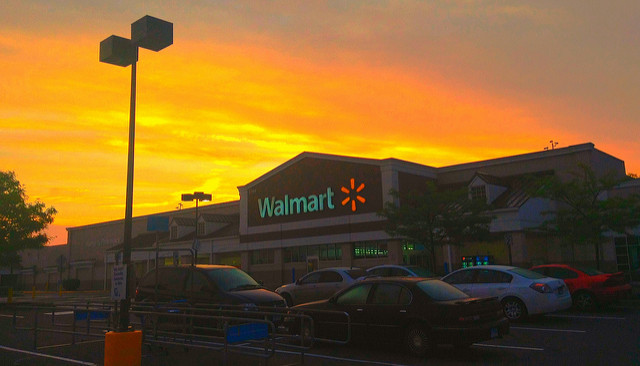
Image Source: Mike Mozart
By Kris Rosemann
Just one day after shares of Walmart (WMT) fell on sentiment from the poor quarterly report from rival Target (TGT), “Target and Non-GAAP Earnings (May 2016),” Walmart reported strong first quarter earnings and shares leapt nearly 10% in the May 19 trading session. Other retailers, however, haven’t been as lucky, experiencing material share price declines as of late due to ongoing weakness across many verticals of the retail space. Some noteworthy retailers that have been punished as a result of poor first quarter performance include Macy’s (M), Kohl’s (KSS), and Nordstrom (JWN), among others, including the aforementioned Target.
The material weakness across retail comes despite US retail and food service sales beating expectations in the April report from the US Department of Commerce. Consumers continue to spend their disposable income, but as a new generation of Americans grows to account for a greater portion of the active consumer, spending trends are changing. Leading the charge for retail sales growth in the four months to start 2016 include areas such as non-store retailers, building supplies, sporting goods, furniture, autos and auto parts, and food service and bars.
Walmart was able to buck the overall trend that has been riding against it in its fiscal first quarter report as traffic increased 1.5% over the same period in 2015. Meanwhile, Target has been punished after reporting number of transactions growth of only 0.3%. Such a low traffic number for Target is additionally concerning due to the company focusing its future growth initiatives squarely on growing traffic, “Same Stories Prevail at Walmart and Target (November 2015).” Selling price per unit growth was able to provide a boost to comparable-store sales, but the underlying traffic issues remain far more concerning for Target.
Traditional department stores have been perhaps the most punished area of retail recently. Collectively, department store sales through the first four months of 2016 have fallen 3% from the same period in 2015. After a poor report in terms of comparable-store sales May 19, Bon-Ton (BONT) can be added to the long list of retailers whose shares have been punished as of late. L Brands (LB) has also been punished as a result of poor recent performance and a weak outlook. After reporting decelerating comparable store sales in its retail categories, the firm issued weak guidance that included the expectation for its comparable-store sales growth to be negative in the month of May. Even the resilient Victoria’s Secret brand has been exhibiting weakness as it works through a realignment process to return its focus to core products.
In somewhat surprising news, at least in the context of the current retail operating environment, American Eagle Outfitters (AEO) reported strong comparable sales growth of 6% in its first quarter of fiscal 2017. The firm’s impressive comps growth came despite considerable weakness in mall traffic, and it continues to take market share from competitors. Urban Outfitters’ (URBN) most recent report was met favorably by investors as well after the firm was able to gain market share among mall retailers simply by avoiding negative comparable store sales growth. Pockets of strength are still present in traditional retail, but the fickle US consumer refuses to be predictable.
Home improvement retailers have been a key pocket of strength for the overall retail space for some time now, and Home Depot (HD) and Lowe’s (LOW) are determined to continue their impressive performance. Consumers continue to invest in their homes as housing price trends have been encouraging as of late, and the two home improvement retail giants have taken advantage. However, we cannot fail to mention the underlying cyclicality of the housing market to which Home Depot and Lowe’s are tied. Just as they have been able to ride the economic wave to strong performance, a similar effect could come from the pull of the economic undertow as the market continues to mature, “When Do the Dark Days Return in Home Improvement? (February 2016).”
Additional reports contradicting the overall retail sales trends came out of the auto parts retail space, after Advance Auto Parts (AAP) and Monro Muffler (MNRO) both reported disappointing results May 19. Advance Auto Parts reported comparable-store sales declining nearly 2% in the first quarter of its fiscal year and provided guidance for comps to be down 3%-5% for the full year. Meanwhile, Monro Muffler reported choppy fourth quarter results for its fiscal 2016, ended March 31, as comparable-store sales grew a mere 0.5% and guidance for comps growth for fiscal 2017 was set between a decrease of 2% and flat.
The overall retail space (XRT) has been under material pressure thus far in 2016, and as investors continue to look for the next hot spot where consumers will be spending their money, we continue to inch our way further and further into a maturing economic cycle. We continue to be reiterate that investments tied to unpredictable fashion trends and consumer spending patterns linked to the economic cycle are inherently more risky than the average company. Investors are likely becoming more defensive, especially as news of major investors betting against the market continues to surface, “Soros, Icahn, Nelson Hedge for Market Fall (May 2016).”
While we may feel that there may be some value to be had in the retail space, “Value (Soon) to Be Had in Retail? (January 2016),” we continue to hold our methodology dear, keeping us from scooping up perceived value opportunities that the market has yet to gain conviction in. At this point in time, we’re most comfortable window shopping as it relates to investing in retail. Be sure to keep your guard up.