
Image Source: Michael Fleshman
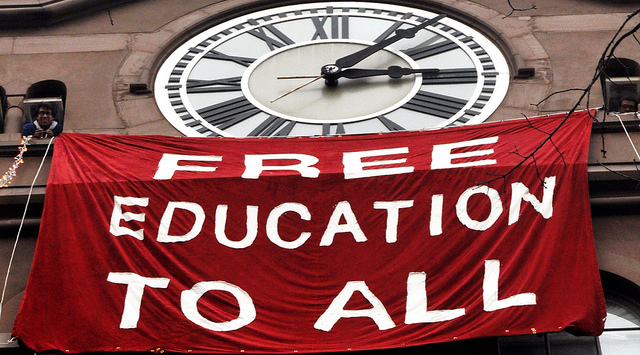
Many readers may be familiar with the rhetoric of the Presidential Election Cycle of 2016 and Democratic hopeful Bernie Sanders’ view on making “college tuition free and debt free.” You can take a read of the 6 steps Bernie will take as president to make college debt-free here. Many may find his last point rather intrusive to the heartbeat of the American economy and the driver behind innovation and standard-of-living improvements, but we’ll leave that conversation for another day. But what’s the shocking statistic, right?
Get this – and I hope you are sitting down. According to an article by the Journal, “more than 40% of Americans who borrowed from the government’s main student-loan program aren’t making payments or are behind on more than $200 billion owed.” How much is $200 billion? To put that number in perspective, it equates to wiping the entire equity value of a global bank like JP Morgan (JPM) completely off the map, or about two Citigroup’s (C), or AIG (AIG), General Motors (GM), and Boeing (BA) combined. One in six borrowers is in default on their student loan, meaning they haven’t made a payment in over a year.
The implications on society may be far-reaching, perhaps playing into the attendance growth of more-affordable community colleges as opposed to the proliferation of attendance at expensive four-year universities that may never deliver on student expectations after graduation. The for-profit education industry has been pummeled by regulations for the past few years, with companies including Apollo (APOL) and Strayer (STRA) taking considerable lumps, but the problem goes far beyond institutions that are looking to make a profit for shareholders. America truly has a student loan problem, and there may not be an easy answer — and unfortunately, the debt binge doesn’t stop with student loans either.
The broader equity and credit markets are growing more and more worried about subprime loans — not of the home mortgage variety that made front-page news late last decade during the Financial Crisis but subprime loans of auto substance. A few weeks ago, another article from the Journal revealed striking similarities to the housing crisis of the past in highlighting the “early performance of a bond issue called Skopos Auto Receivables Trust 2015-2,” which had been constructed using subprime auto loans and formed only a few months ago in November 2015. According the report, through February, “about 12% of the underlying loans were at least 30 days past due, a third of which were more than 60 days delinquent.” In nearly 3% of the packaged loans, the borrowers were bankrupt or had their vehicles repossessed.
We can’t say whether such loan performance may be telling of weaker future auto sales at the Big 3, Ford (F), General Motors, and Fiat Chrysler (FCAU), but it’s yet another data point worth considering. The US economy is resilient and pent-up demand for autos remains, but just how much has the magnitude of the surge in auto sales been augmented by lax lending standards? We’re keeping our eye on the lending environment, and the auto lenders in particular, including Santander Consumer (SC) and Ally Financial (ALLY). Even the auto dealers including high-end Penske Auto (PAG) to no-haggle CarMax (KMX) may not be completely immune to any possible fallout. Just in its fourth-quarter earnings call April 7, CarMax’s CEO Tom Folliard noted that the firm “faced a somewhat more challenging sales environment in the second half of the year.”
Perhaps connected to the poor performance of student loans and auto debt are the challenges that mall retailers are currently facing. It is troubling to see branded retailers such as Aeropostale (ARO) and Bebe Stores (BEBE) trading at pennies per share given their tremendous popularity of years past, perhaps the former more than the latter, but nonetheless. We’ve been highlighting to members the significant risks of investing in any fickle teen retailer, “Investing in Teen Retail Is Like Rolling the Dice,” so this shouldn’t come as too surprising of a development that Pacific Sunwear (PSUN) filed for bankruptcy April 7. Surf and snow gear provider Quiksilver (ZQK) recently filed for bankruptcy, and Sports Authority is yet another firm that has recently encountered troubles.
Putting the pieces together – student loan defaults, auto loan delinquencies, and mall-based retailing pressure – the creditworthiness of the youngest adult generation may not be the healthiest. Millennials may not only be cash-strapped, but their spending patterns may lend themselves more toward buying the latest-and-greatest technological gadgets from Apple (AAPL) and Fitbit (FIT) or eating out at the latest fast-casual place from Panera (PNRA) to Zoe’s Kitchen (ZOES) to Buffalo Wild Wings’ (BWLD) new concept PizzaRev than scooping up fashion at the mall. The depths of the next economic cycle, the timing of which is the only uncertainty, may very well claim the weakest department stores, namely JC Penney (JCP) and Sears Holdings (SHLD). There might not be a long-term picture for these storied franchises, unfortunately.
We’ve been one of the biggest “bulls” on the strength of the upswing of the commercial aerospace market the past few years, pointing to the significant and multi-year backlogs at the airframe makers, Boeing and Airbus (EADSY), but even the former may be hitting somewhat of a “financing” snag in continuing momentum, albeit a small one. Boeing has done a fantastic job reducing the size of its finance arm Boeing Capital Corp in recent years, but new CEO Dennis Muilenburg noted that the aerospace giant is “on the verge of losing sales,” as the Export-Import bank drags its feet in appointing board members. We’re not worried about Boeing, per se, but the supply chain could face minor issues if any key orders are held up. In widely-expected other news, Boeing noted April 7 that commercial aircraft deliveries fell more than 4% in the first quarter, even as deliveries of its workhorse 737 and 787 Dreamliner remained strong. The commercial delivery upswing seems to be getting tired, exacerbated by emerging market weakness and highly-volatile crude oil prices, both of which are complicating the fleet replacement decision at a number of carriers.
We’ve never been a fan of the banking business model, and we’ve outlined as much in our latest ETF piece on the sector, “ETF Analysis: Banks and Financials.” Not only do we prefer diversified banking exposure via ETFs for the reasons outlined in the ETF piece, but our firm-specific theses continue to play out as dividends from the largest banks in the world come under siege. Santander (SAN) cut its dividend March 2015, Standard Chartered (SCBFF) cut its dividend August 2015, Deutsche Bank (DB) eliminated its dividend in October 2015, and Barclays (BCS) cut its dividend earlier this month. Credit Suisse (CS) also had its equivalent of a London Whale incident as traders racked up roughly $1 billion in losses before the firm was able to get things back “under control.” We’ve address our reasons never to own a banking stock for its dividend in our “,” and we think all investors should have a read. While controversial, the analysis continues to be spot on.
As a short update to the Yahoo! (YHOO) saga, one company that is not afraid of holding over $100 billion in long and short-term debt on the books continues to express interest in making a bid for the beleaguered Internet portal. That company is Verizon (VZ), and why not – what’s another $8 billion or so in more debt when it has so much already? Rumors are that former CEO of standalone AOL Tim Armstrong may take the reins if a Verizon (AOL)-Yahoo tie-up does happen, perhaps closing the chapter on the tenure of Marissa Mayer. We continue to believe a deal with eBay (EBAY) may be Yahoo’s best bet over the long haul, but with board members resigning, Starboard Capital launching a proxy fight, suitors leaking interest in bidding, the story remains influx. We continue to watch from the sidelines.
In case you missed it, we launched coverage of Heinz Kraft (KHC), and we’re not excited about how the market is pricing its equity. Holders of its stock should be cognizant of the company’s substantial relative valuation premium to peers, not to mention its relatively weak ROIC measures in light of troubling consolidated earnings performance the past few years. The Oracle of Omaha is far from perfect, and investors should not follow blindly without doing their own homework first. Our fair value estimate implies shares are overpriced, but consumer staples stocks continue to roar higher thanks to buying interest from dividend seekers. We’re available for any questions.
Related ETFs: MILN