
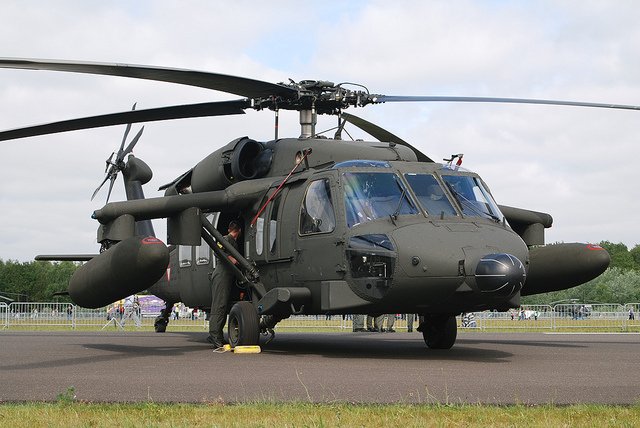
Image Source: Sikorsky S-70 (H-60) Black Hawk, Martijn
By Kris Rosemann
The defense industry continues to face pressure in the face of weak funding and competing budget priorities, and malaise in the global economy could add pressure to those seeking growth from foreign sovereigns. Having an already strong backlog will certainly help to a degree, and ongoing cyber threats, “The Global Pandemic of Cybercrime, Cyber Espionage and Cyber Warfare,” and preparation for modern-day warfare and all its complexities will post both challenges and opportunities for many, “Annual US Defense Spending Still 85% Higher Than Year of September 11 Attacks.”
Defense contractors generally are strong free cash flow generators, and as a result often have reliable and competitive dividends, not to mention fantastic Dividend Cushion ratios. However, the valuations of many are getting stretched, which complicates the total potential return proposition for many investors. Let’s take a look at the fourth-quarter 2015 results and the investment prospects of four of the biggest US-based defense contractors: Lockheed Martin (LMT), General Dynamics (GD), Northrop Grumman (NOC), and Raytheon (RTN).

Lockheed Martin Warns of Sikorsky Performance
January 26, Lockheed Martin reported solid revenue growth in its fourth quarter of 2015 of 3.2% on a year-over-year basis to $12.9 billion. The firm’s international sales grew 6% in the full-year period and now represent 21% of total corporate sales, helping it lean less on US Government and the Department of Defense spending, which account for 78% and 58% of total sales, respectively. Earnings in the fourth quarter of 2015 also grew 3.2% for the company, but earnings-per-share growth was boosted to 6.7% as a result of 15.2 million shares being repurchased during 2015. Cash from operations growth was tremendous due to significant pension contributions in the comparable period.
Lockheed Martin expects its backlog to continue to drive solid growth moving forward, as its legacy operations backlog of $84 billion would have been the highest in the firm’s history on its own, but when including the backlog of Sikorsky–the acquisition of which was closed in the fourth quarter–its total backlog grows to nearly $100 billion. The company is currently expecting 2016 sales to be between $49.5-$51 billion. Diluted earnings per share for the year are projected to be in a range of $11.45-$11.75, while cash from operations are anticipated to be at least $5.3 billion.
However, the firm has warned that the performance of the newly acquired Sikorsky helicopter business might not meet its expectations. Lockheed Martin has pointed to a complex integration process, the potential for unrealizable synergies, weakened demand for its products due to global economic conditions such as oil and gas trends, and changes in Department of Defense policy or perception of the increased size of the company having adverse impacts on its future contract pursuits.
Though Lockheed Martin’s acquisition activity may threaten the pace of its dividend growth, at current levels, its payout appears to be on solid ground as it registers a 1.4 Dividend Cushion ratio. This is an impressive measure when considering the firm’s current annualized dividend of $6.60 per share and enticing annual yield of ~3%. That said, shares appear to be overvalued, trading well above our fair value estimate of $175.
General Dynamics Expects Modest Near-Term Growth
January 27, General Dynamics reported fourth-quarter revenue falling 6.6% to $7.8 billion on a year-over-year basis. The firm’s bottom line fared much better in the quarter; earnings from continuing operations increased 3.7% from the year ago period, but earnings per diluted share from continuing operations leapt 9.7% to $2.40 thanks in part to aggressive share repurchases. Free cash flow remained suppressed in the quarter due to an increase in working capital and the working off of large advanced payments received in 2014. Free cash flow conversion was ~65% of earnings from continuing operations for the full year 2015.
General Dynamics saw its backlog and estimated contract value fall to $90.6 billion at the end of 2015 from $99.1 billion at the same time in 2014, and this has caused the firm take a more conservative view for 2016. It is now expecting revenue to be in the range of $31.6-$31.8 billion, slightly above 2015 revenue of $31.5 billion. The firm’s operating margin is anticipated to remain flat at 13.3%, and diluted earnings per share are expected to grow to ~$9.20 from $9.08 in 2015.
The modest growth across General Dynamics’ business is expected to begin projecting higher in 2017 and beyond. In its Aerospace segment, the return to full production and delivery of its G500 model in 2018 and the G600 model in 2019 will be a key growth driver. The firm’s Combat, Marine, and Information Systems and Technology segments are all anticipated to realize modest growth in 2016, with a significant ramp up in sales coming in 2017. Free cash flow generation is expected to return to its historical robustness in 2017 as well.
General Dynamics expects to return all of its free cash flow to shareholders in the form of dividends and share repurchases in 2016. We think the company’s dividend has great potential to continue growing, and though the recent downturn in free cash flow generation may have an adverse effect on this, its Dividend Cushion ratio currently sits above 3. Shares currently yield ~2% and are trading above our fair value estimate of $127.
Northrop Grumman Feeling Bottom-line Pressure
January 28, Northrop Grumman reported fourth quarter revenue fell 6.6% to $5.7 billion, and earnings fell 9.3% on a year-over-year basis, as lower volumes and increased unallocated corporate expenses helped push results lower. However, earnings per diluted share remained relatively flat at $2.49, compared to $2.48 in the same period of 2014, thanks to weighted average shares outstanding being reduced by 20 million from the fourth quarter of 2014 to 184.2 million. Nevertheless, free cash flow generation was robust, growing 23% to $1.5 billion as a result of benefits in its cash taxes and moving parts in its working capital, as well as significantly reduced capital expenditures compared to the year-ago period. Fourth-quarter free cash flow accounted for nearly 90% of full-year 2015 free cash flow.
The company experienced a decline in its backlog at the end of 2015, which fell to $35.9 billion, compared to $38.2 billion at the same time in 2014. Northrop Grumman now expects full-year 2016 revenue to be in the range of $23.5-$24 billion, compared to $23.5 billion in 2015. Diluted earnings per share are anticipated to be in a range of $9.90-$10.20 for the year, a decrease from $10.39 in 2015. The firm’s 2016 free cash flow guidance of $1.5-$1.6 billion represents the potential for a reasonable increase over 2015 levels despite expectations for capital expenditures to nearly double at the low end of its guidance range.
Management did not provide specific guidance for its use of cash generated in 2016. Historically, the firm has returned far more than 100% of its free cash flow to shareholders via dividends and share repurchases, and we expect the company to continue growing its dividend for the foreseeable future. Its Dividend Cushion ratio is a solid 2.4, though its yield is not as competitive as it could be at ~1.7%. An increased dividend would be a more prudent use of cash in our view, as shares continue to trade well above our fair value estimate of $154 per share.
Strong Bookings Position Raytheon for Growth
January 28, Raytheon reported fourth quarter revenue advanced 2% from the year-ago period to $6.3 billion. Income from continuing operations before taxes, however, fell more than 5% to $774 million, and earnings from continuing operations dropped to $1.85 per share from $1.86 in the comparable period of 2014, partially due to acquisition accounting adjustments related to Forcepoint–formerly known as Ratherion|Websense. Operating cash flow from continuing operations also fell slightly in the quarter, though strong generation in the previous three quarters were able to raise the company’s full year operating cash flow from continuing operations above that of 2014.
The highlight of the quarter and year for Raytheon was its solid performance in bookings, which grew more than 11% from the year-ago period. The firm’s book-to-bill ratio in the fourth quarter was a strong 1.24, helping drive its backlog to $34.7 billion as of the end of 2015, compared to $33.6 billion at the same time in 2014. Strong bookings and backlog numbers has led management to anticipate solid growth in 2016; revenue is expected to advance to a range of $24-$24.5 billion, compared to $23.2 billion in 2015, and earnings-per-share from continuing operations is projected to be in a range of $6.80-$7.00, compared to $6.25 in 2015. Operating cash flow from continuing operations is anticipated to be in the range of $2.7-$3 billion for 2016, outstanding growth from $2.3 billion in 2015. The growth strategy in bringing Raytheon’s advanced cybersecurity capabilities to both government and commercial customers appears to be paying off.
Shareholders should expect a reasonable increase in Raytheon’s dividend as a result of the anticipated jump in cash flow, which will only strengthen its already solid Dividend Cushion ratio of 2.5. The firm’s dividend yield currently sits at a respectable ~2.2%, and we generally would like to see the company allocate more cash to growing its dividend instead of increasing share repurchases; shares appear overvalued when compared to our fair value estimate of $100. We’ll be monitoring developments closely.