
By Brian Nelson, CFA
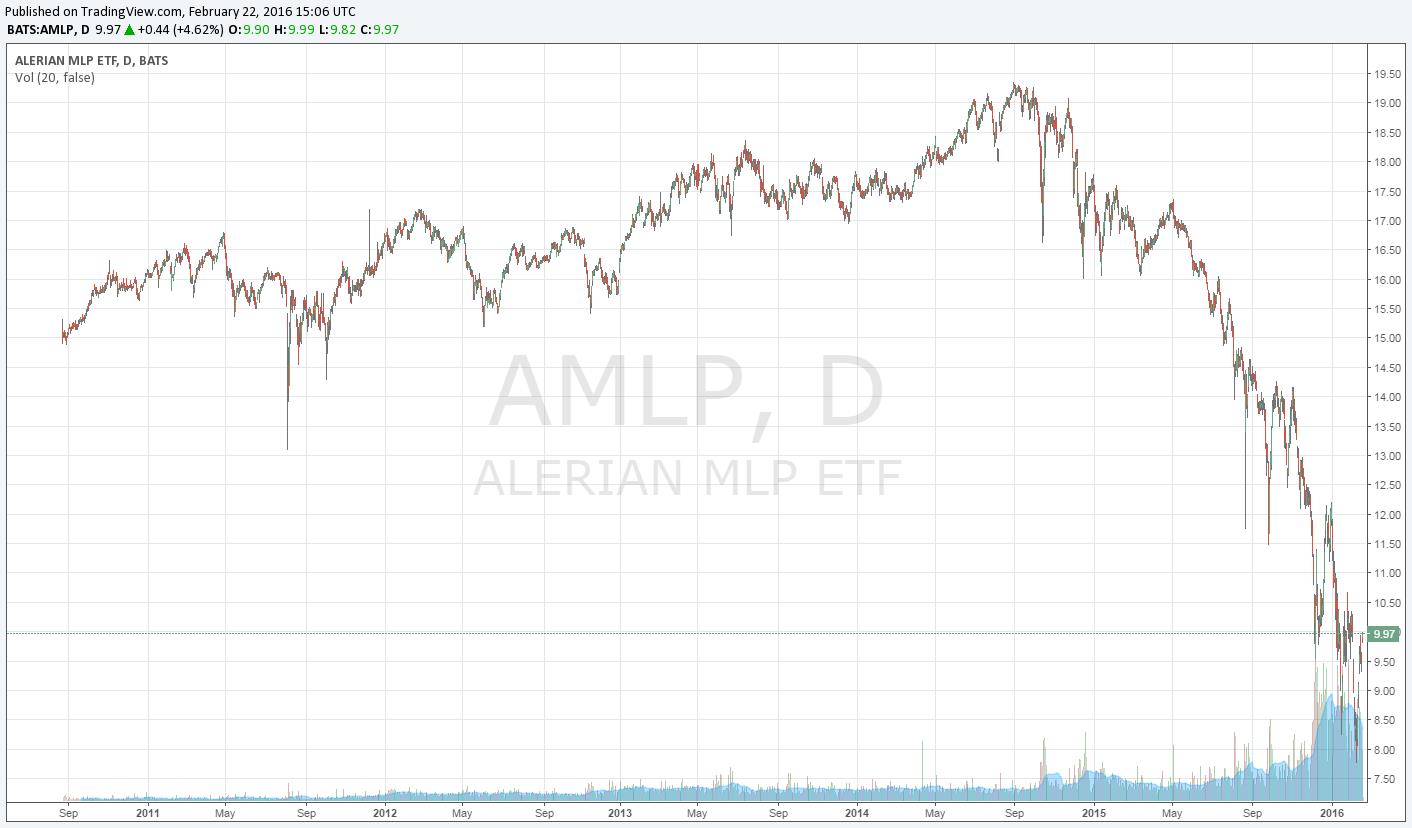
It looks like the energy master limited partnership (AMLP, AMZ) space has been catching a bid the past few days. It’s so important, however, to keep things in perspective, and the best way to do so is to look at an intermediate-term chart of the group, which remains under considerable stress, “Bye Bye Energy MLPs, Part II (Jan 2016)” The market wants some of the most beaten down equities to rally, including Energy Transfer Equity (ETE) and Energy Transfer Partners (ETP), which have fallen devastatingly from their respective peaks of $35 and near-$70 per share, respectively. If you’re not looking at charts, you’re leaving a lot of free information on the table.
Energy master limited partnerships, in our view, continue to trade less on firm-specific dynamics these days, and more on the likelihood of ongoing credit contraction in the high-yield ranks and the vicissitudes of energy resource pricing, the latter fluctuating wildly as of late. The hardest thing about an energy MLP analyst’s job is explaining how this proxy for the energy space, shown above, is still down nearly 50% from highs, and how even the short term bounce has only been a short and near-meaningless move for long-term mom and pop investors that have lost their shirts. So many investors have lost so much money on these instruments that it’s time for better disclosures. Why not include non-GAAP free cash flow, as measured by cash flow from operations less all capital spending on all press releases that provide the industry’s definition of “cash flow,” which we’ve noted in the past omits key cash outlays of the company, “Saturday Morning Musings: Nelson’s Two Pet Peeves.”
Though some can certainly disagree, investing is not like the spectator sport of football where, for example, a Chicago Bears fan, no matter what, may never like the Green Bay Packers, even if the latter may be a far better team. It is just not going to happen. But unlike rooting for your favorite sports teams, investing doesn’t have to be that way – it can be much more straightforward and objective. For one, cutting to their core, companies are nothing more than their future enterprise free cash flow streams and net cash/debt positions on the balance sheet. Trust me, they are – at the end of the day, whatever qualitative dynamic you can think of from your love for management or your optimism regarding a new product’s growth prospects must be quantified (stocks are priced in terms of a currency, not on sentimental value, for better or worse). If a company’s future enterprise free-cash-flow stream and net cash/debt position are worth more on a present-value basis than its share price, the stock is undervalued. If the opposite is true, then shares are overvalued. Of course a margin of safety will always be a consideration in both examples, but for all of its moving parts, investing and valuation is that simple.
You see – in investing, it matters little if you are a Chicago Bears or Green Bay Packers fan when you size up companies objectively. In investing, Bears fans can like the Packers and vice versa. It’s okay – you’re after the preservation of capital, income streams, or capital appreciation, or all of the above and more. Let’s talk more about this. Kinder Morgan, for example, is considered by some to have one of the widest “economic moats,” “Keeping the Horse Before the Cart: Valuentum’s Economic Castle™ Rating,” but it is clear that an assessment of the company’s “economic moat” mattered little in protecting its stock from cratering to under $20 from $40 today. Where we were absolutely pounding the table when shares were vastly overpriced above $40 per share, we are now bullish on the relationship between the company’s share price and its discounted future enterprise free cash flow stream and its net debt position. Please note the objectivity. Price will always matter, as it cuts to the core of investing: Is a company cheap or expensive, and that relationship will and should change over time.
Let’s take this example. Let’s say absolutely nothing changes with respect to Apple’s (AAPL) future outlook in both of the following scenarios. Let’s say that in one scenario Apple’s share price is trading at a million dollars per share, while in the other scenario Apple’s shares are trading at $1 per share (the only difference is price). In one scenario, Apple would be considered a horrible investment at a million dollars per share, while in the other, Apple may be the best thing since sliced bread (at $1 per share). You see – investing is not about a company’s competitive advantages, or economic moat, or holding it forever, or pursuing the “buy and bash” philosophy against everyone that disagrees with you. Price will always determine whether an investment is a good one or a bad one, or somewhere in between. Once you understand that you are investing in future enterprise free cash flows and net debt/cash positions, you can remove yourself from the biases that prevail by being a “buy and hope” investor. How good is it to find undervalued stocks as the market comes around to recognizing their undervalued nature – these are Valuentum stocks, “The Case for the Valuentum Style of Investing.”
What’s more, don’t be so hard on yourself if you can’t predict the future 10, 20 or 30 years down the road. That’s a tough game, and even the Oracle of Omaha himself can’t predict what the world will be like in 2050. You don’t have to win that “game,” and you certainly can change your mind about stocks as expectation about the conditions of the future change. It’s perfectly fine to call Kinder Morgan materially overvalued above $40 and undervalued under $15. It’s okay. You are free to sell overvalued stocks and buy undervalued stocks – nobody should tell you otherwise. That’s what investing is all about. Investing is not about holding your money in one place for a long time, hoping that things will just work out in the end because they always have (“or because that’s how everyone else is doing it”). For retirees that were swept into energy MLPs, their long-term, which is today, is not a good one, or not as best as it could have been. Always ask the question why… why are you getting talked into keeping your money in one place for a long time? Who benefits? We’re now well into the black from the addition of Kinder Morgan to the Best Ideas Newsletter portfolio last week, “Initiating KMI…”
Of course we’re not here to break down any frameworks you may have embraced in the past 10, 20, 30 years while the federal funds rate collapsed from 20% in 1980 to near-0% today, a time period that witnessed the world experience some of the greatest emerging-market growth and productivity advancements in history. We’re just saying that maybe there were some very critical conditions that helped propel the stock market higher over the past 40 years that may eventually turn into stiff headwinds over the next 40 years. We want you to be on guard that “buying” blind and holding may not work over the next 40 years. Granted, we know it’s hard to visualize ongoing Fed tightening in light of other countries around the world pursuing negative interest rates, but it’s a strong likelihood that, in the next decades, we’ll be far-removed from negative interest rates. If we’re not, then the world must have experienced quite the economic calamity to have warranted such accommodative policy for so long, and that’s not good either. Know the risks – think probabilistically.
One of the best lessons for readers on not giving too much weight to the past came in the form of Dividend Aristocrat HCP (HCP) recently, “Health Care REITs Whacked.” As with many investors, we wanted to gain incremental exposure to REITs some time ago, and we thought a tried-and-true dividend growth track record would be a great place to allocate incremental capital. Turns out, as we have known for some time, the past matters little when it comes to the forward-looking business of investing. As in the case of energy MLPs, many of which have had to slow distribution growth or cut the payout altogether, a dividend track record doesn’t mean capital won’t erode materially as the probability of a dividend cut impacts the pricing dynamic of the equity. We think HCP is yet another great example of how a company with a strong historic dividend growth track record of consecutive increases has hurt investors via material capital loss. Price matters. Whenever you forget this fact, imagine how long-term energy MLP investors are feeling right now… Please use common sense.
There’s nothing like some of the most overleveraged companies potentially spending money at-will to gobble up assets, perhaps just for the sake of doing so. It appears that Verizon (VZ), Comcast (CMSCA) and AT&T (T) are interested in buying Yahoo’s (YHOO) core assets, and why not, these companies have been spending money like mad. Only when economic growth in the US slows will we finally see the real implications of Verizon’s $112 billion debt load and ~$7 billion annual dividend payment obligations, Comcast’s $48 billion debt load and ~$2 billion annual dividend payment obligations, and AT&T’s $128 billion debt load and ~$8 billion annual dividend payment obligations. Seriously, what kind of business could you build if you had $128 billion in free debt to do so? It’s going to be interesting to see how these entities cope with pricing wars in a down-economy as debt and dividend obligations pile up. Yahoo is quite savvy – the company knows where to go to find companies that will overpay for assets with seemingly little care for their respective balance sheets.
Remember the $160 billion Time Warner (TWX)-AOL merger, one of the worst Internet acquisitions of all time? Remember when Yahoo bailed out Mark Cuban’s Broadcast.com for $5.7 billion, now defunct? Remember when Yahoo bought GeoCities for $3.6 billion, now the site shut down? Remember when News Corp (NWSA) bought MySpace for $520 million? And remember when AOL bought Netscape? (source) When will management teams learn? Soliciting a “greater fool” is not how sustainable value is generated. Focus on competitive advantages and free cash flow, not pie-in-the sky growth and synergy estimates. Is it any wonder why some consider the eBay-PayPal (PYPL) tie-up one of the best tech deals? These two fantastic companies throw off gobs of free cash flow and continue to do so. Warren Buffett (BRK.A, BRK.B) should take a trip to Silicon Valley, sooner than later.