
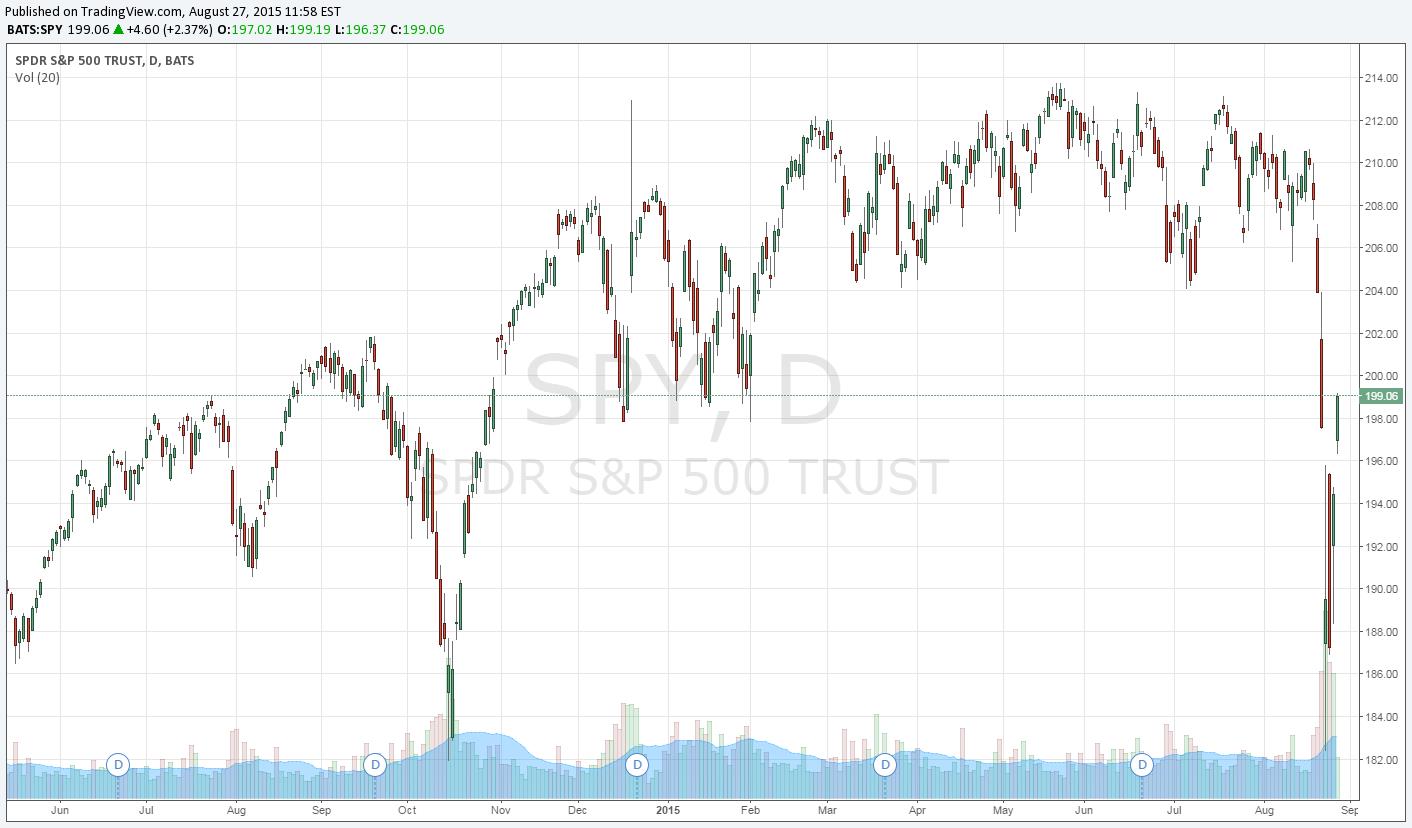
Shown above: The carnage in the S&P 500.
One of the most important measures that we strive to portray is balance.
In our recent writings, we’ve demonstrated a very bearish slant on recent developments, and we still hold those views, but our actions within the newsletter portfolios are also very important in understanding how we react to such views. As we’ve outlined many a time before, global economic developments and US equity markets are not always inextricably linked, meaning that there could be times–seemingly more often than not–when the economy is heading south and equity markets hold up fairly well or even advance, and vice versa. Part of the core Valuentum process, however, centers on finding undervalued stocks and letting winners run until we have a definitive view on both their respective valuation and technical/momentum indicators to warrant removal.
But applying the Valuentum process is only part of what we do. We also perform some of the most extensive forward-looking dividend growth analysis out there, combining our future forecasts of free cash flow against a company’s expectations of future cash dividends paid, in light of the firm’s existing balance sheet. Such a process results in what we call the Dividend Cushion ratio, a measure that if significantly greater than 1, speaks to substantial dividend growth potential. Each newsletter portfolio seeks to capture the unique and distinct goals set forth in it, and because such goals are different between the two portfolios, the processes in which we employ are different as well, sometimes considerably so. For example, we’d never add a non-dividend paying stock to the Dividend Growth Newsletter portfolio, but some of our biggest winners in the Best Ideas Newsletter such as Google (GOOG/GOOGL) or eBay (EBAY) have never paid a dividend.
What we’re trying to say is that in the midst of forecasting the recent market “correction” and in the face of some “scary” declines in the market during the past couple weeks, our tried-and-true long-term approach to meeting the respective portfolio goals continued to shine through. We put all of our thoughts on the table and hold nothing back, but some of our views we feel are actionable in the portfolios and others not-so-much. One would think we would have dumped Alibaba (BABA) in the wake of negative sentiment, but we didn’t. Shares are rallying nearly 4% today, to $71–still off from the cost basis in the Best Ideas Newsletter portfolio, but much better than sub-$60 panic levels.
Seasoned investors know of the Herculean effort it was to “call” not only last year’s near-correction (with put options in advance) and the one that we’ve just bounced from, but all the while staying composed at the wheel (staying within ourselves) and doing our best not to whipsaw our membership. We doubt that we’ll be able to call the next correction, if given another opportunity, but that may not matter, as our current view has migrated to one in which we’re expecting a bear market, or a market in which pure indexers experience more than 20% losses from the highs.
But just because we expect market headwinds, we’re running the portfolios to achieve goals. An astute observer may posit that, when combining the probability that we might be wrong about the general market direction with the probability that our best ideas will outperform a declining market, the chances of continued strong gains and relative outperformance are actually quite good. In fact, it hasn’t yet been two weeks since we achieved new, all-time highs and levels of outperformance in the portfolio of the August edition of the Best Ideas Newsletter, released on the 15th. While others are championing their resolve in the midst of losses so far in 2015, we’re setting new levels of outperformance.
A large number of investors use our research and analysis in a whole host of far-reaching applications (some of which we still don’t know), but common-sense principles have always applied when it comes down to making any alterations to the newsletter portfolios. We’re not day-traders, or even weekly or monthly traders, but instead, we’re value-focused, long-term investors with a momentum and technical overlay coupled with Economic Castle (economic return) analysis and Dividend Cushion (payout health) analysis. Our research runs the gamut and considers a whole host of important factors, and when we do make a call, our track record screams “pay attention.”
Today, we’re bouncing again in the markets, and looking at the charts, it seems as though we had to. The sharp drop in the broad market indices had been so vast that some sort of bounce had to be expected, as traders chase short-covering, a condition that we expect to inevitably reverse in the coming days. Technically speaking, charts look rough, with perhaps the only hope of keeping this bull market alive rests in a sharp recovery that sets new highs again (much like the sharp drop we had predicted in September 2014). Who cares about the charts, you may ask? Billions, if not, trillions of assets under management.
Our two additions today are companies you should know very well. In the Best Ideas Newsletter portfolio, we’re taking a modest 1% position in Michael Kors (KORS) at $42.98 as shares are trading at ~10x earnings with decent total sales expansion and a solid net cash position on the balance sheet. We’re also adding back one of our favorites, Buffalo Wild Wings (BWLD), a 1% position at $196.20 per share. The company showed significant resilience in the midst of the recent market meltdown, and we were watching it every step of the way. Unfortunately, we never did get a price to pull the trigger, but we’re huge fans of the company and believe the high end of our fair value range may be the next stop on its journey.
We may look to add to both of these companies, and others in the newsletter portfolios if the markets continue their slide.
Read why we like B-dubs here >>