
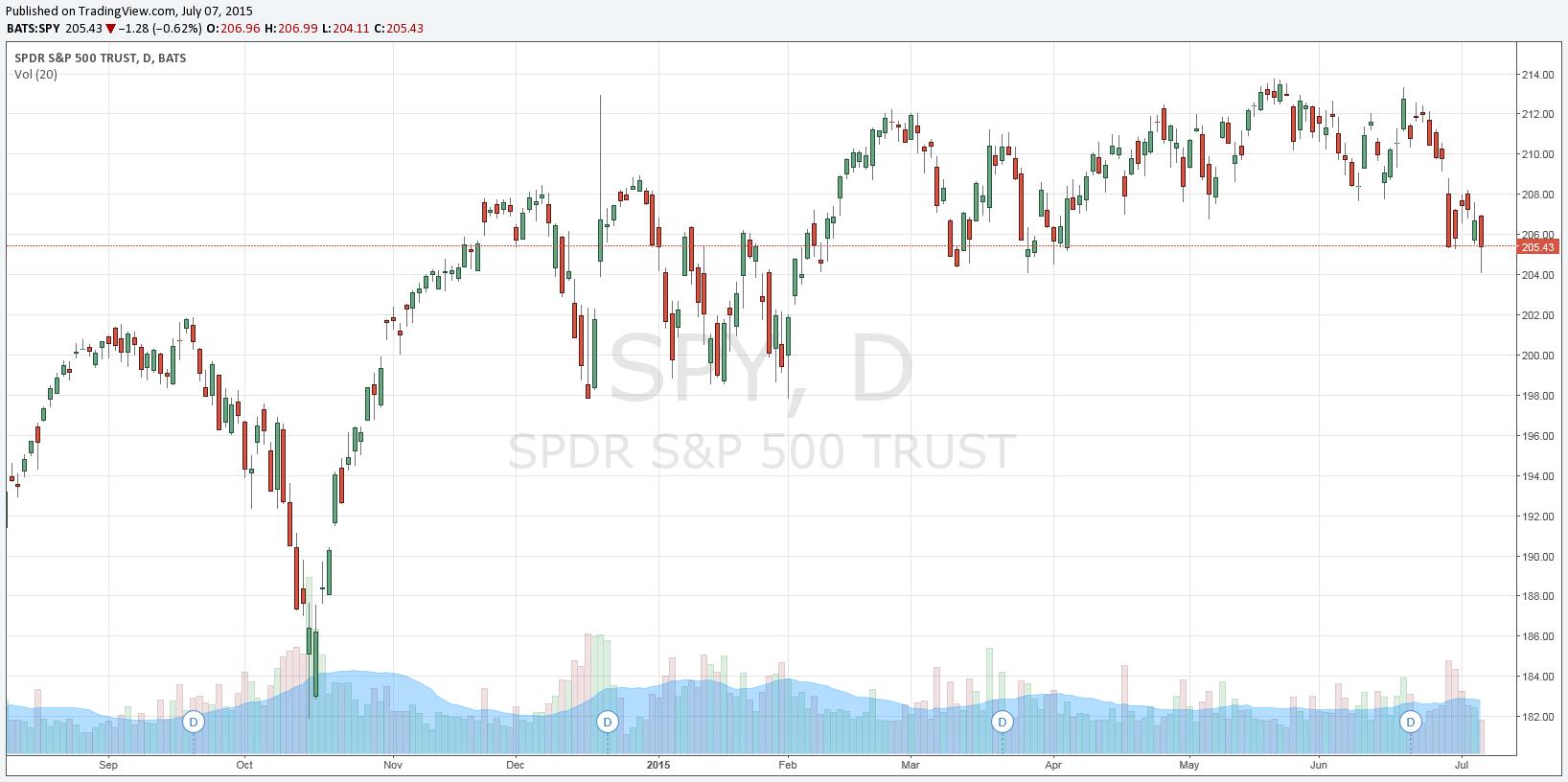
The S&P 500 (SPY) has been stuck in neutral for most of 2015, and we’re not surprised. The forces against a further advance have been mounting for some time. Not only are valuations stretched on some of the strongest business models, but global economic growth remains sluggish, perhaps punctuated by falling gross domestic product in the US during the first quarter of the year.
But that is not all that is ailing the global equity markets as of late.
Nothing short of a 1929 US-equivalent stock-market crash in China (FXI) is currently ensuing, and the government is doing all that it can to prop up the markets to ensure stability. The Shanghai Shenzhen 300 Index has fallen an incredible 30% in three weeks, and Chinese brokerages recently funded the state-owned China Securities Finance Corp with ~$20 billion (~130 billion yuan) to help stem the declines. From our perspective, this explicit “plunge-protection” action by the Chinese government is unprecedented, and if programs do exist in other more-developed markets such as Europe and the US, they’re not widely known or made public. China’s “market-stabilization” fund is market manipulation at the core and may do more harm than good over the long haul.
Weakness in Chinese equites has certainly been the most concerning development in recent weeks. Such a dynamic has implications on everything from the price of global commodities to the interconnectivity of the global financial system. Though the Chinese economy is not as large as that of the US, the trajectory of its incremental growth is vital to the pace of earnings expansion of many multi-nationals listed on US, Canadian, and European exchanges. A collapsing Chinese stock market is poison to the wealth effect that has helped the Chinese middle class expand so rapidly in recent years. The implications on economic growth as a result cannot be ignored.
Greece continues to steal headlines as it struggles to navigate through its own depression. The country’s economic growth has fallen considerably in recent quarters, and controversy over whether the age-old nation should still belong in the Eurozone remains heavily debated. Unlike China, however, the reality for global investors is that Greece simply is not that important to the global financial system or global economy. You wouldn’t know that by the amount of news media coverage dedicated to it, but Greece is not Lehman Brothers, whose demise in 2009 simply sent shockwaves throughout the global financial markets. The complexities that involve a global financial contagion are outlined in our banking piece .
The global markets continue to fall as one, revealing the reduced benefits of diversification this day and age. Equities in France (EWQ), Germany (EWG), Italy (EWI), and Spain (EWP) are all declining, and the Chinese market continues to experience unprecedented selling pressure. US markets have not been spared from this bout of de-risking, and both the crude oil and copper markets have seen rampant selling. The price of West Texas Intermediate crude oil fell nearly 8% yesterday as the world continues to drown in oversupply. Gold (GLD) is no longer the safe-haven it was before–if it ever was–and copper prices (CPER) are resting at 2015 lows. With interest rates set to rise eventually, according to the latest Fed statement, bond prices and fixed-income-like investments from REITs (IYR) to MLPs (AMLP) have higher hurdle rates to overcome.
It’s not a pleasant situation for investors.
Global macro concerns may eventually be the catalyst for a sustained pullback in equities around the globe, but this shouldn’t be surprising. We’ve been outlining the valuation risks for some time. But even if market weakness is nothing more than profit-taking, there aren’t a lot of reasons for investors to blindly rush back into the markets. We have ~30% cash positions in both the Best Ideas Newsletter portfolio and Dividend Growth Newsletter portfolio, and it’s for a reason. We’ll be looking to put that dry powder to work on firms in our watch list as the market weakens further, but we’re remaining patient for now. We’ll likely get better prices to put money to work soon, and we’ll be sure to let you know in which areas.