
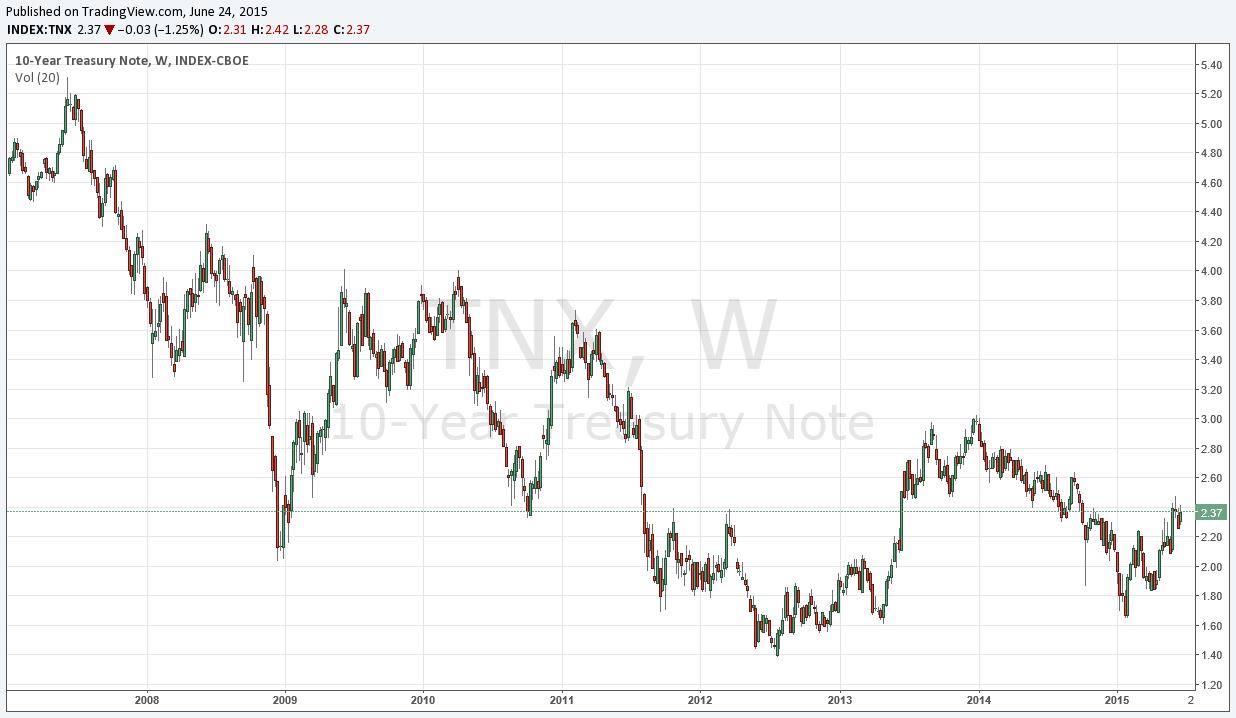
Since the peak of the Financial Crisis, the yield on the 10-year Treasury, a proxy for the risk-free rate within the valuation context, has been in a steady decline (see image above), but a strong bounce in rates since February continues to have the market on edge. Often moving in relation to Treasury yields are REITs and financial firms, though in opposite directions. Generally speaking, as interest rates rise, REITs experience selling pressure as investors opt for higher-yielding risk-free assets, while the opportunity to generate higher spread income is augmented with higher rates, sparking potential buying across the banking universe.
The Fed continues to mull its options with how to build a “stimulus” cushion in advance of the next impending economic downturn, the timing of which is the only uncertainty, and such posturing has created an aura of uncertainty with the pricing performance of REITs and financial institutions. The Fed’s most recent release suggests that there is a slight increase coming later this year, another in late 2016, and another in late 2017, but there are varying opinions on the proper timing of the increases. Our view is that we won’t see a rate hike until about 6-9 months after the equity markets “roll over,” and that hasn’t happened. The S&P 500 still remains in a confirmed uptrend.
Chair Janet Yellen remains adamant that the importance is not in the timing of the first increase but the overall trajectory of the policy. While she is speaking from a much more macroeconomic point of view than we like to take with respect to individual equity analysis, we expect the first increase to immediately impact REITs and the banking industry. A confirmation of an increase will likely set the stage for a prolonged period of contractionary monetary policy. Once the Fed hikes, there’s no turning back. All have their reputation on the lines, and the market simply won’t stand for fickle behavior. In fact, it punishes it.
It is a widely-held thesis that REIT equity performance is inversely correlated with interest rates, and by simple extension, the impending interest rate hike should spell trouble for REITs, in aggregate. There are a few reasons for this relationship. An investor’s required return, or cap rate, will always be a spread above the cost of capital (which is in part influenced by the cost of borrowing and interest rates), therefore tying cap rates and interest rates together. In periods of rising interest rates, property values can be expected to fall to reflect the higher required rates of returns by investors, all else equal. The opposite is true under conditions of falling interest rates.
However, all REITs won’t suffer from rising interest rates, as the conditions to warrant contractionary monetary policy often signal increased economic stability or strength and the potential for real rent increases, higher occupancy levels and robust net operating income expansion. These positive factors, in turn, may mitigate the negative impact that a higher discount rate may have on a REIT’s intrinsic value altogether. Equity values of REITs can theoretically increase in a credit tightening cycle that is slow, steady and properly managed, as long as the pace of net operating income expansion exceeds the incrementally higher required returns demanded by investors.
On the contrary, financial institutions can move in tandem with Treasury yields, as long as spreads (net interest margins) widen along the way. Banking entities use money to make money, instead of using operating assets and raw materials to drive revenue and resulting free cash flow like that of operating entities. This means that, under conditions of rising interest rates, the likelihood for generating increased spread income could second as a source of upside relative to existing expectations. In the event of rising rates, banks can charge higher rates for loans faster than what they are forced to pay on deposits.
Though rising rates spell opportunity for banks, the major issue we have with the banking industry is the high level of systematic risk prevalent. A lot has changed since the Financial Crisis that saw some of the best-known banking entities fail, but perhaps more has stayed the same. We’ve seen that risk management and internal controls can still falter, as was made evident by the London Whale incident of 2012. Banks continue to operate on confidence, which can be shaken by opaque events that are beyond the control of executives at the helm. The best idea for investing in financials, in our view, continues to be through diversified exposure, thereby eliminating firm-specific risk.
On that very note, we hold modest positions of two financials ETFs in the Best Ideas Newsletter portfolio, the Financial Select Sector SPDR (XLF) and the SPDR S&P Bank ETF (KBE), primarily for diversification reasons. With these two holdings, accounting for less than 4% of the portfolio together, we’re positioned to capture higher potential spread income across the entire banking universe under contractionary monetary conditions, without exposing the portfolio to unforeseen risks associated with concentrated exposure to any one entity.
A similar approach has been taken with REITs. Realty Income (O) and HCP (HCP) make up a combined 3.5% of the Dividend Growth Newsletter portfolio. Realty Income has terrific geographic and industry diversification. Its dividend track record may be second to none, and the firm’s dividend prospects are also solid, as should be expected from any dividend growth idea we surface. HCP has some of the best fundamentals in its industry while boasting a tremendous dividend track record in its own right.
We’re huge fans of these two REITs, but no matter how much we like them and others, the severe risks associated with heavy REIT exposure in any portfolio with looming interest rate hikes is too much risk to bear. We think a sub-5% weighting for both financials and REITs, individually, will put us ahead when the next shoe drops. Our equity bank report and our ETF report on real estate here (pdf) offer helpful background information on the myriad risks.
Related ETFs: PIMCO 1-3 Year US Treasury Index ETF (TUZ), iShares 1-3 Year Treasury Bond ETF (SHY), Vanguard Short-Term Government Bond Index ETF (VGSH), iShares 20+ Treasury Bond ETF (TLT), iShares 3-7 Treasury Bond ETF (IEI), PIMCO 3-7 Year US Treasury Index ETF (FIVZ), ProShares UltraShort 20+ Year Treasury ETF (TBT)