
“The way you lose money in the stock market is to start off with an economic picture. I also spend fifteen minutes a year on where the stock market is going.” and “If you spend more than 13 minutes analyzing economic and market forecasts, you’ve wasted 10 minutes.” – Peter Lynch
I’m not so much a Peter Lynch disciple as I am a logical thinker. According to the legendary fund manager, you have a total of three minutes to read this piece on broader economic activity, and then move on to more useful analysis.
There’s no time to waste!
Peter Lynch was the manager of the Magellan Fund at Fidelity Investments through the late 1970s and during the 1980s, where he averaged nearly a 30% average annual return, often more than doubling the performance of the S&P 500 (SPY) index each year. During his tenure, the Magellan Fund was one of the best, if not the best, performing mutual funds in the world. If you haven’t studied his famous texts One Up on Wall Street and Beating the Street yet, then reading those works is your homework for this month.
The lessons from Mr. Lynch go on and on. Here are two more excellent analytical insights that fit the topic of this article.
“Nobody can predict interest rates, the future direction of the economy, or the stock market. Dismiss all such forecasts and concentrate on what’s actually happening to the companies in which you’ve invested.” It is far more productive for an investor to focus their time and energy on systems which are potentially understandable in a way which might reveal a mispriced asset. George Soros said once: “Unfortunately, the more complex the system, the greater the room for error.” The simplest system on which an investor can focus is an individual company. Trying to understand something as complex as an economy in a way which outperforms the markets is not a wise use of time and is unlikely to happen (Source: 25iq).
“The GNP six months out is just malarkey. How is the sneaker industry doing? That’s real economics.” The difference between the predictive power of microeconomics and macroeconomics is “night and day” since with the former vastly fewer assumptions are required and the systems involved are far less complex. The best investors make investing as simple as possible, but no simpler. Lynch is saying he may pay attention to the economics of an industry, but only to understand the economics of the companies he chooses to follow (Source: 25iq).
If you need to take a moment, I understand.
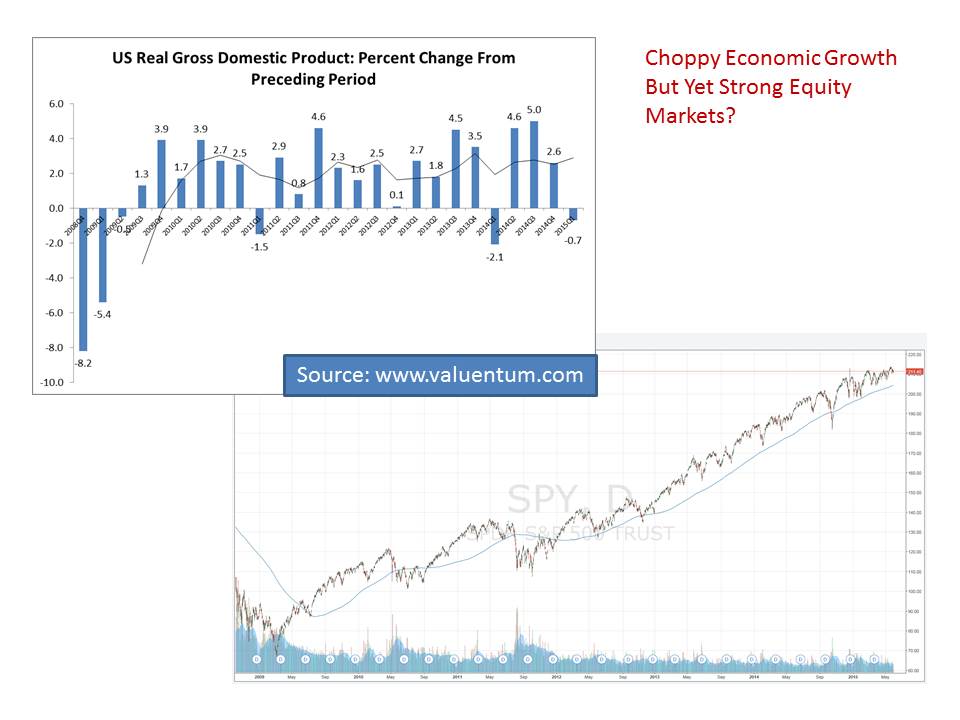
Macroeconomic newsletters have been preying on investors since government bodies started measuring economic activity, but their usefulness is minimal at best and dangerous at worst. So then why are we addressing the 0.7% point contraction in US GDP during the first quarter if we don’t want you to spend much time analyzing the economy?
Great question. We’re writing this up to show you that the equity markets can perform incredibly well during intermittent periods of economic contraction. Just take a look at the image above. The other reason is that many investors have the relationship between economic activity and stock market returns completely backwards.
Academic research, far and wide, suggest “stock prices have been found to provide important information about future economic activities. Fama (1981), Fischer and Merton (1984), and Barro (1990), among many others, document a positive relation between stock market return and subsequent growth in investment and output. Hui Guo (2002).” Stock market returns predict future economic activity, not the other way around.
So why do investors pay so much attention to the economy? Your guess is as good as mine, but it likely has to do with the good ol’ sales pitch that you may have heard for why one has to include emerging markets exposure in their portfolios in the first place. Can you hear the sales team at your local wealth advisor pulling out their pitch decks now?
“Emerging markets are growing faster, and they’ll be a larger weight in the global economy in the decades to come. You need exposure. You’re going to miss out.” – Hypothetical Salesperson
Who better than The Economist magazine to debunk the usefulness of evaluating economic activity in its very own 2014 article, The Growth Paradox: Past Economic Growth Does Not Predict Future Stock Market Returns:
Let us assume that they make forecasts of economic growth by extrapolation from the data for the previous five years, and put money in the equity markets of the countries that have grown the fastest. Since 1972, that approach would have delivered a return of 14.5% a year in dollar terms. But had they invested in the economies with the slowest growth record, investors would have earned 24.6%.
Amazing, isn’t it? The economies with the slowest growth record outperformed those with the fastest. According to The Economist magazine, here’s why:
This may partly be down to a “value” effect, similar to that observed with individual stocks. Countries with good growth records become favored by investors who bid up share prices accordingly; future equity returns are thus lower. But countries with poor growth records see their stock markets shunned; their share prices are thus cheap and offer higher subsequent returns. Another problem is that extrapolating from past economic growth simply doesn’t work. The report finds no correlation since 1900 between GDP growth per person in an individual country in one year and growth two years later.
All told, stock prices are leading economic indicators. In fact, the S&P 500 stock index is included in the Conference Board’s ‘Composite Index of Leading Indicators.’ Economic activity provides little insight into how stock prices will perform. Now you know.
Our three minutes are up.