
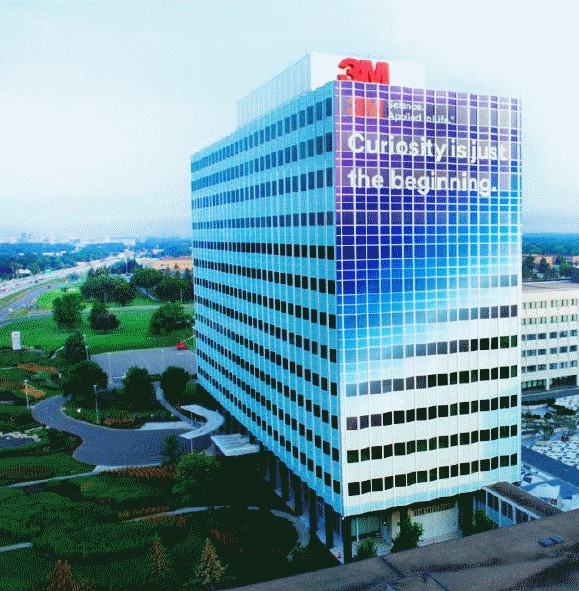
Image Source: 3M Company – IR Presentation
By Callum Turcan
Maker of bathroom scrubbers, specialty adhesive products, personal protection systems, inks, medical supplies, and a whole host of other products under the Scotch, Scotch-Brite, Command, Post-it, and other brands, 3M Company (MMM) is fundamentally a science-based company that holds over 100,000 patents. Innovation forged 3M into the giant conglomerate we know today, but that same innovation has created a major liability which could pressure its financials. Shares of 3M yield 3.5% as of this writing and are not part of any newsletter portfolio.
The Situation
It comes down to per- and polyfluoroalkyl substances (“PFAS”), which can be used as effective water and grease repellents in anything from Teflon pans to Scotchguard products to the foam used in fire extinguishers. Please note that perfluorooctanoic acid (“PFOA”) and perfluorooctane sulfonate (“PFOS”) are varieties of PFAS. These man-made chemicals pose a major legal liability to 3M and those risks have already made themselves known, with 3M agreeing to pay the state of Minnesota $850 million in February 2018 to settle a lawsuit concerning its production of PFAS in the state. That lawsuit alleged that 3M’s production of PFAS contaminated groundwater and resulted in major health risks to several of the state’s communities. 3M had been accused of a major cover up to hide the risks PFAS poses to society but ultimately admitted no wrongdoing as part of the settlement.
The problem comes down to PFAS entering reservoirs and ultimately drinking water, where unsuspecting humans and animals consume a chemical that is nearly impossible to get rid of, once in the organism’s system. Scientists think PFAS has been shown to decrease vaccine response and increase the likelihood for cancer in humans, and that was made especially apparent in the affected regions in Minnesota. An article by Bloomberg noted that the Environmental Working Group cited water tests that showed 110 million Americans have levels of PFAS in their blood that most scientists would consider unsafe. 3M has maintained that PFAS isn’t a danger to public health.
Dozens of lawsuits have been filed all over America over PFAS-related contamination. The state of New York sued the company last year over PFAS contamination stemming from the firefighting foam used at several of the state’s civilian and military airports, saying that the foam caused “extensive contamination” to the nearby fish, soil, and water. Furthermore, that contamination created health risks and those risks are coming back to haunt 3M. Whether 3M will be held liable or not remains to be seen, but this is a growing problem. Other lawsuits have popped up in Alabama, Ohio, New Hampshire and elsewhere, creating a major overhanging on the share price of MMM. Another huge concern relates to whether the EPA will take action and increase regulations on the production of PFAS, a move that could impose significant financial costs on 3M.
Dividend Strength
3M earns a Dividend Cushion ratio above 1 for the time being, providing a decent but not enormous buffer in case downside risks such as these materialize. The possible size of any potential future settlements is impossible to gauge at this point in time (a known “unknown”).
3M generated over $6.4 billion in net operating cash flow on average during the past three years while spending a bit under $1.5 billion on capital expenditures, allowing for $5.0 billion in average annual free cash flow generation from 2016-2018. The company spent $3.2 billion on dividend payments in 2018 and $2.9 billion on average from 2016-2018, which was easily covered by free cash flow. Please note that substantial share buybacks are also at play, which averaged $3.6 billion per year from 2016-2018. Additionally, 3M had a net debt load of $12.9 billion at the end of March 2019 (inclusive of short-term debt).
Share buybacks are already winding down as 3M announced it was acquiring medical device company Acelity in May 2019 through a deal worth $6.7 billion by enterprise value. Previously, 3M planned on allocating $2.0 billion-$4.0 billion towards buybacks in 2019, which has since been scaled down to $1.0 billion-$1.5 billion. Note 3M spent $0.7 billion repurchasing shares during the first quarter of 2019 alone, implying muted buybacks for the rest of the year.
While 3M has good dividend coverage, it could be better. In the event PFAS-related lawsuits end up going against 3M, the company may have to consider suspending its share buyback program in order to maintain its current payout while covering legal settlements. Moody’s Corporation (MCO) gives 3M’s senior unsecured debt an investment grade credit rating of A1 with a stable outlook. When factoring in 3M’s ability to tap capital markets, we don’t think its dividend is at risk of getting cut anytime soon. The company’s innovation-first strategy allows for 3M to have a capex-light business model, enabling material free cash flow generation.
Here are two excerpts from our two-page Dividend Report covering 3M and how we view the strengths and weaknesses of the company’s dividend policy;
Since late 2013, 3M has taken its dividend growth to a more aggressive level, and it believes its ongoing business transformation will result in greater dividend growth potential. Management to deliver 100% free cash flow conversion in the period 2019-2023. However, we fear income growth investors may be falling into the trap of thinking that the recent dividend growth rate is sustainable for 3M through the course of the economic cycle. Even for a strong free cash flow generator like 3M, this may be an insurmountable feat from recent levels. Beware of overly optimistic investor expectations, but we continue to expect growth in the payout. 2019 marks its 61st consecutive year of annual dividend increases…
Very few firms have the free cash flow profile of 3M, but significantly increased annual cash dividend obligations continues to make annual growth in the payout that much more difficult to cover. Currency headwinds may pose challenges in the near term, and recent efforts to restructure the business speak to a company with some slack in its operations. A net debt load of ~$12.9 billion (including short term debt) at the end of the first quarter of 2019 doesn’t help its dividend growth efforts, and management plans to allocate ~40% of its annual capital budget to acquisitions and share repurchases. In 2019, the firm’s total funds available in its budget include cash flow from operations (ex. R&D spend), cash on hand, and additional leverage.
Concluding Thoughts
We will be monitoring the situation as 3M’s legal situation unfolds, and while we aren’t too excited about 3M as things stand today, we don’t see a dividend cut as likely. However, if it turns out that 3M’s PFAS legal liabilities are greater than expected, the company will need to consider adjusting its capital allocation policy. When it comes to dividend increases, 3M may be unable to sustain the brisk payout growth rate seen historically without putting serious stress on its balance sheet. During 3M’s upcoming quarterly conference call later in July, the company might provide more color on this issue.
Conglomerates Industry – DHR GE MON MMM UTX
—–
Valuentum members have access to our 16-page stock reports, Valuentum Buying Index ratings, Dividend Cushion ratios, fair value estimates and ranges, dividend reports and more. Not a member? Subscribe today. The first 14 days are free.
Callum Turcan does not own shares in any of the securities mentioned above. Some of the companies written about in this article may be included in Valuentum’s simulated newsletter portfolios. Contact Valuentum for more information about its editorial policies.