
By Kris Rosemann
Cracker Barrel’s (CBRL) fiscal fourth quarter results, reported September 14, came in at reasonably solid levels, but as we know, what really matters in the market is what lies ahead.
The firm reported revenue growth of 3.7% from the year-ago period, thanks to comparable store restaurant sales increasing 3.2% and comparable store retail sales growth of 3.5%. Though traffic fell 1.2% on a year-over-year basis in the quarter, such weakness was more than offset by a 4.4% increase in average check as the average menu price rose 2.4%. The quarter marked Cracker Barrel’s largest outperformance in sales and traffic of its casual dining peers in fiscal 2016 despite the drop in traffic, as restaurant chains in the US have felt more meaningful traffic pressures in recent months.
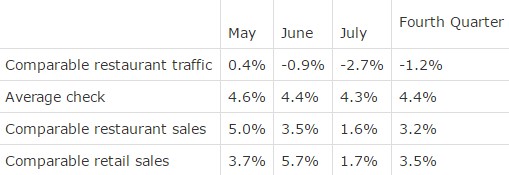
Image source: Cracker Barrel fiscal fourth quarter report
Cracker Barrel’s operating margin improved 30 basis points from the fourth quarter of fiscal 2015 thanks to cost management on the SG&A line and a reduction in cost of goods sold. Restaurant operating expenses continued to rise in the quarter, partially offsetting the aforementioned benefits, most of which was due to ongoing wage inflation. The firm’s bottom line expanded nicely in the quarter, as earnings per diluted share jumped to $2.12 from $1.97 in the year-ago period.
Despite a more than 15% increase in net income in fiscal 2016 compared to the previous year, cash from operations fell nearly 19% as a decrease in accounts payable and net changes in other assets and liabilities weighed on results. Such softness coupled with an increase in capital expenditures led to material pressure on free cash flow in fiscal 2016. This raises questions surrounding management’s decision to pay a special dividend of $3.25 per share in mid-July, which was part of a drain on the firm’s cash balance in the quarter.
The headline-grabbing information in Cracker Barrel’s fiscal fourth quarter report, however, was that of the forward-looking variety. The company expects fiscal 2017 comparable store restaurant sales and comparable store retail sales to slow materially from fiscal 2016 fourth quarter levels as guidance for the two metrics came in at 1%-2% for the full fiscal year. Management will decelerate menu price increases from the run-rate of the past two fiscal years and projects fiscal 2017 menu price hikes to be in the 1%-2% range. The lower guidance takes into account expectations for a continued challenging consumer environment, something that is beyond the firm’s control.
Another factor largely out of Cracker Barrel’s control is the wage inflation pressures it expects to persist in fiscal 2017; the company expects 2.5%-3.5% wage inflation in the fiscal year on a constant mix basis, which it hopes to offset with ongoing cost savings initiatives. As a result, the firm issued earnings per diluted share guidance of a range of $7.95-$8.10, compared to $7.86 in fiscal 2016.
We’re not rushing to dump shares of Cracker Barrel at the moment. We see little reason for concern with the company from an operational standpoint, though we do recognize the headwinds within the broader restaurant industry. While we have a base of reduced expectations for restaurant traffic trends, we will continue to watch the industry for additional weakness as consumer spending remains fickle in a number of ways. In the meantime, we will collect dividend checks yielding ~3.3% at recent price levels!