
By Kris Rosemann
Coach (COH), Michael Kors (KORS), Fossil (FOSL), and Ralph Lauren (RL) all beat consensus estimates in the calendar second quarter of 2016, but the way the market reacted to the beats varied drastically despite none of the above firms necessarily issuing outright optimistic expectations. The weak outlooks have weighed on shares of Coach and Michael Kors, but shares of Fossil and Ralph Lauren have received an updraft in hopes of turnaround strategies and sales-decline stemming plans beginning to take hold.
Ongoing weakness in retail traffic across the US, and a decrease in tourism in major domestic cities have played an important role in the growing issues for luxury brands. In an attempt to combat traffic pressures, many department stores have been offering significant discounts on many luxury goods, which has forced Coach, Michael Kors, and Ralph Lauren to reconsider their strategies in the retail environment. In order to protect their brand images, the firms have decided to pull their products from those offering their luxury goods at deep discounts. Though such a move will undoubtedly bring near-term pain, protecting the branding of an aspirational-luxury goods maker is imperative to long-term success.
Coach reported a relatively solid fourth quarter of its fiscal 2016 (calendar second quarter) in which net sales jumped 15% on a year-over-year basis and North American comparable store sales increased 25%. Operating margin expansion helped drive non-GAAP earnings per share to $0.45 from $0.31 in the comparable period of fiscal 2015. However, Coach brand net sales at department stores in North America declined at a high-single-digit rate compared to the year-ago period. Coach now expects to close ~250 of its wholesale locations and issue a reduction in markdown allowances, which it hopes will preserve its brand as a high-end aspirational target for consumers.
Nevertheless, Coach expects fiscal 2017 to be the year in which it returns to growth across all financials, including the assumption of low-single-digit comparable store sales growth in North America. Revenue is expected to increase in the low-to-mid single digit range, while earnings per diluted share is expected to make a double-digit jump from fiscal 2016. The firm’s balance sheet, and the financial flexibility it offers, continues to be a key attribute in its turnaround plan, as its net cash position stood above $443 million as of the end of the fourth quarter of its fiscal 2016. We think the company, and its ~3.3% dividend yield, continues to be a nice fit in the Dividend Growth Newsletter portfolio.
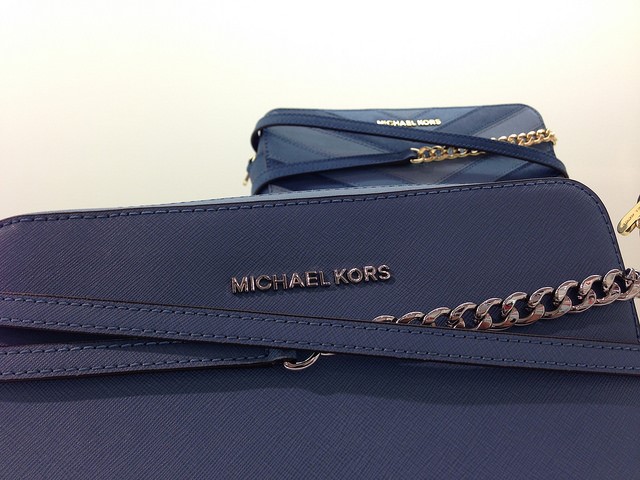
Michael Kors’ first quarter of fiscal 2017 (calendar second quarter) was not nearly as strong as that of Coach. The firm reported total revenue roughly in-line with that of the year-ago period. While retail sales advanced 7.6% thanks to new store openings, primarily in Asia, wholesale net sales fell 7% and comparable sales decreased 7.4%. Net income per ordinary share on a diluted basis dropped $0.04 from the comparable period in fiscal 2016 to $0.83 in the quarter as ongoing investments in international expansion, digital flagships, and global infrastructure resulted in an increase in operating expenses.
Michael Kors’ management was encouraged by the firm’s progress in its North American digital flagships and its global expansion, though such progress was offset by material weakness in its more traditional North American business due to suppressed mall traffic levels and lower tourism spending in major cities. Similar to Coach’s strategy, the company is also working to avoid the aspirational-brand image tarnishing, ultra-competitive discounting taking place at department stores across the US. As CEO John Idol said, “The amount of promotional activity from many of the people who carry our line was at its all-time high, and we had to compete to be able to move our inventories during that period of time. That’s the whole cycle we are going to get ourselves out of.”
Michael Kors expects the aforementioned top-line pressures and operating margin suppressors to continue to impact fiscal 2017 results. The company is projecting total revenue to be flat from fiscal 2016 with comparable sales falling in the mid-single digit range, the latter of which is a downward revision from initial guidance of a low-single digit decline. GAAP diluted earnings per share are expected to come in a range of $4.47-$4.54 compared to $4.44 in fiscal 2016. We will continue to hold shares, which are trading at just over 11 times fiscal 2017 earnings, in the Best Ideas Newsletter portfolio as we continue to believe in the firm as a long-term idea “Fundamental Strength To Outweigh Short-Term Volatility.”
Michael Kors continues to feel the pain of its global watch licensing agreement with Fossil, which reported a net sales decline of 7% on a year-over-year basis, due to a 10% drop in its watches revenue. Management pointed specifically to its licensed brand category of watches as a key drag on its overall sales growth, and the company was not exempt from the pressures impacting its peers. Global retail comps fell 3% in the quarter from the year-ago period as positive comps in its full price stores were mitigated by material comp declines in its outlet stores, and strength in Asia was offset by weakness in the Americas and Europe.
Though Fossil’s quarter left a good deal to be desired, its shares have received an updraft thanks to its better-than-expected reported results. The firm continues to face an uphill battle in its core watches business, which accounts for ~75% of total sales, as the recent increase in wearable technologies continues to weigh on demand for traditional watches. It has attempted to enter the wearables market, but we have our concerns with the true competitive potential of such offerings from a traditional watch maker entering the market considerably later than many. In addition, Fossil’s brand strength could mean little next to the likes of Apple (AAPL) in the wearables market, in our opinion.
Ralph Lauren has seen many of the same market dynamics impacting its business as its peers. The firm reported a less-than-spectacular first quarter of fiscal 2017 (calendar second quarter), but it beat consensus estimates and its shares have rallied as a result of its execution of its turnaround plan. The company’s ‘Way Forward’ plan remains its focus, and is a large reason why investors were not expecting much in terms of financial performance from it in the most recent quarter. Net revenues fell 4% on a year-over-year basis as wholesale revenue was pushed down 5% by US department store weakness and retail revenue was dragged down 3% by a 6% decrease in comparable store sales.
Operating income margin at Ralph Lauren fell roughly half as much as it was expected to in the period, a large positive for the firm as it continues to set its sights down the road. Adjusted net income per diluted share fell to $1.06 from $1.09 in the year-ago period but easily beat consensus estimates of $0.89; full-year guidance was not increased, however. Like its peers, the company also expects to reduce its reliance on the discretion of traffic-desperate department stores, but it will cut 1,000 jobs and close stores in accordance with its restructuring plans associated with its ‘Way Forward’ plan. $180-$220 million in annualized cost savings are anticipated as a result.
The operating environment for aspirational goods producers is not likely to improve in the near term either; strategy adjustments and restructuring initiatives from players within the space speak to this notion, in our view. We may see more share price volatility across the group as their respective strategies play out, and we’ll continue watching the newsletter portfolio constituents in the arena like a hawk. We continue to hold onto Coach as it works toward righting the ship with respect to its brand image. Its quarterly payout looks to be on solid ground, and at ~2% of the Dividend Growth Newsletter portfolio, we like what it does for us in terms of diversification in a portfolio context. We continue to believe in future price-to-fair value convergence in shares of Michael Kors, which are currently trading below the lower bound of our fair value range of $53-$79, though the road may be bumpy. Kors is included in the Best Ideas Newsletter portfolio.