
Image Source: Bill L
By Kris Rosemann
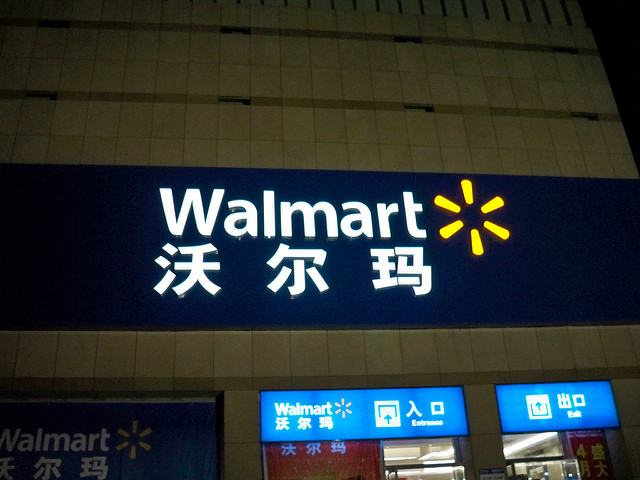
As some US corporations are finding the Chinese market an increasingly difficult one in which to operate, “China (May 2016),” Walmart (WMT) is taking moves to strengthen its presence in the world’s second largest economy. On June 20, the retailing behemoth announced that it has entered into a partnership with JD.com (JD), one of China’s largest e-commerce companies, a move that will enhance offerings to consumers throughout China via a combination of JD.com’s e-commerce prowess and Walmart’s traditional retail operations. While Walmart continues to expand internationally, Target (TGT) continues to retreat from non-US markets, even having abandoning efforts in Canada recently.
In the deal with JD.com, Walmart has agreed to sell its grocery-focused, Chinese e-commerce business Yihaodian to JD.com for a 5% stake in JD.com, worth ~$1.5 billion. JD.com will control the Yihaodian website while Walmart will continue to operate Yihaodian’s direct sales business. Walmart will also continue to sell on the Yihaodian marketplace, which is expected to significantly improve JD.com’s presence in eastern and southern China. JD.com will then receive the right of use to a wide variety of items from Walmart it previously did not have. The two firms will also cooperate to leverage their massive supply chains to increase the offerings for consumers across China, particularly through the expansion of the range of imported products sold.
Perhaps the most important aspect of the transaction is Walmart’s gain of access to such a significant e-commerce platform and same-day delivery network in the second-largest (and still a fast growing) economy in the world. JD.com’s warehouse and delivery network covers approximately 600 million consumers. The American retail giant has had a difficult time in China–it operates just over 400 stores in the country despite having a presence there for ~20 years–and bolstering its online presence may just be the key to future success, particularly when considering that categories such as groceries and household goods have become more prominent items for online shoppers in China as of late. Walmart’s Sam’s Club operations figure to be a beneficiary of such a dynamic, too. The first Sam’s Club was opened in 1996 in China.
Walmart believes the deal has the potential to greatly impact its online traffic from JD.com’s large customer base and delivery network. Walmart’s Yihaodian owns and operates ~250 delivery and pickup stations across China, while JD.com boasts nearly 6,000 of such hubs. Prior to the deal, Walmart had just over 1.5% of the total Chinese online market, good for number 6 overall in the country, a far cry from JD.com’s ~20% share of the Chinese e-commerce marketplace. Righting the ship in China has the potential to be a material driver for Walmart’s growth in coming years; the firm has meaningful potential to grow its presence in the country, both in terms of e-commerce and physical store count. The partnership with JD.com also has serious potential to aid in Walmart’s online initiative, something its ownership of Yihaodian did little to shore up as e-commerce sales growth across the globe has decelerated in recent quarters at Walmart.
Though shares of JD.com have caught an updraft as a result of the deal, this transaction is more about the potential for an additional growth driver for Walmart, in our opinion. Walmart gains ~$1.5 billion in shares of JD.com that are currently trading at a material discount to our fair value estimate of $32, as well as meaningful potential to grow its presence in the largest online marketplace in the world. International expansion, particularly in Brazil and China, has been a focus at Walmart, and this transaction could be a very nice catalyst for more non-US growth initiatives. Though there may be upside for shares of JD.com on the basis of our fair value estimate, we note, however, the firm is still exposed to risks associated with the uncertainties in the Chinese economy and its ever-changing regulatory environment (and it has yet to demonstrate that it can sustainably turn a profit). The deal, however, may still turn out to be a large positive for JD.com as it relates to its competitiveness with the likes of Alibaba (BABA), which owns nearly half of e-commerce share in the country.