
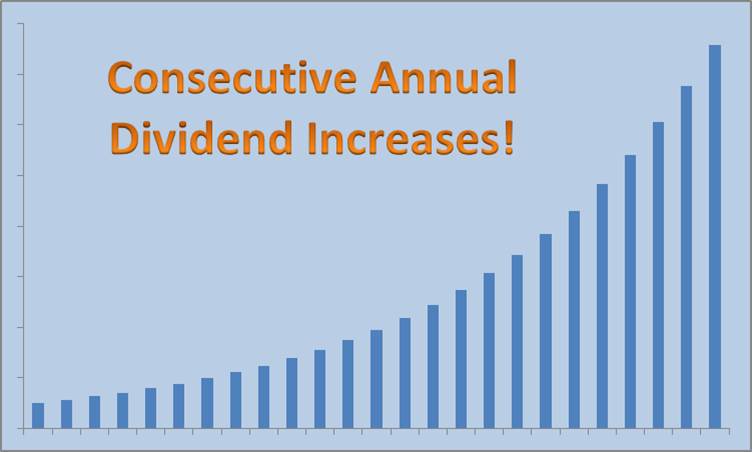
The dividend growth “track record” craze continues to be on in a big way, and we can’t help but feel there are similarities to the outcome of the ‘Nifty Fifty’ craze in the late 1960s and 1970s as there might be to dividend growth investing today. For those that may not be familiar, the ‘Nifty Fifty’ was a group of “buy-and-hold” large cap stocks that were largely credited with driving the market to new heights during the early 1970s. Many called these stocks with stable earnings one-decision stocks — they were to be bought and held forever. We have believed for some time that the proliferation of dividend growth investing may very well have the same effect on today’s market, propelling it ever higher, much like the “Nifty Fifty” did on the market some decades ago now.
Even if the strong performance of dividend growth equities may be more a result of the prospect of continued low interest rates (no alternative sufficient yield growth instruments), the question remains: Who is going to sell these dividend growth equities en masse in order for these stocks to experience abnormal and drastic declines? Overhead resistance is minimal and the very core of the dividend growth strategy centers on dividend reinvestment, which itself offers a solid backbone for even future advances of the equity. Most of the “Nifty Fifty” underperformed during the bear market of the late 1970s, early 1980s, after their run higher, but they had their time. Dividend growth equities could similarly make a striking run higher for the next few years, until interest-rate and/or global growth expectations are inevitably reset, or not. They could run even longer.
To address this lingering idea, we are augmenting the already-strong Dividend Growth Newsletter portfolio with a 5% position in the SPDR S&P Dividend ETF (SDY), and we are also adding a 5% position in the SDY to the Best Ideas Newsletter portfolio ($81.33). We don’t necessarily prefer ETFs over individual stocks, but given the thematic nature of this thesis, we think an ETF makes the most sense. In the case of the SPDR S&P Dividend ETF, diversified exposure to over 100 equities that individually boast dividend track records of consecutive annual increases for the past 20 years hits directly on what’s in vogue in the market today. As more and more income investors pile into equities with long dividend growth track records, we believe most will be buying baskets of such stocks, or this ETF or another one like it, so there is little reason for us to have to take on incremental firm-specific risk with this idea to broadly target the outcome of this particular thesis. That is not to say that other current holdings in the Dividend Growth Newsletter portfolio aren’t the best fit for a dividend growth strategy, but they are already in the portfolio. The SDY, in particular, has performed fantastically since the beginning of 2016, and with the quality of companies in the ETF, it may eventually turn into a long-term position in both portfolios. We expect alpha to continue to be generated by the collective portfolio constituents of both newsletter portfolios, and the ETF will also increase our equity exposure in light of the market’s ongoing push forward, reducing the drag of an outsize cash position.
We are also making another addition, but only within the Best Ideas Newsletter portfolio, as this company is probably most famous for not paying a dividend. Specifically, we are adding a 5% weighting in Berkshire Hathaway (BRK.B) ($146.13). We value shares at $156 each, and while that suggests modest upside, we’re sticking with extremely high quality in today’s overheated market. On a fundamental level, we’re quite fond of Warren Buffett’s recent addition to his diversified portfolio of companies in the form of Precision Castparts, quite possibly the very best-run aerospace parts supplier and a long-time Valuentum favorite. We’re not expecting substantial equity price outperformance from Berkshire Hathaway in light of its mega-cap nature, but the company is a great anchor for what might be ahead of us in today’s bubbling markets.