
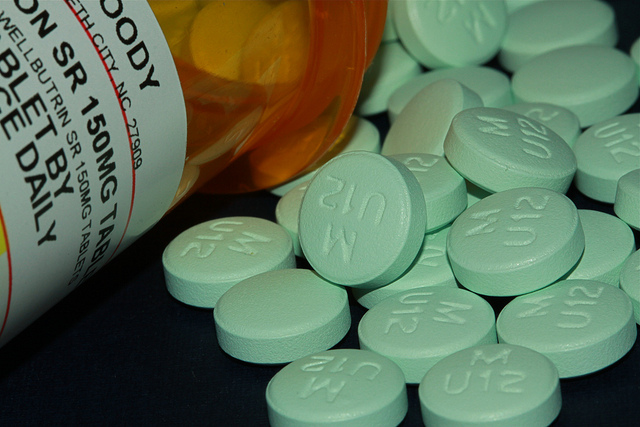
Image: A bottle of Valeant’s anti-depression drug Wellbrutin lay in disarray, much like the company’s operations. Wellbrutin was one of several key drugs on which Valeant used questionable pricing strategies to increase sales, source: Wendy.
Valeant (VRX) CEO Michael Pearson said it rather bluntly on the firm’s preliminary fourth quarter 2015 press release, “The challenges of the past few months are not yet behind us…” The company has faced a significant amount of political and financial pressure in recent months as the firm has been the subject of numerous investigations from government agencies and multiple litigations, and also delayed the filing of its 2015 annual report to April. Valeant has warned that it could face an “event of default” if it does not file the delayed annual report in April, and the company said it cannot commit to its previously announced filing deadline. Activist shareholder Bill Ackman is reeling, and so are many “long-term” investors; the “Valuentum” investor, however, has remained firmly on the sidelines for these many months watching the carnage unfold.
Though Valeant’s fourth-quarter warning left much to be desired, the more incendiary information in its preliminary release March 15 was its significant reduction in guidance for 2016. For the full year, the firm reduced its total revenue guidance to a range of $11-$11.2 billion from $12.5-$12.7 billion. Adjusted earnings per share (non-GAAP) guidance was dropped to a range of $9.50-$10.50 for the year from $13.25-$13.75, and adjusted EBITDA is now expected to be $5.6-$5.8 billion compared to previous guidance of $6.9-$7.1 billion. More downward revisions are likely on the horizon, as management clearly does not have a great handle on the business at the moment. Though Valeant generated ~$840 million in adjusted cash flow from operations during the fourth quarter, it holds ~$30.3 billion in long-term debt and ~$600 million in cash on the books, a major shareholder deficit. How might a Chapter 11 process unfold if the executive team can’t straighten out the books in time? Certainly equity holders would get a lot on the basis of Valeant’s cash-flow generation, but how much is the big question, particularly in light of a much more uncertain future? Valeant’s market capitalization is ~$11 billion at the time of this writing, and it seems long-term holders have been burnt again.
On a fundamental basis, Valeant expects lower-than-expected growth in its US dermatology, gastrointestinal, and woman’s health portfolios, as well as in other regions, such as Western Europe, as it kept its outlook for expenses largely unchanged. The uncertainty regarding the sustainability of its business relationships and the retention of key personnel, in our view, and the heightened scrutiny the firm (and its industry) has faced as a result of questionable pricing strategies were the primary culprits for the vast revisions. For example, the average price of branded prescription drugs in the US has doubled in the past five years, and with 2016 being an election year, the political pressure has been dialed up, from Republican and Democratic candidates alike. Valeant, for one, is currently under congressional investigation over its “outrageous” drug price increases, which have generally not come from more palatable internal research and development but as a result of a “buy-and-raise-prices” roll-up strategy. Congress wants answers. Valeant noted that aggressive price increases will no longer be its modus operandi, which will have profound implications on its long-term intrinsic value.
Unlike Pershing Square’s Bill Ackman, which has been caught up in this “mess” and is facing significant losses, Valeant represents a prime example showcasing how the Valuentum methodology, by not only demanding a stock be undervalued but also that its share price be on firm ground, helped us avoid yet another “value trap” that many pure-value-oriented investors may have succumbed to. As of our previous update, Valeant’s shares were trading below the lower end of our fair value range on the basis of assumptions given by management, which have now been revised lower. These assumptions later proved to be far too optimistic, but the share-price momentum overlay of the Valuentum methodology kept us away from this “falling knife.” As we say time and time again, there is material and usable information in a company’s stock price that goes beyond the GAAP financial statements. Pay attention to pricing information – sometimes it’s the only clue that will help you avoid blow-ups like Valeant.
We expect to publish our updated fair value estimate of Valeant soon, haircutting our forward revenue and earnings outlook of the company.
Related ETFs: IBB