…if stock market indices always go up over the long haul. Speaking the obvious…
We often receive questions from new members about why we have such large (30%+) cash positions in both newsletter portfolios. Some believe it to be a mistake because they have been taught that “timing the market” and/or assessing overall market valuations is a fool’s errand.
For most all investors, it is generally accepted that staying “fully-invested” is a good idea.
But let’s take the recent example of Warren Buffett’s Berkshire Hathaway (BRK.A) buying Precision Castparts (PCP). The latter is certainly not a new company, having been around since the late 1940s, and Buffett has admittedly known about the metal bender for some time. So, then, why didn’t Berkshire launch a bid for Precision when it was approaching $275 per share in early 2014, near its all-time peak?
After all, timing doesn’t matter, right?
Obviously, timing does matter, and so does valuation, and therefore, price. It can probably be reasonably assumed that Berkshire Hathaway was much more open to purchasing shares at $235 each when they were sub-$200, as was the case when the deal was announced a few days ago, than offering a nice premium when shares were approaching $275. Buffett timed his purchase for when shares met his pricing criteria. The truth is that investors can be successful timing the market.
But the reality is that not everyone is Warren Buffett.
Herds of financial advisors therefore encourage most investors to stay “fully invested” at all times, and this probably isn’t a bad generalized suggestion. Selling at the market bottom during the depths of the Financial Crisis in March 2009, for example, would have had disastrous implications on retirement savings. Believe it or not, many did so. There were sell orders, and lots of them. Selling at any “bottom” is unfortunate. But is there anything wrong with selling at market tops? Or near market tops? What’s wrong with taking some profits when one is comfortable in order to de-risk one’s portfolio?
The challenge is in identifying when a market top may be nearing…
During the past several decades, we’ve experienced unprecedented global economic growth, brought about by technological and industrial innovation, and leaps-and-bounds of productivity improvements. Interest rates, the discounting mechanism within the stock valuation framework, have fallen from nosebleed levels in the 1970s and 1980s to literally the ground floor today…the basement, even. Are we to believe that the next 30 or 40 years will be like the last? We’re not sure how they could be? Remember when real estate moguls were saying that housing prices could only go up? That turned out to be dead wrong.
Why do investors believe assets only appreciate in value? It’s not always true.
Whether or not to be “fully invested” certainly is a choice of each individual and their financial advisor, but from our perspective, in times of stock market valuation extremes, as in the case of the dot-com bubble in the late 1990s or even heading into the housing crisis through the middle of last decade, common-sense caution seemed to be well-rewarded. Fast-forward to today, and we continue to see the various valuation risks across several popular sectors from consumer staples to healthcare, and the “popping” of the Chinese stock market bubble a number of weeks ago has us on full alert.
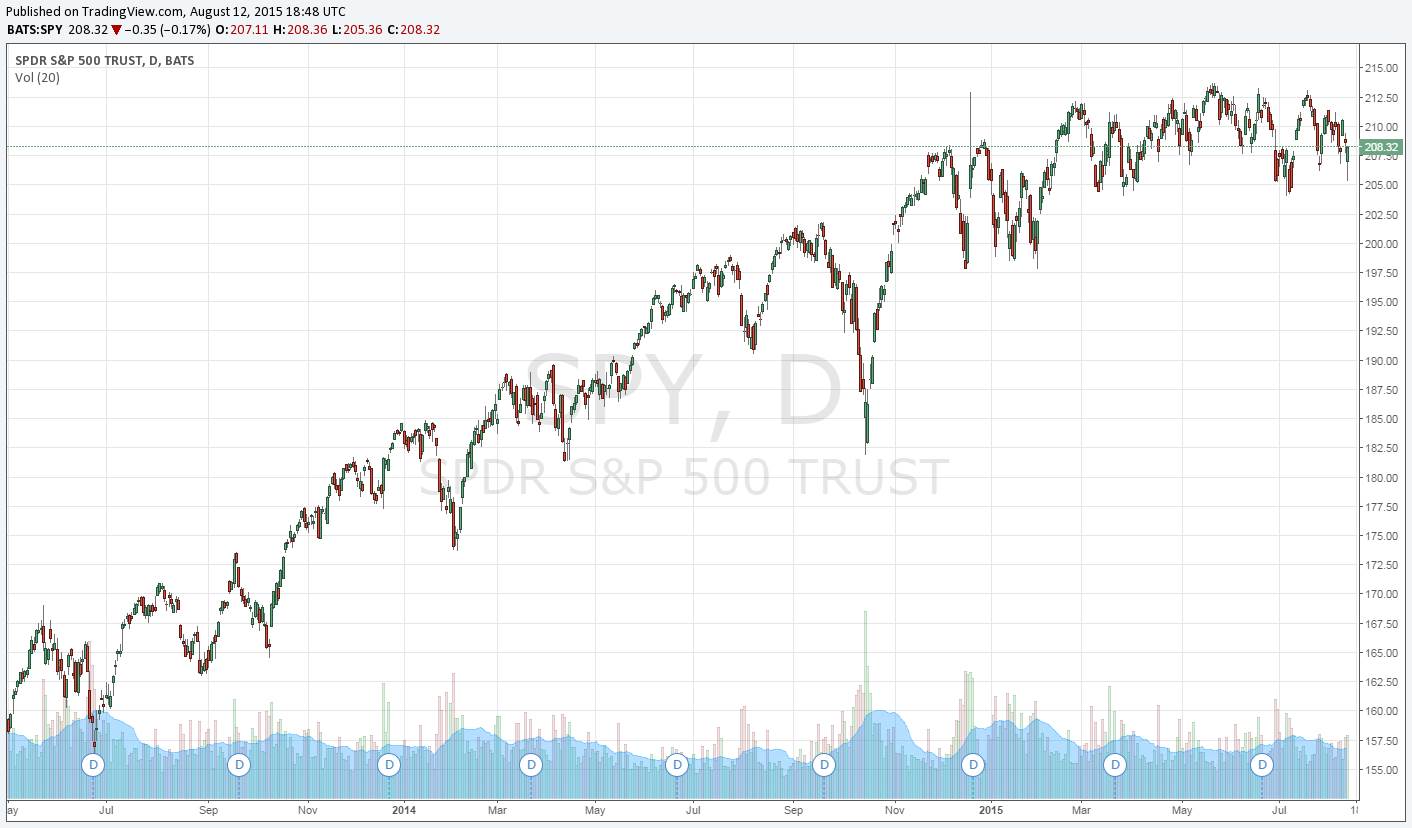
We think the S&P 500 index (SPY) looks “toppy,” and it has so for months. “Caution” is the word on the Street, at least in our view.