
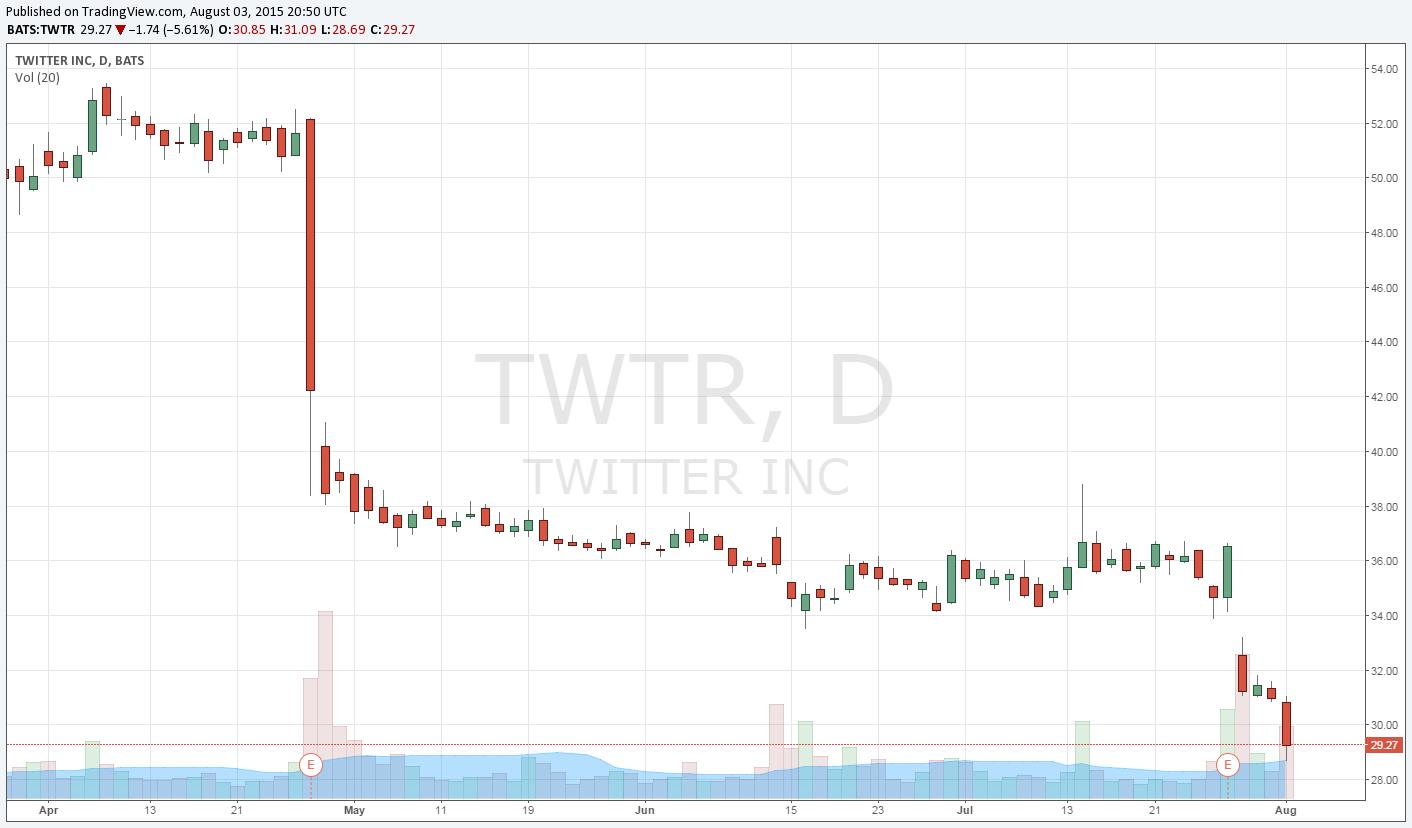
Image: Twitter has tumbled significantly following the release of the past two of its quarterly earnings reports.
The difference between a social media network success story and failure is simple: product iteration and innovation coupled with disciplined execution. This has been the difference between social media giant Facebook (FB) and Twitter (TWTR). While Twitter has spent time fighting through management shifts and attempting to discover its true calling as a social media platform, Facebook has been busy growing its global scale. LinkedIn (LNKD) continues to navigate its wide range of fair value outcomes, and we maintain our view that the company’s business model has yet to be tested.
Twitter’s Valuation Distribution: A Lotto Ticket
Twitter is still in the midst of its search for a new CEO, and its interim CEO, Jack Dorsey, is also the CEO of IPO-to-be Square, giving him an overflowing cup of responsibility. He may be the right man for the CEO job at Twitter, however, and his candid approach to 2015 second-quarter results on July 28 was more refreshing than the results themselves. We’re monitoring executive changes closely. Monetization of the Twitter platform was strong in the quarter, as the firm grew revenue 61% from the year-ago period to $502 million and adjusted EBITDA more than doubled to $120 million. Though the firm is still losing money on a GAAP basis, it reported non-GAAP diluted earnings per share of $0.07, up from $0.02 in the second quarter of 2014.
Despite the solid progress in monetization, Dorsey blatantly stated his dissatisfaction with Twitter’s active user growth rates. Excluding SMS Fast Followers, Monthly Active Users (MAUs) advanced to 304 million in the quarter, a 12% gain on a year-over-year basis, but a “disappointing” increase of 2 million–less than 1% growth–on a sequential basis. The relatively stagnant sequential growth is a reflection of product iterations and innovative initiatives that have failed to produce the results they once promised. Nevertheless, the firm is just scratching the surface of its true potential.
In order to realize that potential, however, Twitter must refocus and execute with much better discipline. The potential of the network as a news-like update platform is largely unrealized, as most current users scroll aimlessly through their timelines having to digest often useless information they may have selected to follow, but ultimately care little about. The firm’s Project Lightning, scheduled to launch this fall, targets the showing of more meaningful tweets and conversations faster, an initiative management believes will help the network capture its potential as an up-to-the minute informative platform.
What’s more is that Twitter’s untapped potential spans the globe. The company has over 95% brand awareness in the “most important” global markets, but despite this, the network has achieved less than 30% penetration in those same markets. Management believes it can increase this penetration rate through the simplification of its product and clearer communication of the unique value Twitter offers. In essence, large scale changes will be needed in order for the company to succeed in the mass market, but the company still has substantial expansion potential, nonetheless.
We can’t make the investment case for Twitter. The firm’s equity has substantial cash-flow duration risk, and we think shares will trade with the technical trends for the foreseeable future, which simply doesn’t bode well. The company’s shares are a lotto ticket – not likely to pay off, and if they do, not anytime soon.
Facebook Continues to Execute Well
As Twitter struggles to find itself, Facebook, on the other hand, reported excellent growth across its family of products in the second quarter, reported July 29. Monetization and active user growth were both solid in the quarter for the maturing social network. Daily Active Users (DAUs) grew 17% in the month of June to 968 million, and mobile DAUs advanced 29% to 844 million. MAUs and mobile MAUs grew at similar rates to their daily counterparts, and MAUs are now nearing the 1.5 billion mark; ~65% of monthly active users are daily active users. Advertising revenue growth outpaced all active user growth metrics, advancing 43% to ~$3.8 billion in the quarter, and non-GAAP diluted earnings per share grew 16% to $0.50 from the year-ago period.
Growth is strong outside of the core Facebook platform as well. Instagram, Messenger, and WhatsApp now have MAUs exceeding 300 million, 700 million, and 800 million, respectively. Facebook’s recent initiatives to improve its product, keeping the most relevant information at users’ fingertips have been successful across all of its platforms. It has reduced the number of crashes on its core Facebook mobile app significantly, and has increased message and load speeds in others. The firm has also enriched its product by making it easier for users to find more relevant and engaging content, such as increased video content.
The focus on video content has increased the network’s ability to capture attention of users concerning important public events–think short, news-like video content–and has increased the effectiveness with which businesses are able to market through Facebook. Newly developed video content tools and resources enable marketers to more effectively engage their audiences visually, helping businesses of all sizes grow. More than 40 million small to medium-size businesses now have Facebook pages.
We’ve wanted to own Facebook for some time, and we’ve yet to get the pullback that we’ve wanted. We held call options on shares in the past, but they failed to deliver in time, despite fantastic performance from the underlying equity. The company remains high-up on the watch list.
LinkedIn’s Wide Range of Fair Value Outcomes
LinkedIn, the world’s largest professional network on the Internet, reported solid second-quarter results on July 30.
The company reported revenue growing 33% from the year-ago period to $712 million, and adjusted EBITDA grew ~12% to $163 million. Recently-acquired lynda.com, an online education company offering various software and other business skill video courses taught by industry experts, had a negative impact of 3 percentage points on adjusted EBITDA margin, which was 23% as reported, and is expected to have a similar impact on full-year adjusted EBITDA results. Non-GAAP diluted earnings per share grew 8% to $0.55. For the full year 2015, the firm is expecting revenue growth of 33%, an adjusted EBITDA margin of 23%, and non-GAAP earnings per share of approximately $2.19.
In the period, cumulative members grew 21% to 380 million, outpaced by member page view growth of 37%, which helped lead to ~60% year-over-year feed engagement growth. The network’s enhanced focus on helping members find employment is paying off as well; it reported 40% growth in unique visiting members to jobs-related pages from the year-ago period. The company continues to integrate lynda.com, which offers 6,800 courses through 280,000 videos in five different languages, and the LinkedIn team is adding 150+ courses a month.
The substantial member growth speaks to LinkedIn’s ability to create value for its members. Recruiters continue to capitalize on LinkedIn’s platform, and the growth in engagement is even more encouraging than the member growth; users are uncovering more and more ways to add value across their professional aspirations. This speaks to the success of product iterations and innovation, and the company will continue down its aggressive R&D path to keep its engagement momentum rolling.
All Things Considered…
We’re not saying Twitter will inevitably go the way of MySpace, but it will need to improve its product considerably if it wishes to grow to the level of Facebook. From our perspective, Twitter’s shares are nothing more than lotto tickets – don’t hold your breath hoping they will pay off.
The social media frenzy has been likened to the dot-com bubble, but we think there’s at least one exception: Facebook. The Zuckerberg production continues to grow like a weed and post significant net income growth, even on a GAAP basis. If we were forced to own one social media entity, it would definitely be Facebook, but only at the right price (the low end of the fair value range). We keep waiting.
LinkedIn has similar financial qualities as Facebook, but we’re less enthused about the professional networking site, if only because we’re uncertain about its performance through the course of the next economic downturn. LinkedIn’s Talent Solutions and advertising-based revenue streams may face significant pressure during slow economic times, while only the latter would face headwinds at Facebook. LinkedIn has benefited from 64 straight months of private sector job growth from February 2008 through June 2015. The company’s business model has not yet been tested, in our view.