
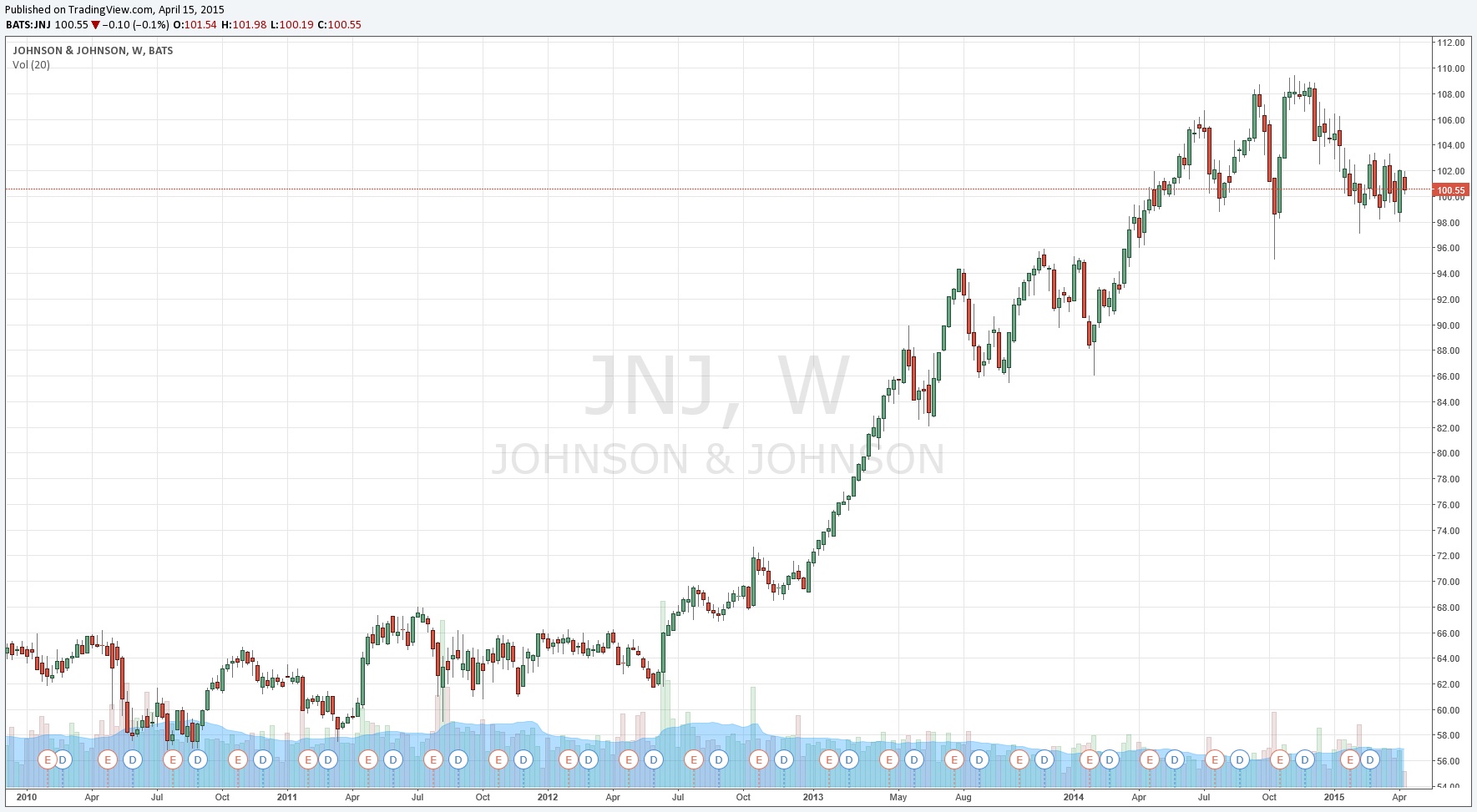
It’s pretty incredible if you think about it: Johnson & Johnson (JNJ) hovering around $100 per share. The company was an inaugural addition to the Dividend Growth portfolio in January 2012 in the mid-$60s, and we’re sure that many of you have been holding J&J for much longer than that. The company has been a big winner, with 2013 being an exceptionally good year. 2014 got off to a good start, but since then, share-price performance has been relatively flat, including thus far in 2015.
On April 14, Johnson & Johnson released its first-quarter results for 2015. As with many global firms, the company’s performance was hurt by currency issues, but adjusted top-line results advanced more than 3%, led by a near-6% increase in domestic sales. International sales, adjusted for a negative currency impact of more than 13 percentage points, were modestly higher. Backing out deal-related sales, worldwide revenue in the quarter leapt 5.7%, comprising of 9%+ expansion in the US and 3% non-US growth. The report certainly wasn’t clean due to currency fluctuations, but underlying top-line strength remains at J&J.
The bottom line in the quarter didn’t fare as well as we would have liked. Excluding a number of charges, adjusted net earnings for the first quarter came in at $4.4 billion and adjusted diluted earnings per share at $1.56, both measures falling 5.9% and 4.3%, respectively, from the year-ago period. J&J also fine-tuned its full-year 2015 earnings guidance to the range of $6.04-$6.19 per share, slightly lower than the range it had been previously targeting. Clearly, J&J is facing challenges on the top line with respect to currency and difficulties advancing earnings, despite core adjusted revenue expansion. The quarter was mixed, at best.
A deeper dive reveals the devastation currency is having on reported results. Internationally, consumer sales dropped nearly 10%, pharmaceutical sales nearly 11%, and medical devices sales nearly 16%. These are some frightening numbers, but foreign currency fluctuations obviously can move in both directions, and while the performance seems concerning at present, reported results can reverse themselves in a hurry should exchange rates revert to year-ago levels. In some ways, the stage has largely been set for currency to potentially be a nice tailwind in coming years.
As it relates to operational standouts, within the Consumer segment, Tylenol and Motrin analgesics, Neutrogena and Aveeno skin care products, and Listerine oral care products contributed to positive operational performance. Within Pharma, sales of blockbuster drug Remicade were roughly flat, but overall immunology sales leapt more than 5% thanks to Simponi and Stelara (plaque psoriasis) growth. J&J’s Olysio continues to feel the pain from Gilead’s (GILD) dominance in hepatitis C and its neuroscience portfolio could have performed better, but J&J continues to do well in oncology and cardiovascular. Zytiga (prostate cancer) and Xarelto (an anticoagulant) were key drivers in those two segments, respectively. Orthopedic products, electrophysiology products, and endocutters helped mitigate weakness in the Medical Devices segment.
J&J has fantastic fundamentals, and while currency is a near-term issue, we’re not writing off foreign exchange as a tailwind in coming years. The firm’s pipeline is flush with potential new candidates and its consumer sales have recovered from a number of mishaps in prior years. Perhaps the things we like most about J&J are its strong free cash flow generation and healthy balance sheet. Additions to property, plant and equipment are a mere fraction of cash flow from operations, and at the end of last year, J&J had more than $33 billion in cash and marketable securities relative to long-term debt of less than half that mark.
Dividend growth investors will have a difficult time going wrong with the company. We value shares at over $110 each.