
Brian Nelson, CFA
We spend a lot of time talking about the safety of a firm’s dividend. In fact, we were the pioneers of the Dividend Cushion ratio, a comprehensive cash-flow based measure of the health of a firm’s dividend that takes into consideration all aspects of the company’s financial statements – not just the relationship between dividends per share and earnings per share, the payout ratio. As readers have come to learn, if a company’s Dividend Cushion ratio is below 0, there is significant risk to the sustainability of the payout. Most recently, the Dividend Cushion ratio highlighted the substantial risk related to Seadrill’s (SDRL) payout (in advance of the suspension), and the Cushion, as we call it here at Valuentum, is already off to a great start in 2015, doing what it does best – helping income investors stay away from risky dividend payers.
On Friday, upstream master limited partnership (MLP) Linn Energy (LINE) announced that it would cut its distribution by more than half. We explicitly outlined that we were expecting the entity to slash its payout on the basis of its terrible Dividend Cushion ratio (see dividend report ), but common sense should have told investors that something wasn’t quite right with the situation at Linn, even without the knowledge of the Dividend Cushion ratio. For one, on an annualized basis, Linn was trading at a skeptical ~22% annual dividend yield before the cut. Though the market is not perfectly efficient, investors aren’t completely off their rockers to allow such a perceived yield mispricing to continue. If the market had thought Linn’s dividend payout was sustainable, investors would have bid the firm’s stock price higher such that the dividend yield would reflect a more appropriate level relative to alternative equity income vehicles, say 5%-8% for most high-yielding MLP peers in a normalized environment. This just didn’t happen. The market, instead, had been expecting a cut, and a big one at that.
The observation may sound apparent to a lot of investors – you may say, “Of course a 20%+ dividend yield was fantasy.” True. But unfortunately, a lot of individual investors and financial advisors fall into what we would describe as income traps, or an equity investment that becomes a falling knife as more and more investors jump ship in anticipation of a dividend/distribution cut. Those that hold onto shares for income reasons hope for a turnaround and then become emotionally attached to the “mistake,” even as the dividend/distribution cut becomes more and more inevitable. Eventually, the dividend/distribution cut happens, and those that fell into the trap are left with a substantially lower payout and a significantly lower stock price. Linn Energy is but the latest example of such an income trap. Time and time again, we learn that a higher dividend yield is not always better.
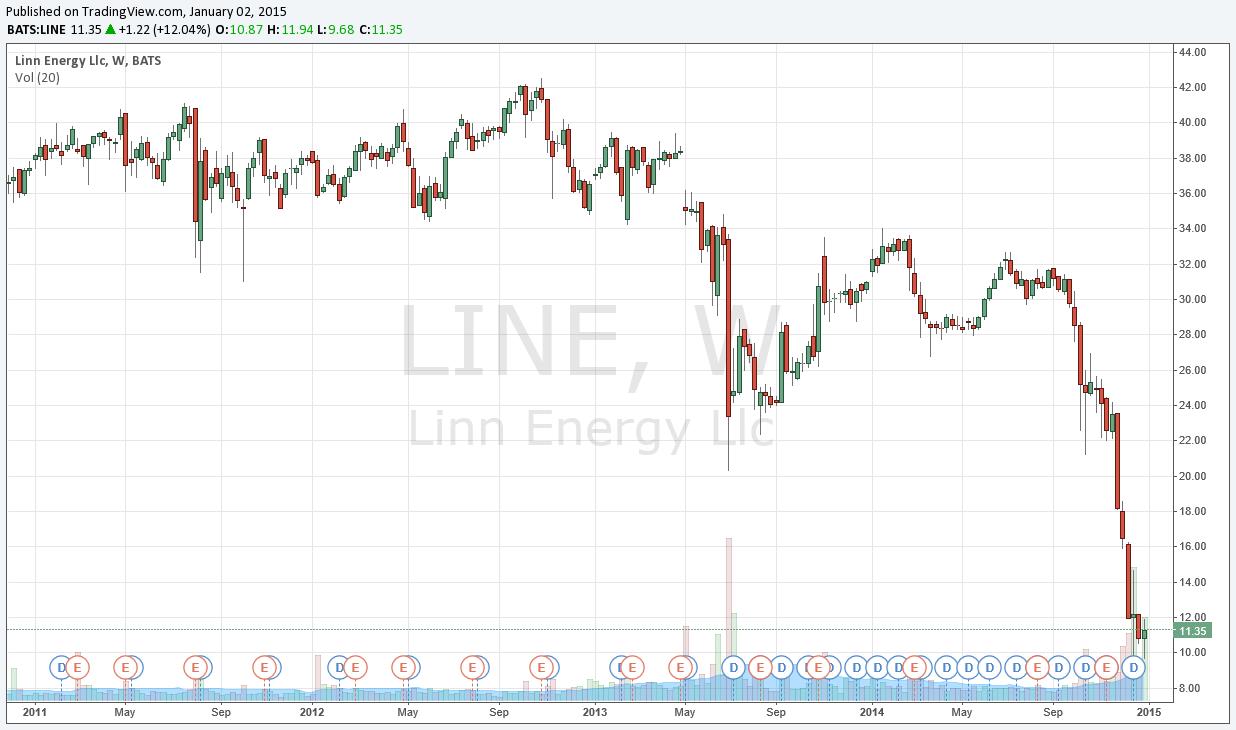
Looking ahead, we’re not interested in shares of either Linn Energy or sister firm LinnCo (LNCO), whose sole purpose is to own shares of Linn. The upstream MLP space is an area that will face ongoing scrutiny by investors, as upstream MLPs remain heavily exposed to funding from the capital markets, if not this year, then eventually. The backstop by Blackstone’s (BX) GSO Capital Advisors, in Linn’s case, is capped at $500 million, and such a figure, while large, may not be enough, especially if crude oil prices continue to fall.
Linn Energy and LinnCo expect to distribute $1.25 per share in 2015 (down from $2.90 per share previously). The forward yield for both is about 11% — a level that we think still reveals material risk to the payout. After factoring in the cut, Linn Energy’s Dividend Cushion ratio looks to come out below the important parity level of 1, signaling that the sustainability of the entity’s payout even at depressed levels is far from guaranteed. Another distribution cut may be in the cards.
In light of plummeting crude oil prices, we think it’s prudent for investors to monitor other upstream MLPs very closely: BreitBurn Energy (BBEP)—which also cut its distribution Friday–EV Energy (EVEP), Eagle Rock Energy (EROC), QR Energy (QRE), Legacy Reserves (LGCY), and Vanguard Natural Resources (VNR) are but a few examples. Midstream MLP Energy Transfer Partners (ETP), corporation Kinder Morgan (KMI), and Chevron (CVX) remain our top picks in energy for 2015. If you haven’t already watched the video, “Dividends, Dividends, Dividends,” please do so at your earliest convenience.
Related MLP ETFs: AMLP, AMJ, MLPL, MLPI, MLPA, MLPN, EMLP, MLPX, MLPS, AMU, ENFR, ATMP, MLPW, IMLP, AMZA, OSMS