
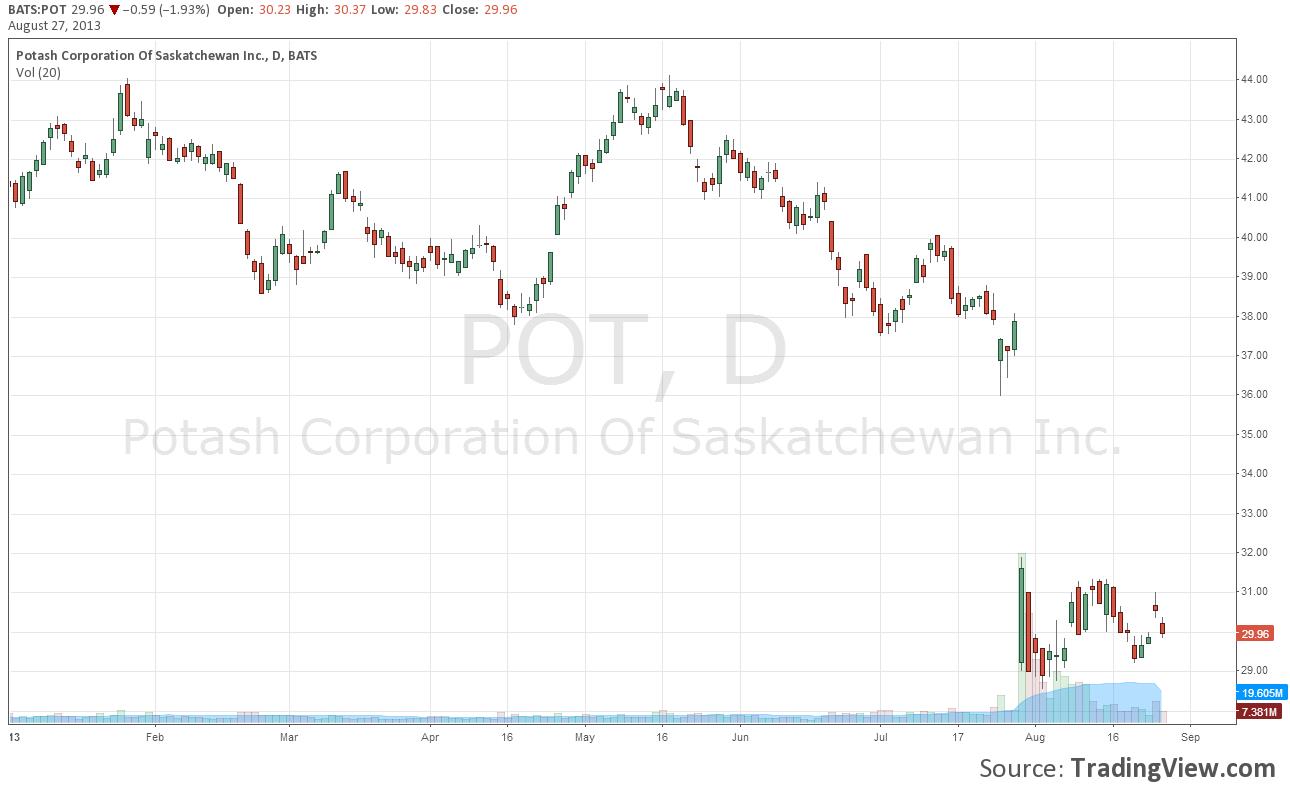
Late last month, Russian producer Uralkali backed out of a highly profitable and rational potash cartel arrangement, creating a free-for-all in the global potash market. As a result, shares of North American potash producers such as Potash (click ticker for report: ), Mosaic (click ticker for report: ), Agrium (click ticker for report: ), and Intrepid Potash (click ticker for report: ) have come under significant pressure as a result of the prospects for significant lower economic returns. Then mining giant BHP (click ticker for report: ) confirmed it will invest in its Jansen potash project, which will add even more potash supply to the market.
A look at industry bellwether Potash’s shares below reveals the recent difficult performance experienced by the group.
Some Background
Before Uralkali left the cartel, the potash industry had been a relatively stable cartel allowing industry participants to generate robust amounts of free cash flow, as spot prices rested well above the cost of production. Belarus Potash Company (Belarusian producers, Uralkali) and Canpotex (Agrium, Potash, and Mosaic) dominated globe potash trade, keeping prices well above the cost of production.
However, Uralkali was not happy that Belarus passed a law allowing sales of potash (below prevailing spot prices) under agreements not covered by the BPC. As a result, Uralkali considered the existing agreement obsolete and abandoned the alliance.
On a conference call following the announcement, Uralkali’s management mentioned that the price of potash could fall by over $100/tonne as Uralkali will boost production nearly 25% and look to steal market share. Uralkali is the single-largest potash producer in the world and likely has the lowest cost position. Even worse, this could drive the North American cartel known as Canpotex to boost production in order to fight to retain market share, and we could see excess capacity become excess supply.
The latest news in the situation suggests Belarus is unhappy about putting an end to the profitable cartel, as Belarusian authorities detained Uralkali’s CEO Vladislav Baumgertner for “abuse of power” and an alleged scheme to make $100 million illegally at the expense of Belarus. The details are sketchy, and the situation is downright bizarre. In fact, the way the story is told makes it seem as if the Belarusian government staged a set up. From Reuters:
“Vladislav Baumgertner, chief executive of the world’s largest potash producer, was detained on Monday at the airport of the Belarusian capital Minsk after being invited to secret talks with Prime Minister Mikhail Myasnikovich.”
At this point, it seems like Baumgertner is a hostage, and it may take intervention from Russian President Vladimir Putin to rectify the situation. In our view, Belarus is looking for some sort of agreement regarding potash. Uralkali’s largest shareholder, Suleiman Kerimov, is close with Putin, so his involvement seems possible. If Belarus proves uncooperative, we could see a broader impact on relations between the two former Soviet allies.
We do not believe detaining executives invited over for business is the best way to negotiate a return to the cartel. However, Belarus depends heavily on potash for generating wealth, and declining potash margins could hurt both the economy and the Belarusian currency.
What Does This Mean for Canpotex?
If Baumgertner being detained acts as a catalyst for Uralkali to rejoin the Belarusian Potash Company, North American potash makers would benefit. We think Uralkali could face some pressure from the Russian government to rectify the situation in order to prevent a larger feud from brewing between the two countries. Even though the Belarusian equivalent has broken down, we’ve seen no evidence that any member of Canpotex plans to leave the cartel. Canpotex members clearly recognize the value of maintaining healthy margins and preventing a supply/demand imbalance.
Still, it is hard to know if the situation will act as a catalyst for a reunion overseas, or whether tensions will stir even more. We think Uralkali will begin to pursue marginal projects, dumping as much supply on the market as possible in order to harm Belarus and the greater potash market. More supply coming on line is also negative for the North American producers, as it would harm pricing in growing Chinese and Indian markets.
Or, we could see Uralkali move to scoop up the assets of Belaruskali—the Belarusian company responsible for potash production. By forcing lower potash prices, Uralkali could reduce the market value of Belaruskali, making it ripe for a takeover bid and perhaps even consolidation into Uralkali. We don’t view this scenario as highly likely, but it remains a possible outcome.
Valuentum’s Take
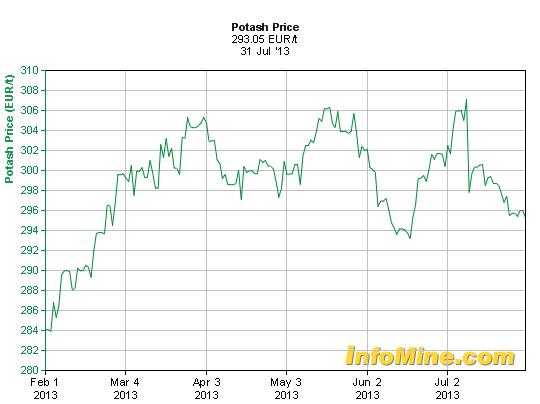
The situation in Belarus is rather bizarre—not something we’re likely to see in the United States or in most of the Western world. We suspect Baumgertner was summoned to help rectify the potash situation, but when he proved uncooperative, Belarus arrested him on his way out. It will likely have large ramifications on the potash market going forward, particularly if the status quo remains intact.
Source: InfoMine.com
At this time, the events have yet to truly impact long-term fundamentals in the potash market, but it does add another cloud of uncertainty. We remain on the sidelines with respect to any potash producer, until the long-term structural characteristics of the potash market can be better predicted.
Chemicals – Agricultural: AGU, CF, CMP, IPI, MON, MOS, POT, SMG, TNH