
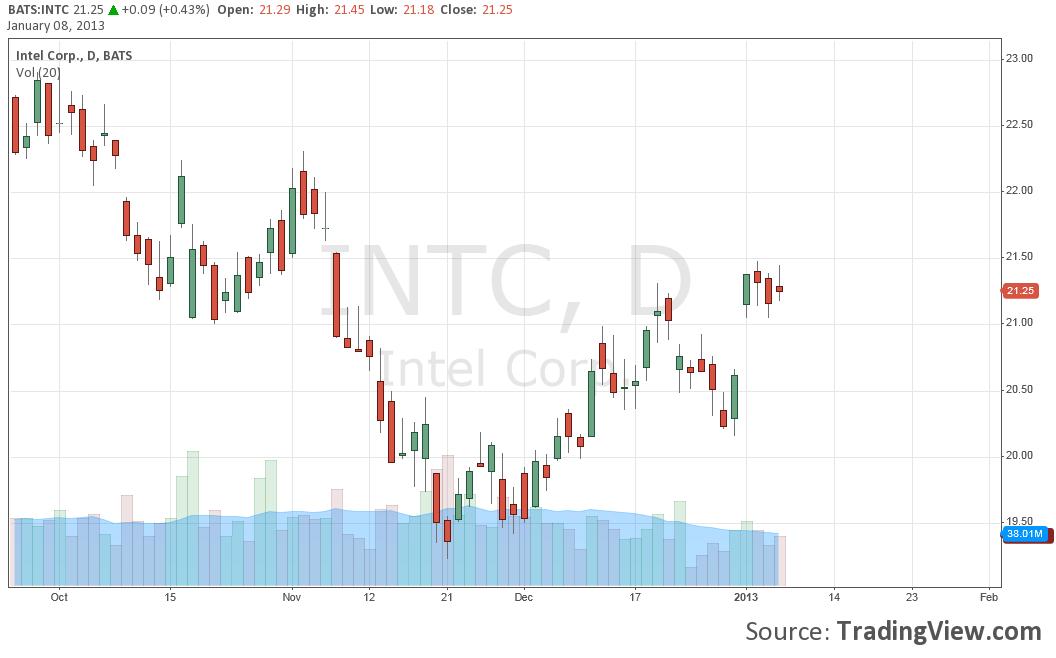
After bottoming in mid-December, shares of Intel (click ticker for report: ) have recovered and are exhibiting some near-term technical strength. Fears of margin compression and a lack of a mobile offering have been putting heavy downward pressure on the share price over the past year. But we don’t think this is justified.
The fundamental outlook, which we have always found sound, has improved following announcements at CES. Intel will work on improving its mobile offerings, which is easily the best news, in our view. Though Intel hasn’t yet achieved much market share in the premium smartphone or tablet markets, the company announced a new generation known as Bay Trail that will power Android and Windows-based tablets with far better efficiency than previous generations. The company will also focus on powering value-priced smartphones in emerging markets such as Brazil and China. Margins and revenue for these chips may not be as high, but we think if Intel is able to prove itself a successful force in the mobile chip market, we wouldn’t be surprised to see the likes of smartphone giant Apple (click ticker for report: ) consider adding the premium chips to its smartphone.
Ivy Bridge, the processors used to run CPUs for PCs, looks like it could be a tremendous success. Intel has focused on dropping power consumption, and its new Ivy Bridge chips will drop wattage from 15 to 17 watts all the way down to 7 watts. While it may be hard to put specific power consumption numbers in context, this enormous decrease in power consumption will lead to increased battery life and cooler (temperature) computers. We don’t believe consumers are too worried about wattage and consumption, but practically speaking, improving the performance of Ultrabooks to be comparable to Mac Book Pros could lead to increased sales and faster adoption of Windows 8 (click ticker for report: ). Intel appears to be banking on the fact that all-in-one (desktop/laptop/tablet) computers will lead consumers to upgrade their machines at a brisker pace. We’re cautious on the outlook for PC demand, but superior products could help.
In addition to chip enhancements, Intel announced a deal with Comcast (click ticker for report: ) to provide streaming and on-demand TV services to Intel powered computers without a set-top box. This gives Intel a new way to generate revenue, and it also may provide the company an opportunity to see if the rumored Intel TV is possible. The big problem with internet TV services from every firm that has tried to circumvent the traditional cable route has been content acquisition. Unfortunately for Intel (and the consumer), we expect resistance to continue as long as content providers have the negotiating power.
Overall, we’re optimistic about the news we heard out of Intel at CES, and it confirms our belief that the company would work to eventually gain a competitive edge in mobile chips, while reasserting its PC CPU dominance. With a yield in excess of 4%, a dirt cheap valuation, and an improving fundamental outlook, we’re holding on to our Intel position in the portfolio of our Best Ideas Newsletter.