
This article was referenced on Seeking Alpha. Please view disclosures: https://seekingalpha.com/article/275567-word-of-caution-boeings-narrowbody-build-rate-is-unsustainable
As competition in the narrowbody market heats up before the Paris Air Show next week, Boeing appears to be losing favor with two of its best customers, Southwest and Ryanair. For those unfamiliar with Southwest’s and Ryanair’s fleets, they are all-Boeing 737 airplanes, and recent actions by these two carriers give us pause, especially as Boeing drags its feet on deciding what to do next with its workhorse 737.
As Bloomberg reported some time ago, Southwest’s CEO Gary Kelly is not all that thrilled by Boeing’s delay in responding to Airbus’ A320neo and the CSeries offered by Bombardier–both planes offering cost advantages better than the 737NG in their corresponding seat categories. Gary Kelly’s comments are worth repeating here:
“When you talk about something that’s 10 years from now, that’s not a solution, that’s an idea … Who among us is to say it won’t be 15 years from now? In the meantime, we’re going to spend $40 billion on fuel.”
“We want something better than we’ve got … Pratt & Whitney has an engine that’s more fuel efficient. GE (General Electric) has an engine that’s not far behind. What’s the plan? You’ve got an answer from Airbus, you’ve got an answer from Bombardier. And we need a means to reduce our fuel bill and our carbon emissions.”
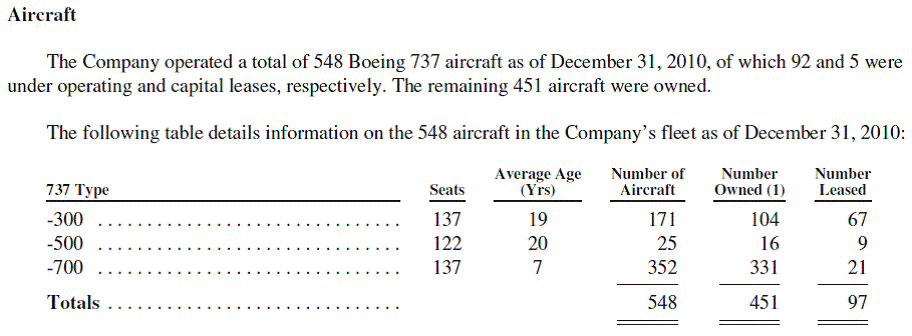
Such comments from one of Boeing’s hundreds of customers should not be that big of a deal, but this is Southwest, which flies about 550 of the jet maker’s narrowbody 737 aircraft (we show Southwest’s fleet disclosure from its 10-K below):
And if Southwest’s disgust weren’t enough, Ryanair, which like Southwest, also flies an all-Boeing 737 fleet (over 270 of them), is having difficulties coming to terms with any future orders from Boeing. As a major blow to Boeing, the Irish carrier now has plans to announce an agreement with Commerical Aircraft Corp. of China (Comac) at the Paris Air Show next week to influence the design elements of the C919 aircraft, including its size and shape. This is huge and further supports our view that the duopoly in the narrowbody market will be shattered in coming years.
And even if Ryanair is bluffing, we can only assume that the carrier is doing so to garner better terms from Boeing, further reinforcing our view that pricing pressure will only increase in the narrowbody market in the coming years. In fact, based on current customer checks and the perception of lengthy delays if Boeing opts to build a brand-new 737 aircraft by 2019-2020 (the perception tarnished by the recurring development problems with the 787 Dreamliner), we would not be surprised to see Southwest and Ryanair defect from their all-Boeing narrowbody fleets by the end of this decade (or even sooner).
Though many shrug off China as a legitimate competitor in the narrowbody market, we are not taking Comac lightly. For one, Comac has teamed up with Bombardier, sharing parts between the CSeries and C919 (both planes are narrowbodies, but they do not overlap in seat configurations–see chart below).
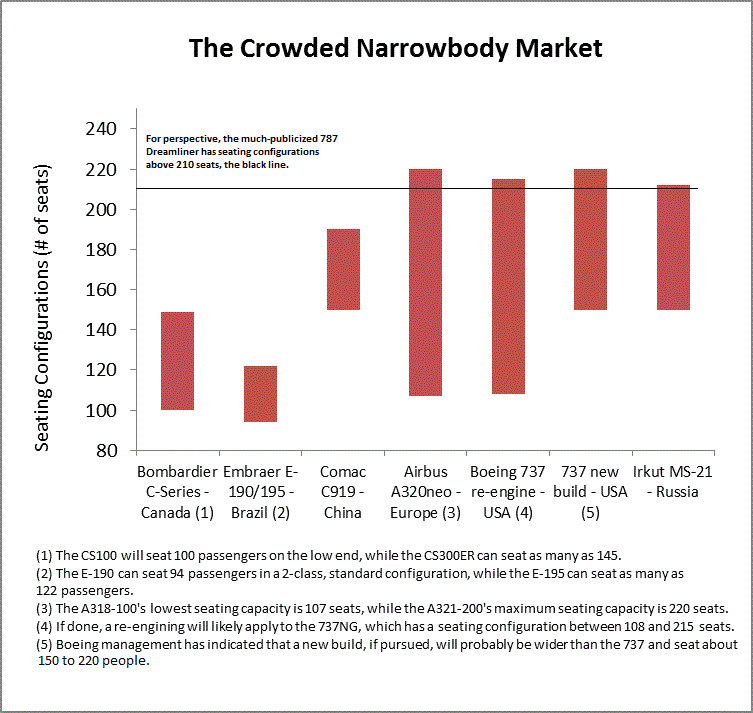
Such a partnership could propel Comac into a serious global competitor, while potentially reducing Boeing’s and Airbus’ presence in the Chinese narrowbody market (Bombardier and Comac would have the narrowbody seat range covered from 100 to 190-plus seats once their respective planes are launched). And now, with Ryanair’s help, Comac has the game plan to gain traction in the western markets, a very serious threat.
We maintain that the current upswing in commercial aerospace deliveries, further augmented by Boeing’s decision to increase production of its 737 to 42 per month by the first half of 2014, offers Boeing upside from these levels. However, we’d be very concerned about holding Boeing’s equity toward the middle part of this decade, given the development of these competitive pressures in the narrowbody market. Our view on airline operators like Southwest and Ryanair remains unchanged, as we continue to believe investors can find better places to put their money that the airline industry.