
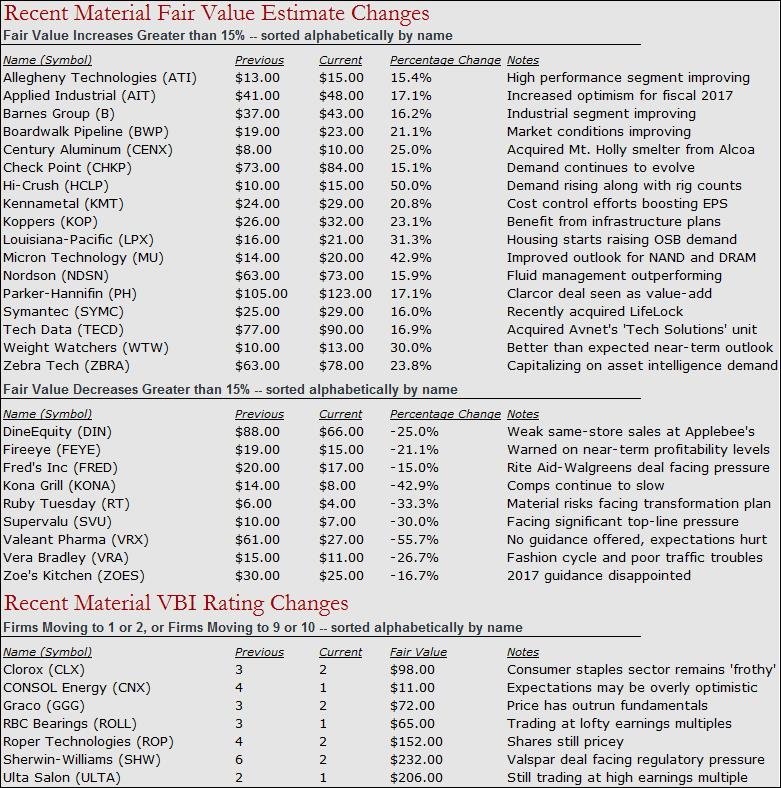
It’s been some time since we’ve updated members on our recent fair value estimate updates. Let’s take a look at the opportunities that exist in some of our favorite portfolio holdings, as well as some key themes driving recent fair value estimate changes across our coverage universe.
By Kris Rosemann and Brian Nelson, CFA
The frothiness of the market has shown little regard for historical valuation norms, and the number of stocks moving to a 1 or 2 on the Valuentum Buying Index is growing as valuations become stretched across our coverage universe. For the first time in Valuentum’s history, there is now not one stock that registers a 9 or 10 (a top rating) on the Valuentum Buying Index. Even though our best ideas continue to reside in the newsletter portfolios, as they always have been, we’re not taking this market valuation signal lightly.
Maintaining a proper perspective as it relates to the valuations of individual equities can be difficult in such a market that seems to go ever-higher, even on what appears to be a waning “Trump” trade. Shortly after our cerebral write-ups, “Understanding the Market Melt Up (July 2016)” and “The Bubble Is Still Inflating (April 2016),” some in the analyst community have also started to discuss the impact of low risk-free rates in the context of a discounted cash flow (DCF) model. They, like us, however, continue to emphasize, “Use DCFs, as we have little (better) alternative,” as comparable multiple analysis is far more hazardous of a valuation technique due to its limitations and systematic overvaluation tendencies, “The Price-to-Earnings Ratio Demystified.” Comparable multiple analysis techniques, for one, cannot identify situations of systematic overvaluation, or in the case when every comparable company is overvalued. Comparable multiple analysis can be a source of pricing “bubbles,” too–when buyers justify a purchase using an overvalued comp.
In any case, historically low risk-free rates have been driving discount rates in a discounted cash flow (DCF) model to very low levels, putting an even-larger amount of value on the free cash flows ten or more years out. The DCF valuation model, however, has always contained duration uncertainty in that most of the value assessment has always been of the longer-duration variety. This just makes sense though: most of the value of a business is not generated in next quarter’s earnings or even next year’s earnings, for that matter, but by the company’s free cash flow generating profile over the long haul. Long-term free cash flows are no more difficult, or easy, to forecast than assessing the sustainability of a company’s competitive advantages ten or more years out, too, something that Mr. Buffett has been known to emphasize. Precision has never been the goal of valuation.
Instead, the sensitivity of the DCF should be embraced because it allows users to understand the most important drivers behind each business. This can’t be had under any other technique. Comparable multiple analysis is too simplistic and residual income models rely too much on accounting book values, which may not be a good representation of market value. Within a DCF, applying a margin of safety (a fair value range) to the point fair value estimate of each company, however, allows users to identify valuation outliers (those whose price is outside the fair value range)–which we posit is the name of the valuation game. We want to swing at the fat pitches, the ones where we stand the best chance of hitting a homerun, or if we’re off the mark a bit, we can still get a nice double or base hit. That’s the value of the fair value range in valuation.
Let’s talk more about this. For example, a company may not necessarily be undervalued if we estimate its fair value at $200 and it is trading at $199 due simply to the likelihood of a margin of error given how small of a difference between our fair value estimate and its price. On the other hand, if that same stock were trading at $50 and we thought shares were still worth $200, then we’ve found a valuation outlier, a gem that should be considered for addition to one of our newsletter portfolios! Precision in estimating fair values is and always will be a fool’s errand, so we rely on the margin of safety to help us sort through the degree of valuation uncertainty that resides in the DCF. We talk about these concepts and more in the following piece: “The 14 Most Important Steps to Understand the Stock Market.” So long as cost-of-equity assumptions do not approach 0%, too (an impossibility), the DCF remains the best valuation technique.